

Kabul
Clamour and Clatter
The 21st century Taliban leadership read the situation differently, given their stated dependence on continued US/Western financial largesse and intelligence support against ISIS.

Afghanistan, Afghans and Pakistan are the subject of intense misinformation, disinformation and manipulated analyses. The serious debate has two shades. The noisier group - comprising members of the CIA, Pentagon, the contractor community and at least 12 lawmakers with financial stakes lined with contractors and heavy weights like Hillary Clinton, Condoleezza Rice -favours a hands-off approach. Their Pakistani interlocutors hide behind cliches like ‘Afghan-owned, Afghan-led solution’ to resolve the current impasse for peace. This group asks for an ‘inclusive political settlement with the Taliban, emphasizing the Movement to share power expansively with Ashraf Ghani and his cabal…aka Northern Alliance (NA), etc.
They tout the Taliban threat to the Afghan Constitution, Afghan women and minorities, citing the dreadful roll-back of the freedoms, won by women/minorities under the US/Western influence. Hardly a day goes by without an article/news story in the mainstream US/Western media, citing urbanite, mostly non-Pashtun Kabuli womenfolk, lamenting the loss of [hard-won] freedoms, if and when the US/Western troops leave the occupation of their country. In simpler terms, they want to be protected from their countrymen by the non-Muslim nemesis, i.e. the foreign forces…feeling no shame in occupation.
Pakistan, through its recent pronouncements urging the Taliban to reconcile ‘on international terms’ for ceasefire, peace and inclusivity – seems to have joined this bandwagon in a hurried and perhaps ‘forced’ re-calculation of its Afghan policy. However, the appeasement-driven bonhomie seems to be short-lived with Ashraf Ghani et al sticking to their poisonous guns against Pakistan, especially against its military establishment.
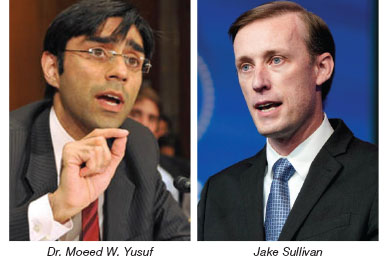
The fact that Pakistan is being drawn back to the US fold - as against China - holds some credence. Some cases in point include the current appointment of a US national, Dr. Moeed Yusaf as Pakistan’s NSA; the recent meeting of ‘this US national’ with his American counterpart (irony), Jake Sullivan in Geneva on 23rd May; the testimony by David F. Helvey, Assistant Secretary of Defence for Indo-Pacific Affairs, in the US Senate recently about Pakistan’s willingness to offer overflight rights and land access to (any) residual US forces inside Afghanistan after September 2021; the meetings in the US by the Pakistan foreign minister about ‘comprehensive’ strategic ties with the US; and the behind-the-scene political conditionalities by international financial organizations like the IMF, WB and FATF, etc. There is a certain cooling-down of the CPEC, incidentally.
The second and less noisy group of stake-holders comprises realists with deep insights in the region, especially Afghan demography, political anthropology and social economy. This group argues that Afghanistan needs to be nudged towards a ‘practically possible solution’ in the short-term, as its traditional conflict resolution mechanism (CRM) stands badly mauled by extensive social breakdown of the traditional authority and institutions. However, these analysts feel the future Afghan political dispensation should and would be dictated by the ground realties, in particular the military situation inside Afghanistan, and must be based on cold rationalism rather than wishful thinking and non-sustainable goals. They feel an end to violence and protection of life and property take precedence over trivialities like constitution, women rights and minorities, etc.
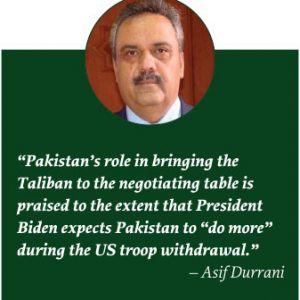
This group cites the ‘humanization’ of the Taliban by the US after decades of demonization and the consequent Doha peace deal of February 29, 2020 as indications of ‘pragmatism’ displayed by the US. They see President Biden’s decision to stick to the US withdrawal, despite the extensive and continuing noise made by the first group, as pragmatic. Biden had called Taliban an ‘indigenous political force’ as early as 2009.
Without getting into the ‘what and how’ debate about the Afghan predicament, some broad conclusions need to be re-stated. Washington papers have extensively covered (as commented upon by this writer) the US strategic policy misdirection, futility of its nation-building, nurturing corruption in Afghanistan, the sorry state of Afghan security forces and drug trafficking, etc.
The US has pursued contradictory goals of reconciliation, defeating the Taliban and establishing a strong central government. Reconciliation was/is not possible without the Taliban, representing a crucial rural Pashtun constituency, hence the stalling of the intra-Afghan dialogue. Likewise, Afghans have resisted a strong centre and the new state (if any) is ‘foreign to many Afghans’ as it tries to displace and replace local, traditional institutions. Centralization also leads to corruption, where the elite are able to buy access and favour through elections… that still produce imperfect solutions for most societies.
The second issue is of an Afghan constitution that ‘re-imagined the Afghan state, once decentralized but stable for generations, into a super-centralized presidency meant to rule every corner of Afghanistan directly from Kabul.’ Again, historically, culturally and traditionally, Afghanistan was a confederation of tribes under the Ahmadzai/Muhammadzai monarchy; where the king - an equal among equals - drew strength from the Pashtun tribes and not the other way round.
The third misconception is the role of women in the future Afghanistan. Women do exercise immense power in traditional Afghan/Pukhtun sociology. They as revered as mothers (adeke mor), adored as wives (janan/sanamjan), nurtured as daughters (gulalai) and respected as sisters (khorjan)…and protected with life in all cases. The 21st century Taliban leadership - compared to their older folks - read the situation differently, given their social media exposure and their stated dependence on continued US/Western financial largesse and intelligence support against ISIS, etc.
That brings us to the revealed US behaviour of ‘leaving but not leaving Afghanistan.’ If media reports are to be believed, the US plans to leave behind an army of paid contractors to outsource the war inside Afghanistan after September 2021. Reportedly, a private security company (‘Triple Canopy’ with ‘Constellis’ as its parent company - Constellis owns ‘Academi’, the new name for Blackwater) is hiring armed guards for Afghanistan deployment. The withdrawal also does not include some special forces.
US, France and Germany are already cultivating Ahmed Massoud, 32, the Sandhurst-educated son of late Ahmed Shah Massoud, for intelligence gathering… much like they cultivated his father, the fabled lion of Panjshir.
The US is also contacting regional countries for bases (possibly Tajikistan, Kazakhstan and Uzbekistan) and logistics (Pakistan) to retain the ability to respond inside Afghanistan. This is ostensibly aimed at bolstering Ashraf Ghani, hedging against Taliban take-over, pressurizing Pakistan, keeping cost-effective presence in the region to watch China and Russia, and placate the noisy group.
However, there are lessons and pointers for Pakistan. First, any local or foreign grouping to coax/challenge the Taliban, would be at best a time-sensitive irritation akin to the dying pangs of a failed order. Aligning with it (directly or indirectly) is bad strategy and reinforcing failure.
Second, Afghan Taliban only can keep Afghanistan under order, united and peaceful. US/West is hedging just the see their efficacy. Their challengers (ISIS, RAW, NDS, US-backed strongmen etc.) do not have any chance, just like the 50-nation alliance in 20 years.
Third, the Taliban are ‘principally correct’ by asking the occupation force to leave. They have the will to fight and die for their cause and are ‘their own men.’ They are nobody’s henchmen and would be open to rationale and reason. Withdrawing Pakistan’s support at this critical time (if so) would go in their long historic memory as another betrayal.
Fourth, re-orienting a long-held policy midway is poor strategy and a recipe for disaster. Alienating the Taliban and their consequent alliance with the TTP would never be in Pakistan’s interest. India would be the ultimate beneficiary.
Fifth, a sharia-compliant future political order in Afghanistan under the Taliban should not induce insomnia in Pakistani policy-makers. It is their country and their will… and we have been supporting an ‘Afghan-led and Afghan-owned’ solution. ![]()

Maj. Gen. Inam Ul Haque (Retd) writes on Global Affairs and Political Sociology. He can be reached at tayyarinam@hotmail.com and his twitter handle @20_Inam


Leave a Reply