



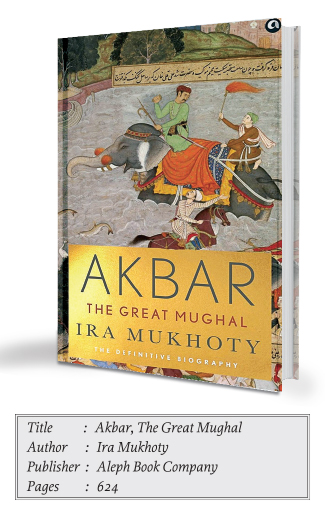
 At a time when the line between popular and academic history is being blurred, Ira Mukhoty’s book is not only timely but very welcome. There have been several biographies of Akbar, so I wondered why another one? Then I realized that Akbar remains an enigma for us even today and his legacy lives on in contradictory ways. His memory continues to be evoked through a variety of media and visuals, creative cultural repertoires, as well as the political and popular symbols that shape the public culture of modern India. But the post-partition fractured histories of South Asia situate Akbar within alternative and competing versions that predominate in the two nation states. Indeed, partition and the making of Pakistan have reframed the histories of the subcontinent, in which Akbar remains a paradoxical figure.
While the usual stereotypes abound, Ira Mukhoty seeks to unravel the hidden histories of the Mughal empire and unfolds a dazzling picture of the magic, mystery and politics of the Mughals. Her voluminous book unpeels the layers to unfold the story of India’s most pre-eminent ruler. It moves beyond the usual conventional ideological frameworks that fix Akbar in predictable ways. Mukhoty stitches together a captivating narrative, from Akbar’s childhood in Kabul, surrounded by his milk brothers and animals, to his evolution as the larger-than-life emperor of Hindustan. The book exposes his flaws and ambitions, which bring him down from the pedestal of a glorified ruler. The emperor becomes all too human.
Written in an inimitable style, Akbar: The Great Mughal flows effortlessly. Mukhoty’s story of this extraordinary figure traces manifold phases of his life; some known, some less known. The shifts in her fluid account sensitively portray the hitherto unknown aspects of the emperor’s daily pursuits. We discover many Akbars in the analysis. And they emerge in the light of different historical contexts, veiled in time and recovered through a meticulous reading of diverse historical sources. The colonial vilification of Mughal history makes it difficult to fathom the significance of that time and its rulers. Mukhoty rescues Akbar’s narrative from the distorted lens of nineteenth-century historiography, which has frozen the Mughals in a narrow perspective. Our contemporary understanding, too, has unfortunately been tainted by the colonial lens. Mukhoty’s book separates the emperor from the bind of a ‘good Muslim ruler’ versus a bad one.
That Akbar was illiterate and yet reached heights unprecedented in Indian history demonstrates that sovereigns do not always require intellectual prowess but can achieve much with an earthy commonsense. Mukhoty tracks diverse dimensions of Akbar’s attractive personality and life. His sense and sensibility were par excellence. Not daunted by external circumstances, he withstood life’s challenges with fortitude and resilience. His perceptions of the world were shaped by his indomitable will, energy and reason. And his visceral experiences, experimentation, and negotiations denote that he was a man of action, unconstrained by the confines of predetermined logical patterns. The beauty of this book lies in touching the chords of Mughal polity, which are quite often drowned in the loud clamour of a big story. Akbar’s relationships with Humayun and Salim, in particular, are analysed with meticulous care and sensitivity. Akbar, as Mukhoty avers, had a cool, calculating disposition whereby he could ‘see into the very heart of the truth’. He displayed immense physical courage, an aspect that gets lost amid other rarefied images of the emperor. Mukhoty highlights Akbar’s spirit, laced as it was with a humane outlook. This paved the way for the creation of a new fluid Hindustani identity, composed of diverse elements, symbols and beliefs. His bold decisions were reflected in dispensing with the jiziya and the pilgrimage tax on non-Muslims, prohibition of slaughter of cows and peacocks, and his patronage of Hindu and Jain temples. His broad-ranging vision looked beyond orthodox Islam.
The book covers multifaceted aspects of Akbar’s life; and is filled with minute details and nuances about his material and political world and inner transformation. He was attracted both to sun worship and austere Jain monks. Interactions with the mystical Shaivite jogis and the Jesuits enriched his eclectic outlook. His presence of mind and courage as a military commander in the face of adversity demonstrate his masterly strategic skills.
The fractured history of South Asia reshapes the memory of the Mughals. Mukhoty’s book, a real tour de force, recovers Akbar and his times untainted by the present political narratives, prejudice and aggressive nationalisms.
Leave a Reply