Turkey, however, has been successful in most of its ventures while Egypt has not had much success. Turkey was able to squelch Kurd nationalists in Turkey, Syria, and Iraq while Egypt faced indignation in terms of its tepid efforts against terrorists in the Sinai Peninsula. Moreover, Turkey has acquired the much-needed experience in fighting clandestine battles, which is expertise lacked by the Egyptian army. All of these factors have given Turkey confidence and made it dispassionate about Egypt’s threats of sending its army into Libya. But that increases the risk of conflict even more since al-Sisi wants to assert and show his power to both Egypt’s allies and enemies while Turkey, overconfident because of its latest victories, may not back away from a fight. In international relations, power as mere possession of resources is worthless unless it is either used as a means to a goal, or as a tool to influence the behaviour of some other actor. Al-Sisi wants the same thing as he believes it is time to show Egypt’s power to others, a gambit already used by Erdoğan.
All this does not ensure smooth sailing for Turkey in Libya because Egypt and the LNA (Libyan National Army) have powerful friends of their own. Egypt and the LNA are backed by some of the most powerful countries in the world. Russia is said to have not only given logistical support to the Libyan National Army but has also sent mercenaries to fight alongside renegade general Khalifa Haftar. The United Arab Emirates has been aiding the LNA with financial support, which was then used by the LNA to strengthen its aerial capabilities. Moreover, the UAE is ruminating on providing full aerial support to Egypt in case the latter decides to send its military into Libya.
A destabilized Libya for Egypt is similar to a destabilized Afghanistan for Pakistan.
Interestingly, Saudi Arabia, a veteran in proxy wars, is behind the screen this time. But in the long run, the ideological and political alliance between the Saudi Kingdom and the Egyptian government may bring Saudi Arabia into the conflict more directly. The LNA is also supported by France because of its interest in oil and energy resources. This convoluted battlefield has put the United States into a very awkward situation because of its association with both Turkey and Egypt, and their respective allies. On the one hand, United States could not retract its support from GNA which is a legitimate, UN-sponsored government, and on the other, it had its share of sympathies for Khalifa Haftar, the general who stayed in Virginia after his expulsion from Libya. However, this dilemma of the United States may be solved after active Russian involvement in the LNA’s quarters as the United States has even warned of imposing sanctions on Haftar’s self-proclaimed government.
Egypt has its reasons to support Haftar’s government in Tobruk. First, Egypt is currently sharing borders with the de-facto government of Haftar in the east of Libya. A porous and unstable border may cause an influx of refugees into Egypt which is already embroiled in a financial crisis, a crisis that was worsened by the coronavirus pandemic. A destabilized Libya for Egypt is similar to a destabilized Afghanistan for Pakistan. Second, both al-Sisi and Haftar came into power by claiming to lead the fight against Islamic extremists and terrorist groups. If Haftar’s LNA loses the battle of Libya, Al-Sisi fears a conservative government in Tripoli. These apprehensions are not entirely baseless for the reason that certain Islamic groups have been supporting the GNA in its fight against the LNA, and Egypt fears that natural ties between Libyan Islamic groups and the Muslim Brotherhood may jeopardize the country’s security. Third, this fragile situation could easily be exploited by ISIL and other non-state actors involved in both countries. Suc active involvement will compromise the national security of both Egypt and Libya. Last, Egypt does not want its backyard to be an open field for new proxy wars in the country, where it has many financial and economic interests.
Turkey has made its intentions to defend its interest in Libya very clear. It had already invested in the power and housing sectors of Libya, but the civil war in the country thwarted all such projects which had by then cost Turkey $16 billion to $19 billion in losses. Priority will now be given to rejuvenate those projects. Second, contrary to the goals of Arab nations and Egypt, Turkey aims to have a conservative, pro-Turkish government in Libya. Ankara has also been accused of using Syrian mercenaries in its fight to defeat the LNA and its Arab allies. Third, Turkey and Libya have already demarcated maritime boundaries in the eastern Mediterranean, permitting Turkey to start oil drilling and energy exploration there. Much to the frustration of Israel, Greece, and Cyprus, this demarcation will impede a pipeline project between these countries which will then need Turkey’s and Libya’s permission since it goes through their jurisdiction. Fourth, a strongman like Erdoğan would love another victory to be added to his resumeand Libya provides the perfect opportunity to Turkey’s absolute ruler. Libya is the new arena for Turkey’s expansionism and adventurism.
It will be very difficult to anticipate the results of any such battle, but the apathy and indifference of the world community becomes evident because it is either silent because of its relations with rich Arab countries, or because of their geostrategic alliances with Turkey and its allies. The United Nations has once again been rendered helpless and toothless. Yet, someone will have to untie this Gordian knot. A solution to the ibyan conundrum is essential to ward off the danger of another refugee and humanitarian crisis like that of Syria and Yemen. 




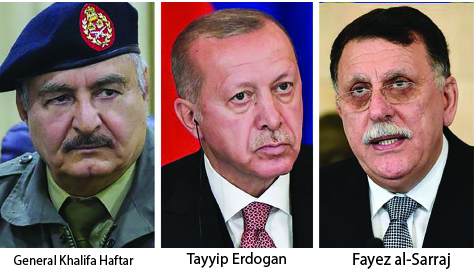 Recent political developments in Libya have sent waves of concern around the world. It seems that the fight on the “red line” is about to begin, a term used by the Egyptian military dictator Abdel Fattah al-Sisi for the city of ‘Sirte’, the new flashpoint in the civil war of Libya. Libya is currently controlled by two parallel governments, one of Fayez al-Sarraj based in Tripoli and supported by Turkey and its allies, and the other of General Khalifa Haftar, based in Tobruk, supported by Egypt, the UAE, Saudi Arabia and Russia. The proxy war in Libya, which has embroiled the country since the death of former dictator Muammar al-Gaddafi, has once again exposed the dividing lines in the Muslim world.
Leave a Reply