

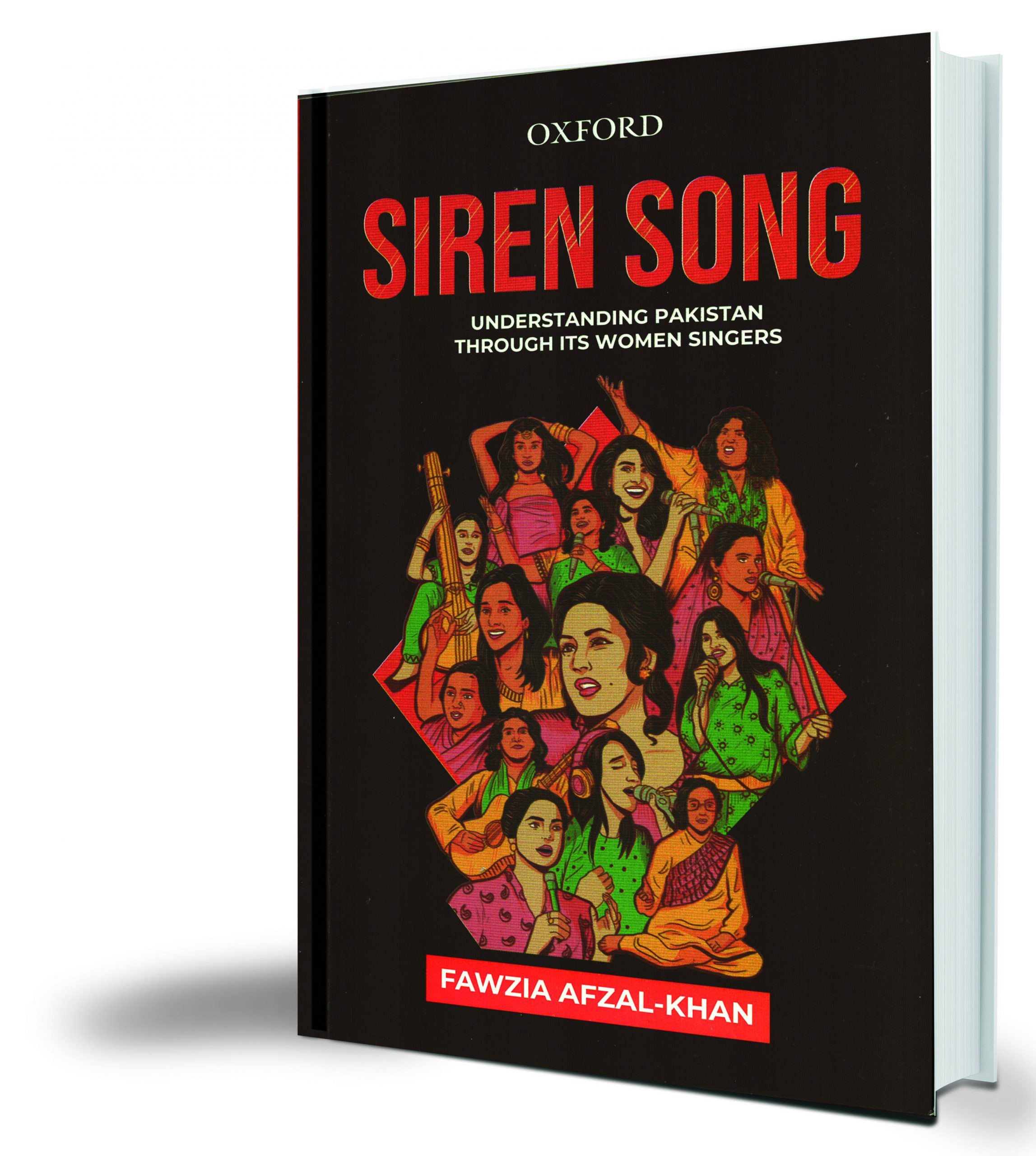
Book
Siren Song
Challenging
Musical Traditions
| Book Title: | Siren Song: Understanding Pakistan Through Its Women Singers |
| Author: | Fawzia Afzal-Khan |
| Publisher: | Oxford University Press Pakistan |
| Pages: | 211 |
| Price: | Rs. 1,250 |
Most women singers and performers in Pakistan have defied society’s narrow, conservative sensibilities, which confine them within the private sphere. They have forged their own path in the music industry. Their struggle to withstand cultural and familial prejudices has often been viewed through a western lens that propagates a false narrative of victimhood about the so-called “oppressed Muslim women”.
Fawzia Afzal-Khan’s Siren Song: Understanding Pakistan Through Its Women Singers offers a much-needed alternative reading of the subject through the prism of cultural and critical feminist studies. With a fundamentally distinct approach that challenges orientalist ideas of victimhood and avoids relying on state-sanctioned narratives, the author demonstrates how women singers in Pakistan have displayed their surefootedness on rough terrain in a patriarchal society. At its core, this account explores how female public performers negotiated the onslaught of moral outrage in an intrinsically Muslim society.
The author doesn’t rely on a simplistic analysis to an issue that is inherently complex and needs to be understood through a fine balance of critical theory and practical insights. The methodological framework of Afzal-Khan’s book falls within the realm of cultural studies and draws on the observations of notable dance historian Sally Banes. Steered by these theoretical underpinnings, the author looks beyond “the sociology of women singers’ lives” and examines the unique ways through which their performances produce “cultural representations of gender identities” that defy prevailing gender norms. By veering away from the individual trajectories of women singers, Afzal-Khan situates their musical legacies within a broader context and explores their influence in cultivating gender identities in Pakistan. As a result, she succeeds in presenting a feminist critique that ponders the role of music in inspiring social change.
Through six deftly braided chapters, Afzal-Khan offers a unique interpretation of the careers of few women singers and performers in Pakistan. In a chapter titled ‘The Respectable Courtesan’, the author raises pertinent points about how female classical musicians were mindful of the influence of ‘respectability politics’ on their career paths. This has been exemplified through a detailed study of Malika Pukhraj’s memoir Song Sung True, which was originally published in Urdu. Afzal-Khan conducts a textual analysis to depict the ways in which the late classical musician forayed into the “tainted public space as an entertainer” by simultaneously rejecting and embracing patriarchal codes of conduct. This allows her to “satisfy the requirement of a Muslim respectability discourse” and concurrently pursue her creative potential.
Moving beyond the purview of ‘respectability politics’ and patriarchal codes, Afzal-Khan also portrays the spirit of boldness and rebellion in the work of Madam Noor Jahan, Abida Parveen and Deeyah. Though their genres vary considerably, these women singers defied patriarchal structures by using music as “incendiary devices”. The author also delves deeper into the contributions of folk musician Reshma in creating a Pakistan-specific musical tradition that challenges elite custodians of culture. This allows her to enrich her gender analysis with a deep-seated understanding of social stratification.
Siren Song examines the role of pop music by Nazia Hassan, Runa Laila and Noor Jahan in displacing the “accepted conventions of respectability”. In this section, Afzal-Khan draws heavily on historical insights, articles and the lyrics of each artiste’s song to analyze the transnational spirit of their work and its broader implications within Pakistan.
Siren Song also includes the edited transcripts of interviews that Afzal-Khan conducted with Tina Sani, Tahira Syed, Suraiya Multanikar, Aliya Rasheed and Hadiqa Kiani. These transcripts might be especially useful for scholars who are interested in building upon the author’s feminist critique.
Devoid of clichéd ideas about “oppressed Muslim womanhood”, Siren Song offers a realistic view of how women singers skilfully negotiate the public-private divide to pursue their passion for music.![]()
|
Cover Story
|
|
Special Editorial Feature
|
|
Region
|
|
News Buzz
|
Update |


Leave a Reply