



 Pakistan is a deeply patriarchal society and gender segregation in the form of women’s exclusion from social and political spheres is an established norm. Nonetheless, a section of women has been successful in creating a niche for themselves and are continuing to demand social justice.
The ‘Democratic Women’s Association (DWA)’ was the first progressive woman organization, that was established on principles of the Marxist philosophy in 1948. Women's movements in Pakistan, in their true form, received momentum, when, in 1981, the ‘Women’s Action Forum (WAF)’ was formed in Karachi. WAF emerged as a feminist forum and spread to other cities. It was a major organization that resisted Zia’s anti-women laws, such as the Hudood Ordinance, the Zina (Adultery) Ordinance (1979) and the Law of Evidence (1983). Throughout the years since its inception, WAF has been active in major cities such as Karachi, Lahore, Quetta and Peshawar.
The first event in the history of women’s movements in Pakistan that gave strength to women’s resistance took place in Lahore, when the Pakistan Women Lawyers organized a march to the Lahore High Court to file a petition against the then proposed Law of Evidence on 12th February 1983. This was the first time when a large number of women, including WAF members, joined a demonstration and were baton-charged and tear-gassed on the Mall in Lahore. Later, February 12 was declared a National Women’s Day. This was the first time in the history of the country that women were targeted and nearly 50 arrested.
Like the active role played by WAF, Sindhiyani Tehrik (Movement of Sindhi Women) was another strong pressure group, based in Sindh, which resisted Zia’s martial law. Unlike some other women organizations, Sindhiyani Tehrik (ST) was and is completely a political organization since it is the sister wing of the leftist party, Awami Tehrik, which was founded by late Rasool Bux Palijo and his companion Fazil Rahu.
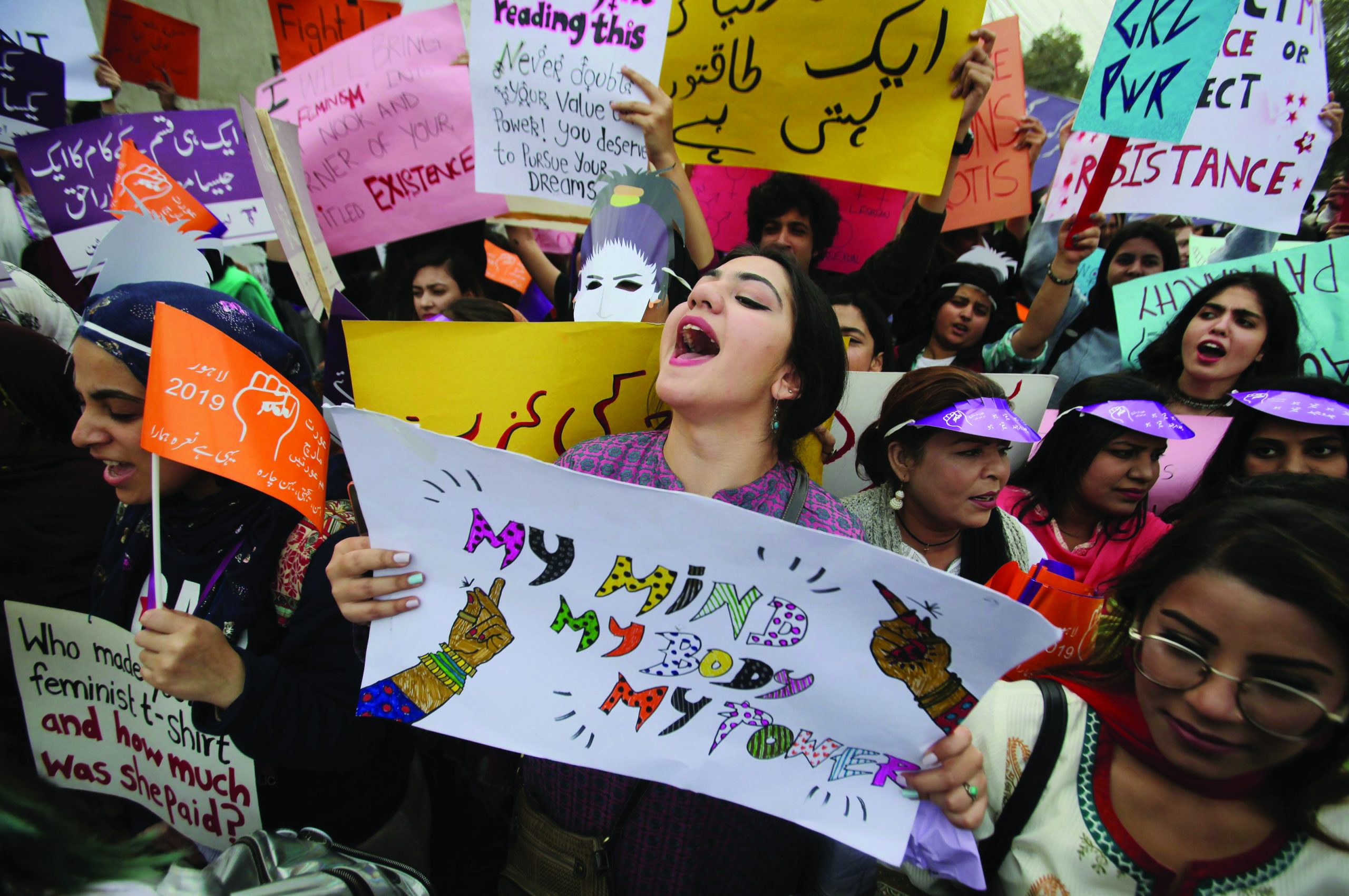
Although, on the one hand, Zia’s martial law had tried to suppress every progressive voice, surprisingly this suppression united the progressive forces in the country. It was a result of General Zia’s suppression against political voices that a wider alliance of different political parties, called the Movement for the Restoration of Democracy (MRD), was formed. Likewise, it is quite possible that had Zia not introduced his so-called Islamization project, women organizations, like WAF and ST, may not have been formed.


The writer has a PhD in Global Studies from the College of Liberal Arts, Shanghai University and teaches at Quaid-i-Azam University, Islamabad. He can be reached at qasim_shu2016@yahoo.com |
|
Cover Story
|
|
Virus
|
|
Forum
|
|
News Buzz
|
Leave a Reply |
Update |
There are various factors which are impeding the rights which are granted by Allah Kareem to everyone. If every woman decides she will not let any men engulf her rights and every man or at least 50 percent men do good to their women at home, the things can go in favour of woman and of course it is a good effort by Dr Qasim. As a writer he may create some awareness among masses.