
Event
Notes from a Literary Weekend
Attending select sessions of the 17th edition of the Karachi Literature Festival was a bittersweet experience characterized by both delight and disappointment

To begin with, let me admit that I attended only a few events of the 17th edition of the Karachi Literature Festival held recently. I didn’t go on the first day, which was mainly an inauguration ceremony, and I did not want to listen to the rants of representatives of two governments who are genocide deniers as well as genocide enablers. Also, there were speeches scheduled by two politicians who claimed to be for democracy but actively supported the 26th and 27th amendments, which totally destroyed the constitution of Pakistan.
I did go on the second day. The launch of the book by Sameena Nazir was a delightful event, with the author interviewed by Wusatullah, a renowned journalist. The book is a collection of short stories, and Wusatullah was excellent in getting the author, Sameena Nazir, to expose her personality and motivations. She was at ease with the interviewer in telling about her imagined characters, some of whom resembled real folks she knew. An interesting phase of the interview was when Wusatullah asked her about what happens when a character begins to defy the story and becomes disobedient.
I then attended the session “Beyond the Classroom: The future of learning.” There were nearly a dozen people on stage, moderated by an Associate Professor at LUMS. The panelists were mainly principals or owners of (English medium) schools and conversed among each other and with the moderator in English. Most of the conversation was about whether Artificial Intelligence will have an adverse impact on the educational process. While some felt that schools could take advantage of AI and that students would be better off using it, others on the panel expressed concern that AI could harm education. There was no one on the panel with any connection to post-secondary education (college, university, technical, professional, etc.). Consequently, no consideration was given to levels and types of education.
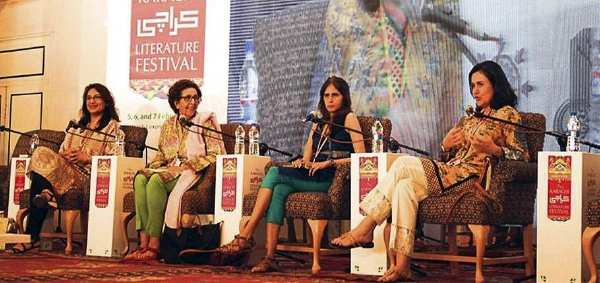
My next stop was the conversation between Anoushey Ashraf and Sharmeen Obaid-Chinoy. It was a pleasant “show,” if I may call it that, as many nice visual clips were shown on the screen.
The conversation between Anoushey Ashraf and Sharmeen Obaid-Chinoy was a pleasant “show,” if I may call it that, as many nice visual clips were shown on the screen
I made sure to get a front-row seat for the Public Interest discussion on Pakistan’s economic reset. The panel included a former boss of the State Bank (Dr. Ishrat Husain), two former federal Finance Ministers (Miftah Ismail and Asad Umar), the boss of the privatisation commission, and a representative of the business community. I was hoping that these wizards of Pakistan’s economy would enlighten us about what is wrong and how to set it right. Boy, was I disappointed.
They talked about macroeconomic fundamentals, fiscal discipline, privatisation, investment climate reforms, the critical role of institutional credibility in economic recovery, and the importance of aligning political will with economic realities to place Pakistan on a more resilient and inclusive path. Only Mr. Miftah Ismail pointed out that the rapidly growing population is a serious impediment to solving the country’s economic problems. However, he did not mention how this should be tackled.
In the QA session, I asked what we have to export and why we don’t seriously consider reducing imports instead. I took the liberty of pointing out that energy imports are a significant component of our imports and that a major share of imported fuel goes into the transportation sector because we have neglected public transport development. My question became too long. Of course, it was. But I was right to assume that the 5 men and one woman sitting on the stage were still looking to get into a slice of the pie that is the government. That is why none of them said a word about curtailing government expenditure. Only Miftah Ismail said he was in favour of cutting pension benefits of retired government employees.
Disgusted, I did not go to the final day’s sessions. In retrospect, I probably overreacted, as there were some good sessions.
The writer is the former Chairman of the Chemistry Department, University of Karachi, and can be reached at arif.kazmi@gmail.com


Leave a Reply