



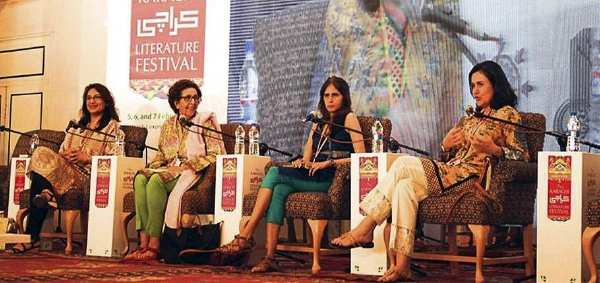
To begin with, let me admit that I attended only a few events of the 17th edition of the Karachi Literature Festival held recently. I didn’t go on the first day, which was mainly an inauguration ceremony, and I did not want to listen to the rants of representatives of two governments who are genocide deniers as well as genocide enablers. Also, there were speeches scheduled by two politicians who claimed to be for democracy but actively supported the 26th and 27th amendments, which totally destroyed the constitution of Pakistan.
I did go on the second day. The launch of the book by Sameena Nazir was a delightful event, with the author interviewed by Wusatullah, a renowned journalist. The book is a collection of short stories, and Wusatullah was excellent in getting the author, Sameena Nazir, to expose her personality and motivations. She was at ease with the interviewer in telling about her imagined characters, some of whom resembled real folks she knew. An interesting phase of the interview was when Wusatullah asked her about what happens when a character begins to defy the story and becomes disobedient.
I then attended the session “Beyond the Classroom: The future of learning.” There were nearly a dozen people on stage, moderated by an Associate Professor at LUMS. The panelists were mainly principals or owners of (English medium) schools and conversed among each other and with the moderator in English. Most of the conversation was about whether Artificial Intelligence will have an adverse impact on the educational process. While some felt that schools could take advantage of AI and that students would be better off using it, others on the panel expressed concern that AI could harm education. There was no one on the panel with any connection to post-secondary education (college, university, technical, professional, etc.). Consequently, no consideration was given to levels and types of education.


The writer is the former Chairman of the Chemistry Department, University of Karachi, and can be reached at arif.kazmi@gmail.com
Leave a Reply