



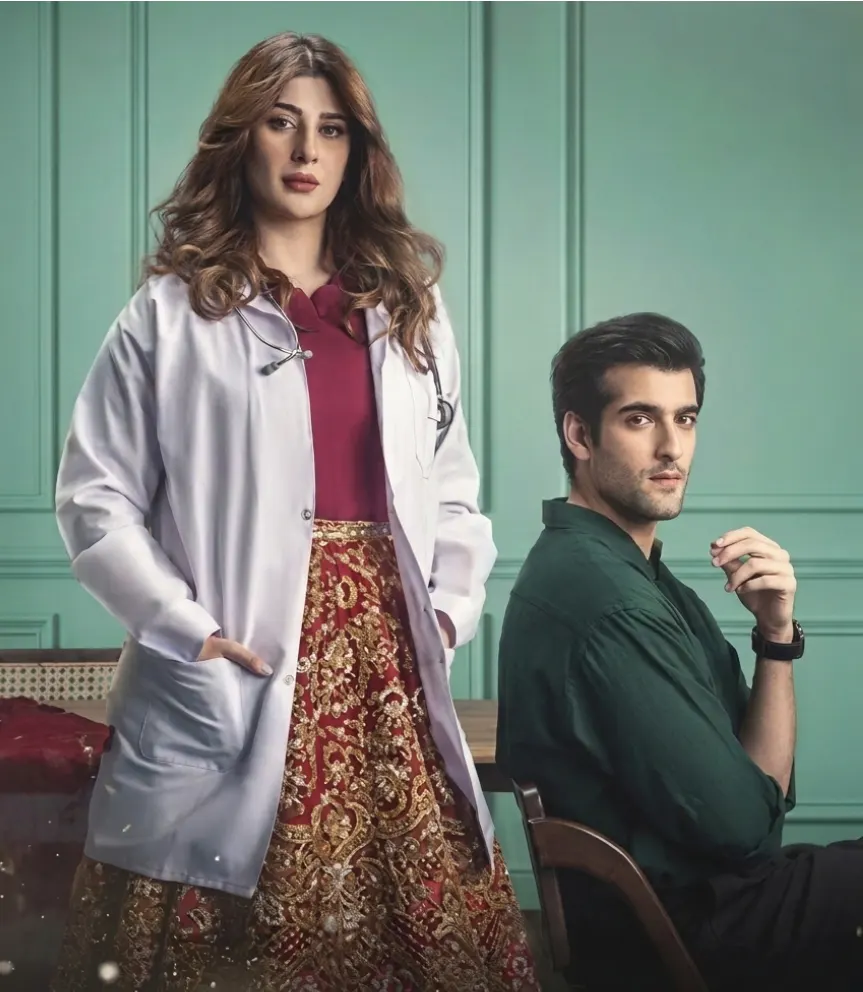
 The TV serial Dr. Bahu, directed by Mehreen Jabbar and written by Sanam Mehdi Zaryab, tackles a subject that many Pakistani families will find familiar, even if they would rather not admit it.
Dr. Bahu follows Sania, played by Kubra Khan, an ambitious doctor working towards becoming a surgeon. Her father is her biggest supporter, while her mother is more focused on getting her married. When a proposal comes through from a well-off family, Sania finds herself married into a household where women, despite being educated and accomplished, are expected to leave their professional careers behind.
The central conflict is simple but effective. Sania enters a family that appears modern and progressive on the surface but quietly operates according to traditional expectations. Her struggle to hold onto her professional identity while navigating her new home forms the core of the story.
Kubra Khan handles her role well, portraying a woman who is frustrated but composed, determined without being loud about it. The supporting cast adds a lot to the overall experience. Bakhtawar Mazhar stands out with a performance that brings some much-needed lightness to the story. Saba Hameed, Marina Khan, Muhammad Ahmed, and Shahzad Nawaz all deliver solidly, as expected from actors of their experience.
Mehreen Jabbar’s direction keeps the serial grounded. Scenes feel natural rather than staged, and the emotions never feel forced or exaggerated. The writing, for the most part, reflects situations that feel true to life, and the dialogues carry weight without becoming preachy.
On the flip side, the pacing is inconsistent. Some episodes feel slow, with scenes that stretch beyond what the story requires, while important moments are sometimes wrapped up too quickly. This uneven rhythm can test the patience of viewers used to tighter storytelling.
Sania, as a character, while well performed, is written a little too flawlessly. She is patient, intelligent, professionally accomplished, and emotionally strong almost all the time. This makes her admirable but not always relatable. A character with more visible flaws and moments of doubt would have made her journey feel more human and engaging.
Some of the supporting characters, particularly on the in-laws’ side, feel one-dimensional. Their role seems to be limited to creating obstacles for Sania rather than being fully developed people with their own motivations.
The TV serial also moves slowly in its earlier episodes, and viewers looking for a quicker build-up may find the first few weeks underwhelming. The payoff comes gradually, which is a deliberate creative choice, but it does risk losing casual viewers early on.
Largely shown through a one-dimensional prism glorifying career-oriented women, Dr. Bahu raises questions about how a traditional society treats the ambitions of educated women. Dr. Bahu puts a spotlight on something very common in Pakistani society, particularly in educated, upper-middle-class families, which is the contradiction of celebrating a woman’s education and career before marriage and then quietly expecting her to set it all aside afterward.
By telling this story through a medical professional, the TV serial makes the issue harder to dismiss. It is not about a woman who wants to work in an office or pursue a hobby. It is about someone whose profession involves saving lives. That career choice makes the family’s restrictions feel even more difficult to justify, and the show uses that tension well.
Leave a Reply