

Cover Story
A Nation Against Itself
Pakistan’s greatest challenge is not external aggression but the urgent need for democratic governance, institutional reform and national renewal
(Will you dispense justice only after the people have perished?
If you are truly just, why not bring about the Day of Judgement now?)
The question of whether Pakistan can win its war within is almost a forbidden question. Accordingly, answering it honestly is also an almost forbidden undertaking. This is because it boils down to asking whether Pakistan can undertake the range of reforms that are essential to providing good governance to its citizens, which is an existential question. If the government fails to provide such governance and reforms, and if the people remain incapable of compelling or influencing the government to do so, then the outlook for Pakistan’s survival in any viable shape will indeed be bleak.
If one skims the titles of books on Pakistan written by Pakistanis and foreigners over the past several decades up to the present, a very high proportion of them carry negative or pessimistic implications. While many of the authors acknowledge Pakistan’s achievements over the decades, they also identify a range of maladies and failings, such as political instability, economic vulnerability, regional and sub-regional alienation, ever-increasing mass poverty, widespread illiteracy, the lack of functional and relevant education, significant malnutrition and stunting, endemic exploitation, a short-term policy focus, long-term policy irresponsibility, outright corruption, the misuse of religious enthusiasm, class warfare, and, not least, comprador elitism that serves foreign rather than national interests. By and large, the above have defined the state of Pakistan. Those who deny this are, more often than not, directly or indirectly, knowingly or unknowingly, complicit in the state of the country.
The loss of East Pakistan seems to have had little or no impact on the governance of what was left of the country. No lessons were learned. In fact, they were not allowed to be learned. The Hamoodur Rahman Commission Report was designated Top Secret for three decades, and when it was finally published in Pakistan, many of its key conclusions and recommendations had been deleted. No wonder the follies and fallacies, not to mention crimes, that led to the loss of the Pakistan of Quaid-e-Azam and the Pakistan Movement were repeated in a diminished Pakistan, particularly in Balochistan, Khyber Pakhtunkhwa (KP) and now in Azad Jammu and Kashmir (AJK), whose governance is Pakistan’s international responsibility.
Similarly, after the US military incursion into Pakistan to assassinate Osama bin Laden and others in Abbottabad in 2011, an outraged nation and Parliament demanded a Commission of Inquiry to investigate and report on the flagrant violation of Pakistan’s sovereignty, as well as Pakistan’s failure to intercept the invaders. The Report of the Abbottabad Commission, including its recommendations, has never been made public because of a dissenting note, which was an integral part of the report. Once again, the lessons to be learned were suppressed. The future of the country was simply not the priority.
It is relatively easy to list a range of reforms that can make a crucial difference between the prospect of Pakistan becoming a failed state and being a state that is able to realise its potential for all its citizens. There is a whole range of international and national literature on the subject, almost none of which is of any practical interest to those who make the final decisions.
The poor Constitution has been mangled by amendments, or ‘commandments’ against itself, so that it has, in effect, become a mockery of its purpose
The question, accordingly, is not: “What is to be done?” Nor is it: “How can it be done?” Instead, the question facing Pakistan today is: How do we address the far more serious problem of the ruling elite’s refusal to do, or allow, what needs to be done in order to transform the country into a united, democratic, developing and progressive state capable of facing its future with justified assurance and confidence? This is indeed a ‘to be or not to be’ question.
Nevertheless, one of the former Prime Ministers, when informed of the deepening alienation taking place in Balochistan, reportedly commented: “Lahore se Balochistan nahin dikhta” (From Lahore, Balochistan cannot be seen). In other words, Balochistan could be safely ignored. As a result, the whole of Pakistan today is fast becoming one greater Balochistan. While our adversaries may well take advantage of the situation, the primary reason for this state of affairs has been the refusal of our rulers, both formal and real, to prioritise the essential reforms needed for good governance. Such governance is essentially democratic, people-centred, transformative in its mission and measures, and its priorities should be determined by the people’s genuinely elected representatives after consultation with relevant experts and ministries, rather than by unelected and unaccountable institutions acting in defiance of the Constitution.
The poor Constitution, however, has been mangled by amendments, or ‘commandments’ against itself, so that it has, in effect, become a mockery of its purpose. There is, moreover, talk of further amendments which would, in effect, if not formally, abrogate the Constitution. As we have been told, the law of the jungle is nature’s law. And Martial Law, apparently, approaches that ideal, even when it dresses itself up in the guise of ‘hybrid governance’, whatever that means. A fair guess is that it means constitutionally sanctioned unconstitutional governance.
As a result of accumulated misrule and all that it entails, Pakistan today ranks among the lowest-performing countries on many of the critical indices that determine the future of nations in the Global South. Given its population of almost a quarter of a billion people, low growth rates, high income inequality, a permanent debt trap, the erosion of economic sovereignty, and the inability to create even minimally secure and sustainable jobs for the hundreds of thousands entering the labour force each year, together with the likely impact of the current international and regional environment, millions of Pakistanis are slipping irreversibly towards, or below, the poverty line, where human rights become meaningless and prospects disappear.
Outrageously, millions of children are condemned from birth to brief lives of hopelessness, abuse, violence, poverty and crime, ending all too often in tragedy. No wonder the young, the poor and the vulnerable, including women, look towards a saviour who is locked away but remains in their hearts. His fate will largely reflect whether the people of Pakistan have the will to win the fight within.
It is said that the price of liberty is eternal vigilance. Nothing achieved is permanent; it has to be maintained and improved upon if it is to endure. It is also said that power corrupts, and absolute power corrupts absolutely. It is against these opposing realities that liberty, freedom and the people’s rights must be achieved and vigilantly preserved. This is a whole-of-the-nation jihad for the welfare and protection of khalq-e-khuda—God’s people.
The people’s struggle does not need to be violent. It needs to be organised, motivated, informed, inclusive, consultative, united and unrelenting. It requires an institutional infrastructure and sustained public commitment. A whole world of possibility is waiting to open up before every Pakistani—civilian and military alike—when they take the first irreversible steps on the right path.
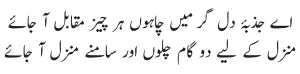
As Behzad Lakhnawi said:

(Oh, heartfelt passion, should I wish, all may come to me;
A few steps towards the goal, and the destination itself will appear before me.)
Based in Islamabad, the writer is Pakistan’s former ambassador to the US, India, and China and head of UN missions in Iraq and Sudan. He can be reached at ashrafjqazi@gmail.com


Leave a Reply