



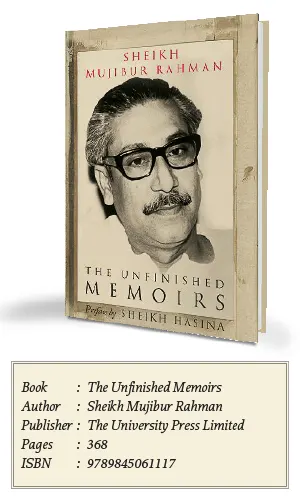
The Unfinished Memoirs by Sheikh Mujibur Rahman, based on his diary written in Bengali and later translated into English, offers valuable insights into the political developments that eventually led to the birth of Bangladesh.
In his memoirs, Rahman recalls that Khawaja Nazimuddin, who later succeeded Quaid-e-Azam Muhammad Ali Jinnah as Governor-General of Pakistan, had been defeated by A. K. Fazlul Haq in the 1946 elections in Patuakhali. Following this defeat, Nazimuddin’s political future appeared uncertain. It was Huseyn Shaheed Suhrawardy, who had won two seats in the election, who vacated one of them to enable Nazimuddin to return to the legislature. Mujib’s account suggests that, based on political ability and public support, Suhrawardy was a stronger candidate to succeed Jinnah than Nazimuddin.
Rahman describes the political awakening of Bengali Muslims during the first half of the twentieth century. He identifies three leading figures of the period: A. K. Fazlul Haq, Huseyn Shaheed Suhrawardy, and Khawaja Nazimuddin, all of whom served as Prime Ministers of Bengal under British rule. Suhrawardy was the most capable of the three. He possessed greater political vision, a better understanding of history, and recognised earlier than others that the Muslims of Bengal had to become active participants in the Pakistan Movement. Although he rose to prominence later than the other two leaders, his contribution to the Pakistan Movement was perhaps the most significant.
After independence, however, Suhrawardy became deeply disappointed with the direction of the Muslim League because the party had become dominated by landlords, bureaucrats and political elites. Suhrawardy then joined Maulana Abdul Hamid Khan Bhashani, Shamsul Huq and Sheikh Mujibur Rahman in establishing the East Pakistan Awami Muslim League in June 1949.
Rahman notes that during Khawaja Nazimuddin’s tenure as Prime Minister, none of Suhrawardy’s supporters were given ministerial positions or even appointed as parliamentary secretaries. Those who had played an important role in the Pakistan Movement found themselves excluded from positions they believed they had earned.
Ironically, Nazimuddin himself later became a victim of political injustice when his government was dismissed by Governor-General Ghulam Muhammad in 1953. His overnight dismissal is widely regarded as one of the earliest examples of extra-constitutional intervention in Pakistan’s political history.
The contribution of Bengal to the creation of Pakistan was indeed substantial. Under the leadership of Suhrawardy, the Muslim League won a decisive victory in the 1946 provincial elections in Bengal. This demonstrated overwhelming support among Bengali Muslims for the demand for Pakistan and weakened the Indian National Congress’s claim to represent all communities. Following the rejection of the Cabinet Mission Plan, Suhrawardy’s government also observed 16 August 1946 as Direct Action Day, reflecting the determination of many Muslims across British India to pursue their political objectives.
Another major contribution came from A. K. Fazlul Haq, who moved the historic Lahore Resolution of 1940, later known as the Pakistan Resolution.
These historical facts underscore the important role played by Bengali Muslims in the creation of Pakistan. They constituted the majority of Pakistan’s population at independence and made major political, electoral and intellectual contributions to the Pakistan Movement.
Leave a Reply