



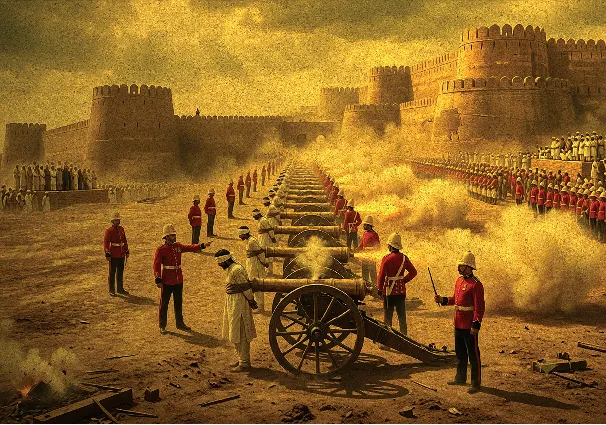
On 10 June 1857, on the old parade ground of Peshawar, where today aircraft taxi on the tarmac, forty men were bound to the muzzles of nine-pounder cannons and executed in full view of thousands of assembled troops. It was the single largest mass execution of the War of Independence anywhere in India. One hundred and sixty-nine years later, no memorial marks the spot. The men who died there remain largely forgotten.
They were sepoys of the 55th Native Infantry and other East India Company regiments, charged with open mutiny. In the eyes of the colonial administration, they were traitors. In the eyes of history, they were among the first to rise against an occupying power — paying for that defiance with their lives, and with the deliberate destruction of their remains.
The Road to Peshawar
The uprising of 1857, which the British termed the Sepoy Mutiny and which successive generations of South Asians have called the War of Independence, began in Meerut in May of that year and spread rapidly across the subcontinent. News of the rebellion reached Peshawar almost immediately. The colonial administration, acutely aware that it sat on the volatile edge of the North West Frontier, moved swiftly to suppress any possibility of a sympathetic uprising among the large garrison stationed there.
Charges of open mutiny were brought against sepoys who had deserted or been found with arms. Courts-martial sat in continuous sessions. The sentences handed down were severe: death by hanging for some, transportation and imprisonment for others, and for the mutineers of the 55th Native Infantry — execution by cannon.
The officers who supervised the punishment included some of the most prominent names in British India’s military history: John Nicholson, Sydney Cotton, and Neville Chamberlain. Nicholson, who had first received news of the rebellion in Peshawar, departed the city on 14 June 1857 to join the assault on Delhi, where he would later die of his wounds during the siege.
The Execution
The scene on the morning of 10 June was one of calculated theatre. All troops — European and native, armed and disarmed, loyal and suspected — were drawn up on the parade ground on three sides of a square. The fourth side was formed by ten nine-pounder cannons. The forty condemned men were marched in under heavy European guard, their charges and sentences read aloud at the head of each regiment. They were then marched around the square and brought to the guns in batches of ten.
Each man was blindfolded, his back pressed against the cannon’s muzzle, his arms fastened to the wheels. At the signal of the Artillery Major, the port-fires were lit, and the guns were fired.
The Illustrated London News published a sketch of the scene, showing the parade ground with the Khyber Hills in the background and Jamrud Fort visible in the distance — a haunting image of imperial punishment conducted in the shadow of the frontier.
Similar executions were carried out in Ferozepur in Punjab a few days later, but the Peshawar execution remained without parallel in its scale.
An Eyewitness Account
The most detailed account of the executions was published in Blackwood’s Magazine in November 1858, wrtten by an unnamed eyewitness. The extract, reproduced here in part, reflects the unsparing colonial mindset of the time — yet even its author cannot suppress a note of reluctant admiration for the dignity with which the condemned men faced their deaths:


The writer is a historian based in Lahore whose work explores the rich cultural, social, and political history of the Indian subcontinent, combining rigorous historical research with engaging storytelling.
Leave a Reply