



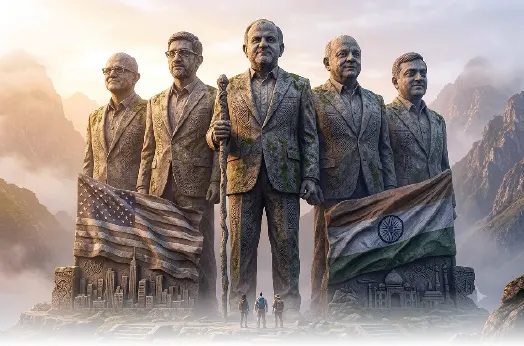
For decades, America’s technology industry has been regarded as the world’s ultimate meritocracy—a place where the brightest minds, regardless of race, nationality, or background, could rise to the very top. Yet an increasingly contentious debate is emerging around one of Silicon Valley’s most remarkable success stories: the rise of Indian-born executives to leadership positions in some of America’s most powerful technology companies.
Today, Indian-origin leaders sit at the helm of firms that shape the digital lives of billions. Sundar Pichai leads Google and Alphabet. Satya Nadella transformed Microsoft into one of the world’s most valuable companies. Shantanu Narayen heads Adobe. Arvind Krishna runs IBM. Neal Mohan oversees YouTube.
To many, these appointments represent the triumph of talent and hard work. But to critics, they raise an uncomfortable question: has the growing influence of Indian executives changed the hiring culture of America’s technology sector?
The concerns extend far beyond who occupies the corner office. Critics argue that the rise of Indian leadership has coincided with a dramatic increase in the recruitment of workers from India through the H-1B visa system, as well as the expansion of outsourcing operations to the subcontinent.
The numbers are frequently cited by those who believe the trend deserves closer scrutiny. When Sundar Pichai became CEO of Google in 2015, the company filed thousands of H-1B-related applications. By 2021, those filings had more than tripled. Similar patterns have been observed at Microsoft following Satya Nadella’s appointment as CEO in 2014. At Twitter, H-1B-related filings also increased significantly during the period in which Parag Agrawal rose through the company’s leadership ranks before eventually becoming CEO.
Supporters of these executives argue that such growth reflects the increasing demand for highly skilled workers in software engineering, artificial intelligence, and cloud computing. Yet critics remain unconvinced. They point to what they view as a broader pattern in which leadership, recruitment, and outsourcing increasingly revolve around Indian professional networks.
One former technology recruiter interviewed in the documentary claimed that confidential interview questions were sometimes shared among candidates through informal networks. According to this account, applicants who had already completed interviews would pass questions on to fellow candidates before their own interviews took place. While such allegations are difficult to verify and, if true, would violate company policies, critics argue that they illustrate how tightly connected professional communities can influence hiring outcomes.
The issue, they say, is not individual misconduct but what happens when hiring becomes tribal.
“When you look at the hiring, it gets tribal. It’s India versus the rest of the world,” one commentator argues in a documentary.
That accusation lies at the heart of the controversy. Critics claim that once a critical mass of managers from a particular background occupies positions of influence, hiring decisions may begin to favour candidates from the same networks, universities, regions, or cultural communities. Such practices need not be formally organised to have a significant effect. Informal referrals, personal recommendations, and familiarity can shape recruitment decisions in subtle ways that outsiders struggle to challenge.


Based in Karachi, the writer is a Social Development and Policy graduate from Habib University, Karachi. He can be reached at bilalmustikhan@yahoo.com
Leave a Reply