



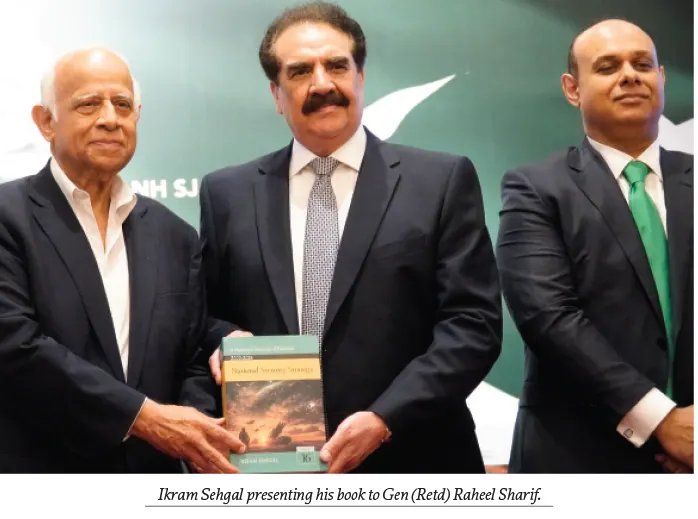
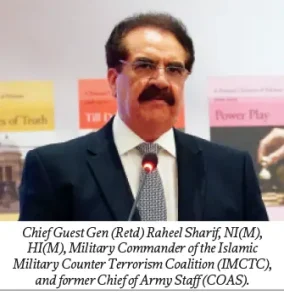
The 16th volume of Ikram Sehgal’s “A Personal Chronicle of Pakistan” series, the “National Security Strategy”, was launched in Islamabad in July. Hosted by Ikram Sehgal and Zarrar Sehgal, the reception brought together senior military officers, diplomats, academics and policymakers. With the Commander of the Islamic Military Counter Terrorism Coalition and former COAS Pakistan Army, Gen (Retd) Raheel Sharif NI(M) HI(M) as the Chief Guest, eminent speakers reflected on the book’s contribution to Pakistan’s national security discourse from different perspectives as well as their association with the author Ikram Sehgal.
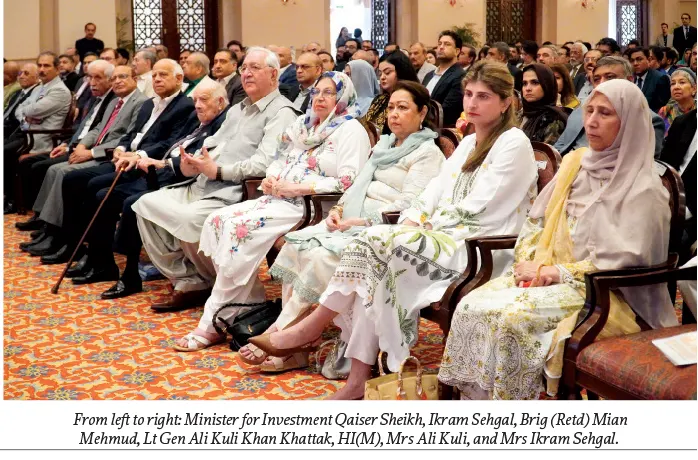
Prof. Dr Huma Baqai spoke about Ikram Sehgal’s authorship, patriotism, his father’s legacy, and the sacrifices of Pakistan’s Armed Forces. She described the book as a people-centric chronicle of Pakistan’s geopolitical and economic transformation. Highlighting state-society relations, food security, population growth, equality, and education. Pakistan lacked a formal “National Security Policy” framework in the early 2000s. Recalling his own experience at the National Defence University (NDU) when even a basic policy format was unavailable, Air Marshal (Retd) Masood Akhtar acknowledged that Pakistan lacked a formal “National Security Policy” framework in the early 2000s. NDU had tasked Ikram Sehgal to give the very first lecture in 2002 on “National Security Strategy”. He applauded Ikram Sehgal’s intellectual contribution.
Shahid Khaqan Abbasi recalled that his uncle Brig Mohammad Taj SJ & Bar, one of the most decorated soldiers of the Pakistan Army, was Ikram Sehgal’s Commanding Officer during the 1971 War. Ikram Sehgal had been a familiar name in his family since his childhood. He touched upon his own personal association with Ikram Sehgal, rooted in longstanding ties. He praised Ikram Sehgal’s extensive body of work and encouraged him to document more of his personal experiences, describing them as an important part of Pakistan’s history. He commended Ikram Sehgal for his decades of quiet service and contribution to the country, noting that he had taken many initiatives and built many institutions without seeking recognition.
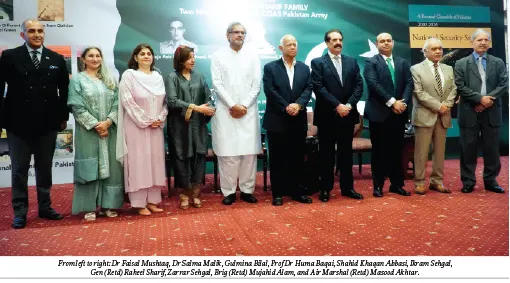
Gen Raheel Sharif paid tribute to Ikram Sehgal’s lifelong friendship with the Sharif family and thanked him for dedicating the book to them. He said he had known Ikram Sehgal since childhood in Lahore. Recalling their decades-long association, he said he admired him alongwith his brothers Major Shabbir Sharif (NH) and Capt Mumtaz (SBt). Gen Raheel Sharif said he looked up to soldiers like Shabbir Sharif, Nadir Parvez, Ikram Sehgal, Farooq Nawaz Janjua, Sabir Kamal Meyer and others for their military service, sporting excellence, and personal character. They were role models of the then Young Officers (YOs) of the Pakistan Army. He praised Ikram Sehgal’s distinguished career as an infantry soldier, aviator, defence analyst, author and businessman, as well as his longstanding efforts to project Pakistan’s perspective internationally through the World Economic Forum (WEF) in Davos. He also paid tribute to Mrs Ikram Sehgal, whose grace and steadfast support have been integral to his remarkable journey and to his son, Zarrar, who is carrying forward his family’s distinguished legacy.
In his closing remarks, Ikram Sehgal delivered a deeply personal address, tracing his family’s roots through a Punjabi father and Bengali mother and recounting his experiences during the 1971 war, including his escape from Indian captivity and the challenges he faced after returning to a divided Pakistan. He described his love for his country and for his battalion, 44 Punjab (now 4 Sindh), known in the Army as SARMAST BATTALION. The Rifle Company Ikram Sehgal commanded during the 1971 War, Delta Company, was re-named by Col Taj as “Sehgal Company” on the battlefield on Dec 13, 1971. He called his love for his father and his unit a lifelong vindication of his decision in 1974 to remain in Pakistan. He also thanked the guests and reflected on his life journey, his father, the Sharif family, and his national security vision. Expressing strong trust and faith in the people around him, he emphasized that his belief in Allah and the divinity of his faith contributed to his success. 
Leave a Reply