



he defining challenge of the 21st century is not remembering information but solving complex problems that have no ready-made answers. Climate change, artificial intelligence, public health crises, energy shortages, food security, urban congestion and environmental degradation all demand minds that can think scientifically, work collaboratively and respond creatively. This is where STEM and STEAM education become central to Pakistan’s future.
STEM (Science, Technology, Engineering and Mathematics) is not just a combination of school subjects. At its best, it is a way of thinking. It teaches students how to observe, test, measure, analyze and improve. STEAM adds Arts to this framework, reminding us that creativity, design, communication and imagination are not luxuries outside science; they are essential to innovation itself. A bridge must be engineered, but it must also be designed. A medical discovery must be scientifically valid, but it must also be communicated clearly. A climate solution must be technically sound, but it must also be understood by communities.
Pakistan has begun embracing STEM and STEAM through robotics events, coding workshops, science fairs, incubation centers, and technology parks. These developments show growing awareness of the importance of science and innovation.
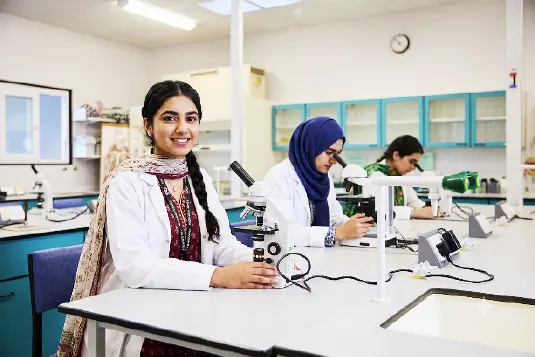
However, real transformation requires scientific thinking to become part of daily classroom practice. Students should be encouraged to question, experiment, build, fail, and redesign. At present, many schools, especially public-sector schools, lack proper labs, equipment, digital access, and trained teachers. As a result, students often study science as theory without experiencing science as practice.
This is one of the deepest weaknesses in our education system. A student may memorise the laws of physics without ever designing a simple experiment. A child may learn definitions in biology without observing living systems. A class may study environmental pollution without measuring the air, water or waste patterns in its own neighbourhood. Such learning produces examination success, but not scientific confidence.
Infrastructure, therefore, matters greatly. Schools need more than classrooms and textbooks. They need functional science laboratories, computer labs, maker spaces, robotics kits, digital learning tools, simulation software, and flexible environments where students can collaborate on real-world projects. Modern STEM and STEAM education depends on project-based learning. Students should design water filtration systems, build solar-powered models, analyse local environmental data, create simple machines, develop basic coding projects, and present their findings.
Yet infrastructure alone will not solve the problem. A modern laboratory without a trained teacher is merely a room full of equipment. The teacher remains the heart of educational change.
STEM and STEAM education require a major shift in teaching methods. Teachers need to move beyond one-way lectures and encourage inquiry-based, collaborative, and interdisciplinary learning. This is not easy. Many teachers were themselves trained in systems that valued memorisation over experimentation. It is unfair to expect them to transform classrooms without serious support.
Continuous teacher training must therefore become a national priority. Pakistan needs professional development programs that are practical, sustained, and relevant. Teacher training should be practical, continuous, and classroom-focused, equipping educators to design experiments, manage projects, integrate digital tools, and connect learning with real-world challenges. Training should not be a formality conducted for certificates. It should become a living process of mentoring, peer learning, and classroom support.


Based in Karachi, the writer holds a PhD from CTH, Sweden, and serves as Professor and Chairman of the Physics Department at the University of Karachi. He can be reached at iulfat@uok.edu.pk.
Leave a Reply