Pakistan’s friendship with China may be ‘higher than the Himalayas’ and ‘deeper than the oceans,’ but the economic returns remain surprisingly shallow. It’s time to reset the relationship.
BySirajuddin Aziz | August 2026
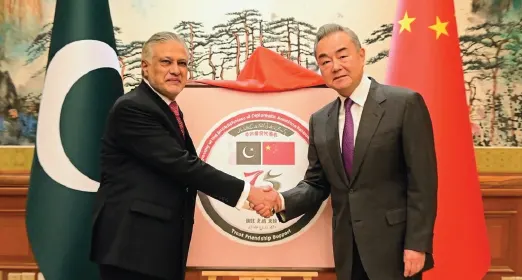
This year, we are celebrating the 75th anniversary of the establishment of diplomatic relations with the People’s Republic of China. Following Mao Zedong’s proclamation of the founding of the People’s Republic of China and the defeat of the Kuomintang (KMT) forces of Chiang Kai-shek on October 1, 1949, at Tiananmen Square, Pakistan was one of the first few countries that recognised communist China in 1950.
The relationship has weathered all storms caused by the fluctuating behaviour of nations following the Second World War. The Korean War (1950–1953) did not have a negative impact on the relationship, despite our close association with the USA.
From the 1950s until July 1971, the USA was obsessed with its doctrine of containing the spread of communist ideology. They looked at the Soviet Union and China as a dual threat. In pursuance of this political objective, the USA was the frontrunner in the creation of NATO (1949); then, after the end of the Korean War, SEATO (1954) was formed, and CENTO (Baghdad Pact) followed later. The singular purpose was to limit and stop the influence and expansion of communism.
Pakistan, then a newly created state, aligned itself with the West and unwisely became a member of SEATO and CENTO. This move fortunately did not impair our friendship with China. Concurrent with these events, India was flirting with developing a relationship with China, albeit by this time, the then Indian prime minister, Jawaharlal Nehru, had befriended the Soviet Union.
This led to Premier Zhou Enlai’s state visit to India—Jawaharlal Nehru capitalised on it. The slogan ‘Hindi-Chini Bhai Bhai’ echoed across the Himalayas. Prior to this visit, some of the warmth and closeness between Pakistan and China had already developed at the Bandung Conference in Indonesia in 1955. Premier Muhammad Ali Bogra and Zhou Enlai clicked. A beginning had been made.
India’s relationship with China did not improve. Instead, the China-India conflict (1962) in the Ladakh region put a complete damper on the friendship. Nehru was caught unaware by India’s misadventures in the NEFA region. History records that the defeat at the hands of the Chinese cost Jawaharlal his health and ultimately his life. Nehru died a depressed man in May 1964.
By this time, Pakistan had achieved limited success in forging deeper links with its giant neighbour. Z.A. Bhutto, who is often credited as the architect of Pakistan’s friendship with China, did indeed develop stronger bonds with Beijing alongside President Ayub Khan. The duo expertly worked hard to maintain balance, while walking the tightrope of relationships with Washington and Beijing.
In July 1971, Pakistan became the conduit nation that facilitated the rapprochement between the United States and Communist China. We arranged a surreptitious visit by Dr. Henry Kissinger. He travelled from Islamabad to Beijing, while the international media napped under the smokescreen that he had been taken ill and was recuperating in Abbottabad. This resulted in the first-ever visit of a US President to Communist China in 1972. Richard Nixon signed the document of détente, which came to be known as the “Shanghai Communiqué.” The People’s Republic of China (PRC) gave Pakistan full credit for opening China’s doors to the world.
From the year of our tragic dismemberment as a country till today, our political friendship has matured and become internationally formidable. China, from being a closed country, has over the years emerged as the ‘world’s factory’ and presently has gained worldwide recognition as a place that thrives on new advancements in science and technology.
A simple case in point is the futuristic city of Chongqing. Slowly but steadily, China is catching up with the West, not only in the arena of international trade but also in scientific and technological progress. Huawei is a global brand today, especially in hardware related to cellular technologies.
China is today an economic miracle. The size of its economy is expected to outgrow the United States in the next few years. China has progressed. It was founded two years after Pakistan. However, in these 75 years of friendship, what have we learned from China?
The question is loaded. Apart from seeking political support, we derived little economic benefit. Looking at its FX reserves, the investment of US $63 billion in CPEC is a drop in the ocean. We have failed to draw Chinese investors’ interest in our special economic zones.
In the last decade(s), through the courtesy of a leading newspaper, I have lamented time and again about our lack of focus to create strong economic bonds with China. We must recognise the new realities: Chinese international relations have moved from friendship with just Pakistan and Albania to many countries now. They have significantly moved away from political slogans and look at relations through an economic prism. We continue to quote, “higher than the Himalayas, deeper than the ocean, sweeter than honey,” “iron brothers,” etc. These slogans should have been converted into economic gains. We have failed. New Delhi is still an ‘enemy’ for Beijing...yet it has more investment than we do. This is pure economics. That’s a reality. We are caught napping.
Having lived for over a decade in the Far East, including a stint of over a year in Beijing, I have been witness to China’s economic transformation. The economic revolution began with the establishment of the Special Economic Zones (SEZs). These were areas identified where the Chinese state-owned enterprises, alongside international investors, were allowed to test capitalism (market economy) within the imaginatively magical politico-economic slogan of ‘One Country, Two Systems’ coined by Deng Xiaoping, the master architect of China’s modernisation drive. The SEZs have been a roaring success; initially, they were just four. These were quickly followed by the opening of thirteen other coastal cities. Investments into these zones poured not just from international businesses but also from the large and strong diaspora of overseas Chinese.
Chinese diplomats, in spite of both diplomatic reluctance as well as adherence to the long-held Chinese cultural values, refrain from making negative comments, yet some of them have voiced in private conversations how ill-prepared we normally are at official meetings, be it at the business level or the state level. We seem not to know to date what we want from China for our economic growth and development.
Bureaucracy is an eternal foe of growth, innovation and development. All they can do is to place obstacles on the path of economic progress. We tend to kill with speed all initiatives through stubborn inertia. Surprisingly, even the Special Investment Facilitation Council (SIFC) has not taken off in the manner it was expected to do or at least how it was envisaged to perform...again caught in the cobweb of bureaucratic entanglements.
We too identified some moons back a few Special Economic Zones, but to no avail. They are lying in neglect and decay. Our Planning Commission is obstinately caught in the ‘glass-half-full’ syndrome. It is good to be positive. However, it is foolish to be so if there is a lack of initiative and action.
Why can’t we import for a limited period those economic managers who developed China’s special economic zones? Our economy will not be able to come out of the woods unless it fully embraces the concept of sustainable growth through promotion of exports. We need an economic policy that is built on the creation of an export-oriented economy. Let’s just replicate the Chinese experience, if we cannot imagine anything more or better.
China has changed. Its dynamics will continue to change. They have stood firmly as our friends. We must learn from them. There is a need for fresh imagination. Let us reset the relationship by transforming political goodwill into meaningful economic partnership.






Leave a Reply