



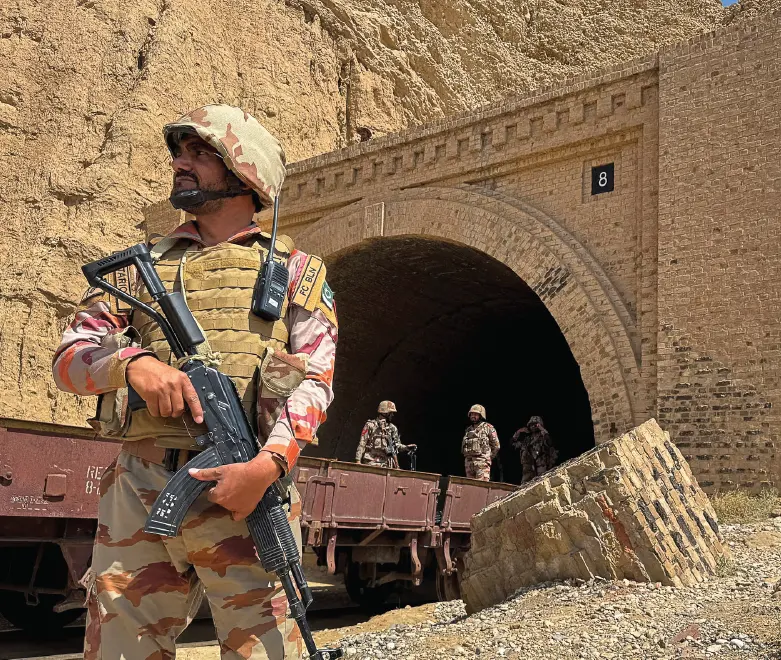
Pakistan is confronting one of the most serious internal security crises in its recent history. Militant insurgencies have engulfed the strategically important provinces of Khyber Pakhtunkhwa and Balochistan, while widespread unrest in Azad Kashmir has created an arc of instability across the country. In large parts of these regions, the state appears to be losing its writ.
Pakistani security forces have been fighting insurgent groups for more than two decades, with limited success. The latest wave of militant attacks in Khyber Pakhtunkhwa and Balochistan is a grim reminder that the threat has returned with greater ferocity. Although the conflicts in the two provinces have different origins and dynamics, together they have made Pakistan’s security challenge far more complex. The violence has become a national nightmare at a time of deepening political instability.
The separatist militancy that has gripped Balochistan for the past two decades now appears to have developed into a full-scale insurgency. Violence has risen sharply over the past five years, with 2025 becoming the deadliest year on record. According to the Pakistan Institute for Peace Studies, the province experienced at least 254 attacks in 2025, an increase of 26 per cent over the previous year. More than 400 people were killed. Highly trained militants have engaged security forces in gun battles lasting several hours, demonstrating their capacity to mount sustained challenges to the state.
The outlawed Balochistan Liberation Army has claimed responsibility for many of these attacks. The scale and coordination of its recent operations suggest that the organisation has substantial resources and support. The worst-affected areas include the coastal belt and districts bordering Iran. This is also the region where China is helping to develop Gwadar, a major port on the Arabian Sea and a flagship project of the multibillion-dollar China-Pakistan Economic Corridor (CPEC).
The recent increase in attacks on Chinese nationals working on CPEC projects is particularly alarming. Several Chinese workers have been killed in Balochistan and elsewhere in Pakistan. After claiming responsibility for some of these attacks, the BLA issued an ultimatum demanding that China withdraw from Balochistan or face intensified attacks on what it described as Beijing’s “key interests” in the region. These attacks could have serious geopolitical consequences. The mounting casualties among Chinese nationals working in Pakistan show the gravity of the threat.
The continuing violence also contradicts the government’s claim that the situation is under control. More damaging is the state’s failure to win public support for its campaign against the separatists. Balochistan has long been an epicentre of political unrest, creating conditions in which militant groups can operate and recruit. Baloch women have carried out some major attacks. Their growing participation, particularly among women from educated, middle-class backgrounds, suggests that the insurgency’s appeal has widened.
Public discontent has intensified because many people in Balochistan believe the province has been denied its political and economic rights. Civilian administration is absent or ineffective across large parts of the province. The disputed 2024 national elections further aggravated the situation. Allegations of electoral manipulation reinforced the perception that the provincial government lacks legitimacy and has therefore been unable to establish its authority.
No state can tolerate armed violence or a direct challenge to its authority. The state has the right to use force against a separatist insurgency. But force alone cannot resolve the conflict. Pakistan must also confront the political grievances that continue to fuel unrest in Balochistan. The security establishment’s flawed and excessively coercive approach has contributed significantly to the present crisis.
Meanwhile, suicide bombings and insurgent raids have increased sharply in Khyber Pakhtunkhwa. A reinvigorated Tehreek-i-Taliban Pakistan has reportedly carried out most of these attacks. Raids on heavily guarded security installations also suggest that militant organisations have developed the capacity to conduct complex operations in high-security areas.


The writer, based in Islamabad, is a veteran journalist, author and television analyst. He can be reached at zhussain100@yahoo.com.
Leave a Reply