

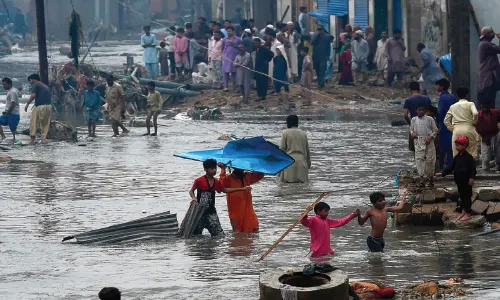
Sialkot
Monsoon Reckoning
The monsoon season in Pakistan is no longer defined by how much rain it brings, but by the growing unpredictability of where, when and how it falls

For centuries, the arrival of the monsoon across the Indian subcontinent was celebrated as a profound cultural inheritance. It was a season of poetry, village fairs, swings hanging from banyan trees, and the joyous anticipation of farmers waiting for the skies to replenish the earth. Today, however, those same dark clouds evoke a very different emotion. In Pakistan, the monsoon has transformed from an icon of romantic nostalgia into a source of acute climate anxiety. The clouds have not changed their color, but our relationship with them has been irrevocably altered by global climate destabilization.
As the 2026 monsoon season unfolds, Pakistan faces a bizarre and dangerous paradox: a macro-forecast of below-average regional rainfall while posing an imminent threat of catastrophic local flood disasters. To understand this erratic behavior, one must look to the equatorial oceans, where two massive global climate phenomena are currently dictating the fate of South Asia’s weather systems.
The Global Architects: ENSO and the Indian Ocean Dipole
The performance of the South Asian monsoon is largely governed by the delicate dance between the two oceanic-atmospheric phenomena: the El Niño-Southern Oscillation (ENSO) in the Pacific Ocean and the Indian Ocean Dipole (IOD) closer to home.
The first global driver, ENSO, refers to the periodic fluctuation of sea surface temperatures in the equatorial Pacific.
For the summer of 2026, the Pakistan Meteorological Department (PMD) and global climate models indicate that atmospheric conditions are transitioning toward an El Niño phase. Historically, El Niño is associated with warming in the central and eastern Pacific, which suppresses the South Asian monsoon by disrupting wind patterns and reducing moisture transport toward the subcontinent. Meteorologists warn that this could evolve into a “super El Niño,” potentially suppressing the overall volume of rain across the broader region.
However, the monsoon is not governed by the Pacific alone. The second phenomenon, the Indian Ocean Dipole (IOD), often described as the Pacific’s “twin,” refers to the temperature differential between the western and eastern sectors of the Indian Ocean. In 2026, climate models project the emergence of a strong positive IOD phase. A positive IOD occurs when western Indian Ocean temperatures rise significantly above normal, a condition that typically acts to exacerbate rainfall over parts of Pakistan and northwest India by feeding a surge of low-pressure moisture directly into the region.
The collision of a developing El Niño and a positive IOD creates a highly volatile, non-linear weather regime. Instead of a predictable, widespread seasonal rain, Pakistan is experiencing extreme regional variances, characterized by extended dry spells and punishing heatwaves, punctuated by hyper-local, violent deluges.
The 2026 Paradox: Dry Skies, Raging Rivers
This atmospheric tug-of-war explains why official 2026 outlooks from the World Meteorological Organization (WMO) project below-normal cumulative precipitation for South Asia, yet Pakistani authorities remain on high alert for imminent flood disasters. The risk this year is driven less by the total volume of seasonal rain and more by extreme atmospheric energy and shifting thermodynamic patterns. Nowhere is this threat more acute than in Punjab’s major economic engines, where the PMD has issued explicit urban flooding warnings. The vulnerabilities, however, are vastly different, as illustrated by the distinct risks facing Sialkot and Faisalabad.
Sialkot: The Transboundary Hydrological Hazard
Sialkot, Pakistan’s premier export-oriented manufacturing hub, presents a classic case of vulnerable transboundary hydrology. Nestled in the sub-mountainous terrain of northeastern Punjab, the city sits directly in the path of seasonal alpine torrents, most notably the Aik and Palkhu intermittent streams that flow directly from the Indian Jammu and Kashmir hills. Sialkot’s danger is twofold. First, its high-intensity industrial zone has expanded rapidly into the natural floodplains and catchments of these streams, severely restricting their natural drainage pathways. Second, because these water bodies originate across a sensitive international border, Pakistan’s meteorologists lack real-time, upstream physical telemetry data. When sudden cloudbursts hit the Kashmiri highlands, millions of cusecs of water rush into Sialkot’s clogged streams with almost zero lead time, threatening to inundate industrial estates, destroy export inventories worth billions of rupees, and disrupt the national supply chain overnight.
Climate resilience can no longer be treated as an isolated environmental issue; it must become a core pillar of Pakistan’s national security strategy.
Faisalabad: Concrete Footprint and Outdated Engineering
Faisalabad, on the other hand, faces an entirely different, internal structural crisis. Being a flat, densely populated textile metropolis, it is a victim of its own concrete footprint and antiquated civil engineering. Decades of urban migration have led to haphazard, concrete-heavy zoning that leaves virtually no porous soil for rainwater infiltration. The city’s primary drainage network was designed for a bygone era and is perpetually choked by municipal solid waste and industrial effluents from its massive textile cluster. When the 2026 monsoon strikes, the flat terrain offers no natural runoff channels, resulting in instant pluvial inundation. Stormwaters mix with overflowing domestic sewers, creating toxic urban lakes that bring the city’s economic life to a complete standstill, damaging machinery, spoiling raw cotton stores, and posing severe public health risks to millions of industrial laborers.
The Thermal Catalyst and GLOF Risks
Earlier in the spring of 2026, Pakistan was gripped by a severe pre-monsoon heatwave that saw temperatures soar 3-5 °C above average in the northern regions of Gilgit-Baltistan and Khyber Pakhtunkhwa. This intense thermal stress, combined with reduced winter snowfall and accelerated snow compaction, has destabilized the cryosphere. The massive mountain glaciers are melting at an unprecedented rate, filling glacial lakes to the brink. Even a modest, highly localized monsoon cloudburst over these northern catchments can trigger catastrophic Glacial Lake Outburst Floods (GLOFs) and high-altitude flash flooding, sweeping away critical bridge infrastructure and downstream settlements.
Intense Cloudbursts and Urban Flooding
A warmer atmosphere holds more moisture, roughly 7% more water vapor for every 1°C of warming. Consequently, when monsoon systems do breach the El Niño barrier, they do not drop gentle showers; they unleash hyper-concentrated, vertical downpours known as cloudbursts. This threatens major industrial and urban hubs like Sialkot, Faisalabad, Lahore, and Karachi with severe pluvial flooding, as outdated, debris-clogged municipal drainage networks are overwhelmed within hours.
The Anatomy of Vulnerability: Moving Beyond 2010 and 2022
Pakistan is no stranger to hydrological nightmares. The historic mega-floods of 2010 exposed deep institutional vulnerabilities in riverine defense, while the “monsoon on steroids” in 2022 inundated one-third of the country, displaced 33 million people, and inflicted over $30 billion in economic losses.
Yet, as the first spells of the 2026 monsoon damage infrastructure in northern districts like Diamer and Chitral, a recurring systemic weakness remains evident. Disaster management in Pakistan continues to suffer from a post-disaster response bias rather than a proactive risk-mitigation doctrine.
The Economics of Prevention
International climate economics persistently demonstrates that every single rupee invested in disaster preparedness, floodplain zoning, and early warning systems saves up to seven rupees in post-disaster recovery, reconstruction, and humanitarian aid.
Despite the stellar efforts of agencies like the National Disaster Management Authority (NDMA) and Rescue 1122, a critical gap persists in the “last-mile” dissemination of risk. For instance, recent tragic incidents of tourists and locals being swept away while standing in active riverbeds illustrate that while scientific forecasts are generated, real-time risk communication often fails to transform public behavior.
Furthermore, repeated flooding carries massive sediment loads downstream, gradually choking the reservoirs of vital dams like Tarbela and Mangla. This reservoir sedimentation reduces water storage capacity, threatens long-term energy security via reduced hydropower efficiency, and severely complicates downstream flood regulation during peak river flows.
A Roadmap to Climate Security
Climate resilience can no longer be treated as an isolated environmental issue; it must become a core pillar of Pakistan’s national security strategy. True resilience requires shifting from a culture of emergency management to one of structural anticipation.
· Enforce Strict Floodplain Zoning: Local administrations must strictly enforce laws prohibiting permanent commercial and residential construction along active river channels and high-altitude torrents.
· Revolutionize Risk Communication: Moving beyond standard weather advisories, authorities must utilize localized SMS alerts, install highly visible physical hazard signage at vulnerable riverbeds, and temporarily restrict public access to high-risk zones during peak surges.
· Mainstream Nature-Based Solutions: Instead of relying entirely on concrete embankments, Pakistan must invest in watershed restoration, upper-catchment afforestation, and wetlands revival to naturally slow down floodwaters and trap heavy sediments before they reach major reservoirs.
Restoring the Balance
The erratic monsoon of 2026 is a stark reminder that we cannot defeat the changing climate through reactive heroism alone. True resilience lies in preparing wisely and systematically for climate risks before disaster strikes. If Pakistan is to secure its agricultural future, safeguard its economic stability, and protect its citizens from recurring trauma, it must rewire its institutional governance to align with modern climate realities. Only by marrying science with sound, anticipatory governance can we hope to restore our ancient relationship with the monsoon, transforming it once again from a season of fear back into a season of life.
The writer is a senior banker who has closely followed China since the early 1990s. He is also a published author.


Leave a Reply