



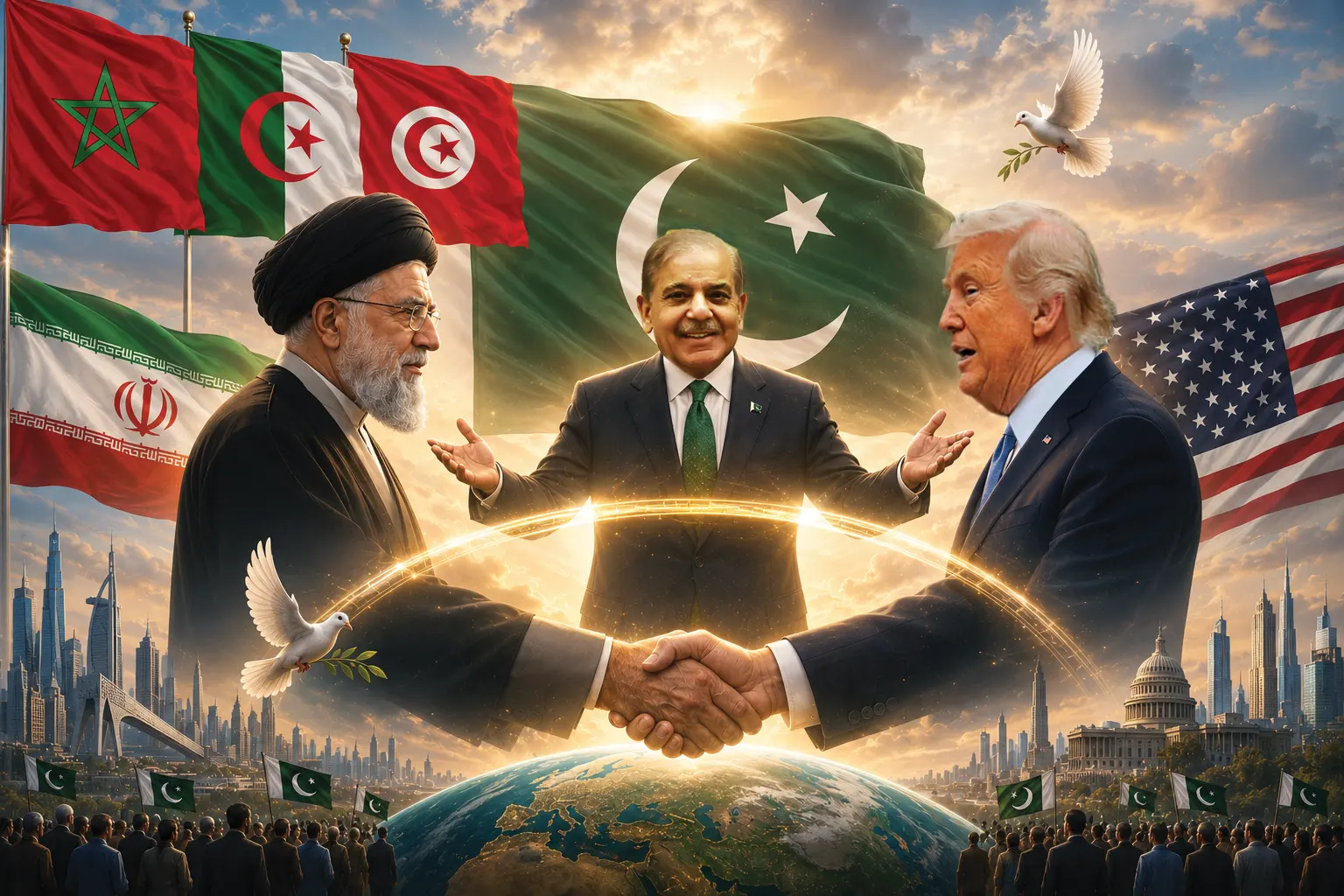
Pakistan’s recent role as a mediator between Iran and the United States — facilitating the highest-level in-person contact between the two countries in 47 years — has drawn global attention. Commentators have described the intervention as key to saving “a whole civilisation” from obliteration. Pakistan’s diplomatic engagement has rarely been so visible, so praised, or so consequential.
Yet for those who know its history, none of this should come as a surprise. What the world is only now noticing is something Pakistan practised quietly, more than seven decades ago. Through a historical lens, one can trace Pakistan’s largely undocumented role in supporting the independence movements of Morocco, Algeria, and Tunisia — interventions that helped put new nations on the map long before the term “soft power” was even coined.
The country was barely five years old when it began acting on principle on the world stage. Its infancy was no excuse for inaction.
A Pakistani Passport That Changed History
In 1952, Morocco was still under French colonial rule. Sultan Muhammad V, who was spearheading the independence movement, dispatched Ahmed Balafrej — a senior Moroccan freedom leader — to address the UN Security Council. The French colonisers blocked his address because Morocco was a French territory, and Balafrej, therefore, had no standing to speak independently.
It was at this moment that Pakistan intervened. Sir Zafarullah Khan, Pakistan’s Foreign Minister, was leading the Pakistani delegation at the UNSC session. According to the Pakistan–Morocco relations section on the Ministry of Foreign Affairs website, Khan ordered the Pakistani embassy to open that very night and a Pakistani passport was issued to Balafrej. The next morning, Balafrej addressed the Security Council as a Pakistani citizen. The intervention helped crystallise Morocco’s case for independence internationally; the country achieved it in March 1956.
Balafrej went on to become Morocco’s first Prime Minister. For years afterwards, visitors to his office would notice a framed souvenir: a Pakistani passport. It was not nostalgia. It was a reminder of principles and solidarity diplomacy that paved the way towards a nation’s independence.
Opening Doors in Karachi: The Algerian Revolution
Pakistan’s engagement with Algeria’s independence movement predated formal recognition, as Pakistan was a vocal supporter of Algerian self-determination. When the Provisional Government of the Republic of Algeria was declared in exile on 19 September 1958, under the Prime Ministership of Ferhat Abbas, Pakistan was among the first countries to recognise it and permitted it to open a mission in Karachi, then Pakistan’s capital, according to the Ministry of Foreign Affairs (MOFA) website.
Some historical records also indicate that Pakistan issued diplomatic passports to leaders of the Algerian revolution, one of whom was Ahmed Ben Bella, who would go on to become Algeria’s first President. Karachi, in this period, was briefly a hub of anti-colonial diplomatic activity, hosting revolutionary offices, receiving North African leaders, and projecting Pakistani influence into the Arab and African worlds.
There is also the story of Eqbal Ahmad, a prolific Pakistani writer and activist whom renowned physicist Dr Pervez Hoodbhoy has written about as a “highly unusual” Friend of the Algerian Revolution — the sole Pakistani known to have actively fought alongside Algerians for liberation from French rule.
Pakistan at the UN for Tunisia
In 1956, Tunisia also gained independence — and again, Pakistani diplomats were instrumental. On the 70th anniversary of Tunisian independence, Ambassador (Retd.) Khalid Mahmood, Chairman of the Board of Governors at the Institute of Strategic Studies, Islamabad, recalled the historic bond between the two nations and Pakistan’s consistent support for Tunisian self-determination at the United Nations.
 It was at the UN that Sir Zafarullah Khan delivered what those present described as a landmark address, directly countering a French propaganda campaign against Tunisian independence. The speech was of such sustained force that the President of the UN General Assembly, Sir Leslie Munro, was moved to remark: “This is the first time in my life that I have sat motionless in my seat for three hours, because I did not wish to miss a single word of your speech.”


The writer, who is based in Karachi, is a communications professional and a dedicated UN Volunteer. Feel free to reach out to her at mariaamkahn@gmail.com.
Leave a Reply