




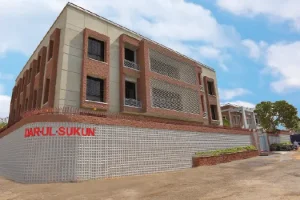
For a long time, I had wanted to spend a few hours with some of our senior friends who now live at Dar-ul-Sukun. The Dar-ul-Sukun Welfare Trust runs several care institutions in Karachi and other places, with its head office on Kashmir Road. The centre we visited is a home for elderly residents, located near Purani Numaish on M.A. Jinnah Road, opposite the Quaid’s Mausoleum.
At first, we had thought of visiting on Eid, but our friend Syed Sajid Raza told me that many residents are taken home by their families during the holidays. Then came Muharram, when the area around Dar-ul-Sukun is often blocked because of security arrangements. Finally, our visit was fixed for 4 July.
Sajid was waiting for me near the Quaid’s Mausoleum and together we walked inside. At the reception, Shahneela was there to welcome us with warmth and kindness. We learned that every morning at 10 a.m., the residents gather in the dining hall for tea.
Before joining them, Sajid suggested that we first meet the administrator, John Dominic Fernandes. He came across as a highly organised, courteous and attentive person. Despite his many responsibilities, he personally made sure that tea and coffee were arranged for us.
As we made our way to the dining hall, we passed the activity hall on one side and the physiotherapy hall on the other. Almost all the tables in the dining hall were occupied. Residents who needed assistance were being escorted in carefully by the staff. Everywhere, staff members were serving tea and biscuits, helping residents settle into their seats, offering assistance and speaking gently with them.
It was here that we began meeting the people of Dar-ul-Sukun. Each face carried a reflection of memories and struggle.
Farhat, a lively woman in a wheelchair, greeted us by singing a line from an old song. When we praised her warmth and spirit, her eyes sparkled, and her face lit up. She is around seventy. She lost one of her legs in an accident in the United States. When her children decided to send her back to Pakistan, her husband insisted on coming with her. He is now critically ill and under treatment at Dar-ul-Sukun’s clinic. Farhat loves poetry and music, remembers many old and new songs, and despite the hardship of life, still speaks with cheerfulness.
Jafar Bhai, about eighty-six, is a refined and well-read gentleman with a deep interest in literature and poetry. He spent thirty-five years in Dubai, working in human resources and administration for a shipping company. He has a son and two daughters, all educated and settled. Yet family circumstances brought him here. Food sometimes comes from home, and his son visits, but the fact remains that he is away from his own house.
Sagheer Bhai is only fifty-six, but he lost his eyesight at the age of twenty-two. His siblings looked after him at first, but over time the responsibility was passed from one person to another until he was brought to Dar-ul-Sukun. Now, no one visits and no relatives remain in touch. Sometimes the deepest wound is not the loss itself but being forgotten by one’s own people.
Apa Ruqayya, sixty-five, has spent almost her entire life at Dar-ul-Sukun. Her parents realised when she was very young that she was blind and brought her here in the early years of the institution. She has a beautiful voice and plays the piano very well. In her music, there is both sadness and light.
Lateef Bhai, eighty-two, belongs to the Memon community and still has a strong understanding of business. At one time, he was one of the well-known brokers of the Karachi Stock Exchange. After business losses, his circumstances changed, and eventually his children brought him here.
 Julius, at ninety-two, is the oldest resident. He can still speak and understand English, but his memory has almost disappeared. Very little is known about him now. Perhaps one of the loneliest parts of old age is slowly becoming distant from one’s own story.


The writer is Meritorious Professor, former Dean of the Faculty of Science, and former Director General of KIBGE at the University of Karachi. He holds a Ph.D. from the Australian National University and a D.Sc., and can be reached at abidazharuk@gmail.com.
Leave a Reply