



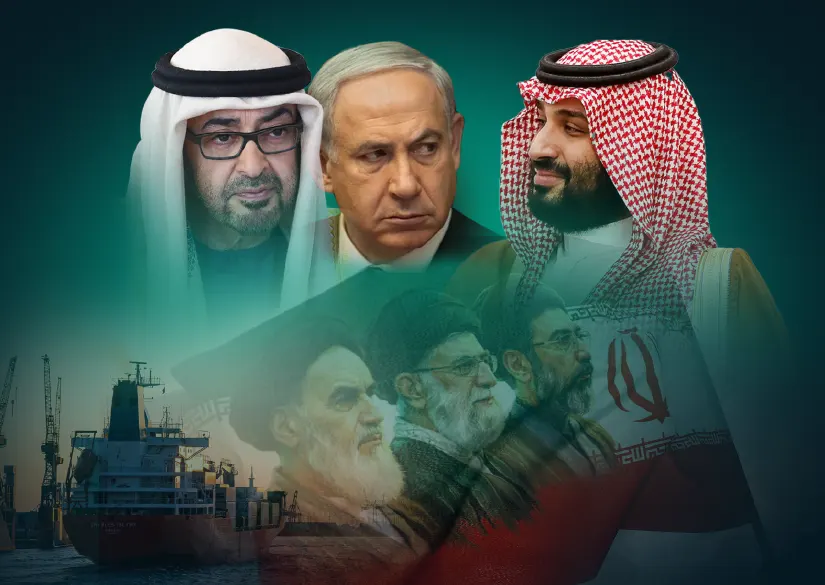
For nearly half a century, the Gulf’s political order rested on a deceptively simple premise: that despite rivalries, monarchies bound by oil wealth, American security guarantees and shared fears of revolution would ultimately cooperate when regional stability was at stake. Today, that assumption is collapsing.
The United Arab Emirates’ decision to leave OPEC, once unthinkable for a founding pillar of the Gulf energy system, was not merely an economic maneuver but a geopolitical declaration. Behind the technocratic language of “production flexibility” lies a deeper fracture reshaping the Middle East into three increasingly distinct power centers: a UAE-India-Israel axis focused on technology, maritime trade and hard security; a looser Pakistan-Saudi-Turkey-Egypt bloc seeking strategic autonomy and Sunni political coordination; and Iran’s battered yet adaptive “Axis of Resistance,” stretching from Iraq and Lebanon to Yemen. The result is the most consequential regional realignment since the 1979 Iranian Revolution.
For decades, Gulf unity survived because oil demanded it. The Gulf Cooperation Council, established in 1981 during the Iran-Iraq War, functioned less as a true political union than as a security compact against revolutionary Iran. Even when member states disagreed, as they did during Qatar’s blockade from 2017 to 2021, the broader architecture held because Washington remained the ultimate guarantor of order and because oil coordination through OPEC imposed strategic discipline.
However, that order began unraveling long before the UAE’s exit. The Arab uprisings of 2011 exposed profound differences between Gulf states over political Islam, counterrevolution and regional intervention. The war in Yemen further deepened tensions. Abu Dhabi and Riyadh entered the conflict as allies in 2015, only to emerge pursuing competing agendas on southern separatism, ports, and Red Sea logistics. The post-October 7 Middle East dramatically accelerated those fractures.
As Israel’s war in Gaza expanded into a broader confrontation involving Hezbollah, the Houthis and Iranian-backed militias, Gulf states responded not with unity but with diverging calculations. The UAE increasingly prioritized strategic integration with Israel, particularly in intelligence, cyberwarfare, air defense, and maritime security. Economic ties between Abu Dhabi and New Delhi also intensified through the India-Middle East-Europe Economic Corridor, envisioned partly as a counterweight to both Chinese infrastructure dominance and Iranian-controlled transit routes.
This emerging UAE-India-Israel alignment is not a formal alliance in the NATO sense. It is something more fluid and perhaps more durable: a networked bloc organized around ports, artificial intelligence, logistics, surveillance technology, and anti-Iranian deterrence. The UAE’s growing investments in Israeli gas fields, defense technology and intelligence coordination reflect this shift. Its strategic logic is fundamentally maritime. Control of trade corridors, from the Eastern Mediterranean through the Red Sea and into the Indian Ocean, has become the defining geopolitical contest of the postwar Middle East. Emirati ports, Israeli technology and Indian manufacturing ambitions fit together with remarkable coherence. In this vision of the region, prosperity depends not on pan-Arab solidarity but on integration into global supply chains protected by advanced military systems and Western-aligned capital. Saudi Arabia, however, has hesitated to fully join this architecture.
Crown Prince Mohammed bin Salman still appears interested in eventual normalization with Israel, but Riyadh’s calculus is more cautious in lieu of its ties to the greater Muslim world. The Gaza war intensified domestic and regional sensitivities surrounding the Palestinian issue, while Saudi officials remain wary of surrendering regional leadership to Abu Dhabi. Increasingly, Saudi Arabia appears to be pursuing a parallel strategy: balancing relations with Turkey, Egypt and Pakistan while maintaining selective engagement with the West and China simultaneously.


Based in Islamabad, the writer holds an undergraduate degree in Literary Studies from Eugene Lang College of Liberal Arts at The New School and an MPhil in South Asian Studies from the University of Cambridge. She can be reached at fathimahsheikh@gmail.com
Leave a Reply