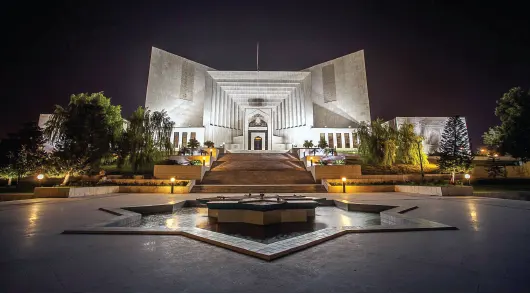
Islamabad
Reforming the Constitution to Death
The gradual strangulation of the judiciary and the politicization of the judicial system undermine the integrity of judges, reducing their role to that of mere civil servants

The earlier constitutional basic structure deviation by the Twenty-Sixth Amendment to the Constitution had already mutilated the Constitution, the Parliament motivatedly, again embarked upon the next leg of disaster which ended in the promulgation of the ‘Constitution (Twenty-Seventh Amendment) Act 2025’ on 13th November 2025 aimed to annihilated the entire ‘Basic Structure’ of the Constitution, being democracy, parliamentary form of government and independence of the judiciary. In the case of ‘Sindh High Court Bar Association Vs Federation of Pakistan[1] the Supreme Court, consisting of 14 judges, observed:
“An independent and strong judiciary is the backbone of a viable democratic system all over the world. -------- Equally, the independent and strong judiciary acts as an arbiter, striking a balance among the segments of the Democratic system. ----- The Constitution of Pakistan 1973, too, provides the judiciary guarantees enshrined in it and states that the judiciary shall be fully secured, but, unfortunately, to the great dismay, the organ of the State has, all along, been under the wrath of adventurers imposing their dictatorial terms obviously for their ulterior designs.”
In another case, being the ‘District Bar Association Rawalpindi V Federation of Pakistan[2], it was clearly established that the independence of the judiciary was the ‘basic structure’ of the Constitution. The Supreme Court of Pakistan held:
“The Constitution contains a scheme reflecting its Salient Features which define the Constitution. Such Salient Features are obvious and self-evident upon a harmonious and holistic interpretation of the Constitution.” [underlining and bold print by me for emphasis].
The adventures of the Form 47 government have gone so far as to destroy the judicial system. The 26th Amendment directly attacked judicial independence through the method of appointing judges, first by the 26th Amendment and then by the 27th Amendment. The appointment of the judges of the Federal Constitutional Court is made by the executive and is at its discretion. The Executive thus controls the superior judiciary to ensure judgments are delivered in accordance with its dictates.
After tinkering with the judicial system to take total control of the Judiciary, the military command structure has also been altered. Article 243 was amended so that the Chief of Army Staff would concurrently serve as the Chief of the Defence Forces, thereby making one person all-powerful. The post of the Chairman, Joint Chief of Staff Committee, was abolished. Additionally, the Commander of the National Strategic Command has to be appointed on the recommendation of the Chief of Defence Forces from the Pakistan Army. Most amazing provision: that the Field Marshal, once appointed, would retain the rank and privileges, and remain in uniform for life, with lifetime immunity to the Field Marshal, Marshal of the Air Force, Marshal of the Naval Fleet, and the President.
These ‘unconstitutional’ constitutional amendments are a cause of concern. The government propagates the idea that the amendments would lead to better, more efficient functioning of the courts and the military. The earlier structure of the Constitution of 1973 has been purposely changed.
Article 175B creates the Federal Constitutional Court (FCC) as a permanent court, with the almost unlimited jurisdiction taken away from the Supreme Court of Pakistan. The Twenty-sixth Amendment created Constitutional Benches in the Supreme Court with authority to address issues of constitutional interpretation, while the other benches of the Supreme Court dealt with other matters. Now, the motivated departure is significant, as the Constitutional Court’s judgements would also be binding on the Supreme Court. This FCC has exclusive jurisdiction to hear cases arising from petitions filed in the High Court under Article 199, whether or not the petition concerns subjects not requiring Constitutional interpretation.
In protest, Mr. Justice Mansoor Ali Shah and Mr. Justice Athar Minallah, both senior judges of the Supreme Court of Pakistan, resigned, arguing that the Supreme Court of Pakistan has de facto been reduced to an appellate court, with its entire jurisdiction transferred to the newly created Federal Constitutional Court.
The Federal Law Minister, Azam Nazir Tarar, introduced the Constitution (Twenty-seventh Amendment) Bill, 2025, on 9 November 2025. The said bill was passed in both houses with an unbelievable speed of five days, including the assent of the President Asif Ali Zardari.
There was no prior notice or discussion in any committee of the Houses of Parliament, and the legislative process was rushed through in only five days. This rushed constitutional amendment drew criticism that these amendments mask the true objectives, from the legal experts, the opposition and the civil society and internationally, saying these should have been debated through broader consultation and deliberation.
The adventures of the Form 47 government have gone so far as to destroy the judicial system
The amendment is the total executive and military control over the judicial process by the principal litigator, the government in power. It is said that “The Constitution is not an instrument for the government to restrain the people; it is an instrument for the people to restrain the government.”[3] The amendments change this constitutional structure. The senior officers in government and the military act with impunity and get away with it, supported by handpicked judges. In an Article[4] Abid Hussain says: “Democracy does not survive where impunity is made a constitutional right.” Rida Hosain, a Lahore-based constitutional lawyer, told Al Jazeera. “It grants a non-elected army officer protections and powers that no democratically elected leader in the country has.”[5]
The retirement age for FCC judges is 68, compared with 65 for Supreme Court judges. Never heard of earlier, was that the First Chief Justice was to be (and was) appointed by the President on the advice of the Prime Minister. What more can be said than that the independence of the Judiciary has been compromised, with the executive appointing the Chief Justice and the judicial institution being ignored entirely. Similarly, the first batch of FCC judges was reappointed. Thus, the entire FCC has judges appointed and handpicked by the motivated government.
The appointment of subsequent judges of the FCC is made as recommended by the Judicial Commission of Pakistan and confirmed by the Parliamentary Committee created by the 26th Amendment, whose members are drawn from Parliament and include political appointees. The President would appoint the subsequent Chief Justice of the FCC on the advice of the Prime Minister.
Under the earlier 26th Amendment, a judge could be transferred from one court to another, with his consent, in consultation with the Chief Justice of Pakistan and the two chief justices of the respective high courts. However, the 27th Amendment changed all this. Now the President can transfer a judge to another jurisdiction on the JCP’s recommendation, without the judge’s consent. Refusal leads the judge to his accountability proceedings, being a veiled threat. The constant fear of punitive or retaliatory transfer overshadows the judiciary.
Reema Omer[6], said: “The new amendment has concerning implications, particularly in the short and medium term.” She further said that: “It appears this is being done to shield the existing set-up from judicial scrutiny and accountability. Also, if and when required, the FCC can be used to give constitutional cover and legitimacy to these decisions of this set-up.”
Justice (R) Mansoor Ali Shah, the second most senior judge of the Supreme Court of Pakistan (SCP), wrote in an open letter to Chief Justice Yahya Afridi, observing that the FCC does not represent a “genuine reform agenda” but is instead a “political device to weaken and control the judiciary”, calling it a “manipulation of [the] judicial process”. He further wrote: “History does not easily forgive such abdications of duty; it records them as constitutional failures of leadership and moments when silence within institutions weakened the very edifice they were meant to guard,”.
After the changes made by the 26th Amendment, the 27th Amendment changed the composition of the Judicial Commission of Pakistan, taking control of the Commission. The JCP members are nominated at will, and proceedings would be in camera, with no transparency. The constitution of the Special Parliamentary Committee is from the Parliament, responsible for confirming the judicial appointments, and acting with total impunity and discretion. This Political Committee works on the government’s dictates to control the judiciary.
The Supreme Court was a constitutional guardian with all powers, under which all courts and authorities were required to come in aid of the Supreme Court, but has now been reduced to merely an appellate forum. The two courts now have distinct jurisdictions, except that any issue decided by the FCC shall be binding on the SC. This has been validated by the Supreme Court itself, which restricted its own jurisdiction as above [7].
One does ask how, by creating the FCC and transferring a part of the jurisdiction, the independence of the judiciary would be affected. As noted above, the methodology for appointing judges is sufficient to discern the reason for the FCC’s creation.
The independence of the Judiciary has been compromised, with the executive appointing the Chief Justice and the judicial institution being ignored entirely
The constitution has a basic structure that, for the purposes of creating independence, clearly places the appointment procedure in the hands of the judiciary, though in consultation with lawyers and the Attorney General/Advocate General. Under the new dispensation, this has been tilted so that appointments would be by majority vote rather than on merit, with the JCP having a majority of members who are politicians and government appointees. Considering the above, it is apparent why the hastily passed 27th Amendment aimed at creating a court they could control.
The HRCP said. “The government’s haste, including the absence of any meaningful consultation with the political opposition, the wider legal fraternity and civil society, calls into question the very intention behind moving this amendment bill.” [8]
Omer of the ICJ warned that the amendment marked a “fundamental change” for the judiciary, and she spoke that the “27th Amendment reduces the Supreme Court of Pakistan to only an appellate court. It is also no longer the ‘Supreme Court of Pakistan’, but only the ‘Supreme Court’ and its chief justice will be the CJ of the SC, not the CJ of Pakistan.”
It is apparent that the judiciary, at least in the short and medium term, will be largely beholden to the executive. According to Omer: “Any real accountability or review of the executive and parliament appears unlikely.”[9]. Omar said: “It institutionalises the supremacy of the uniform over the ballot,” and that “The 27th Amendment is constitutional surrender.”[10]
On the 28 of April, we witnessed Article 200 of the Constitution as amended by the 27th Amendment, practically destroying judicial independence. The independent fabric of the judiciary was torn to pieces. Three independent and outstanding Judges of the Islamabad High Court were transferred to three other High Courts of Pakistan without their consent. The reason given was to fill vacancies in those High Courts and create vacancies in the Islamabad High Court to appoint like-minded judges. This was a shameful act, revealing an intent to control the independent judicial system. The Chief Justice of Pakistan said that the transfer amounts to an intrusion into judicial independence. Too little and too late, the meeting was held, and decisions were taken per the dictates of the government. Judges are being treated as Civil Servants.
References:
[1] PLD 2009 SC 879 @ page 954 para 12, in the Short Order.
[2] PLD 2015 SC 401 @ page 745, being the majority judgment.
[3] Patric Henery TTPPWIRE.COM
[4] Al Jazeera published Article of Abid Hussain on 11th November 2025.
[5] Aljazeera.com/news/2025/11/11/how-would-pakistanis-27th-amendment-reshape-its-military-and-courts#:~text=The%2027th%Amendment%20reduces%20the,of%Pakistan%2C%20she%20said.
[6] legal adviser for the International Commission of Jurists (ICJ), a Geneva-based nongovernmental organisation of judges and lawyers
[7] CP Nos. 1011, 1040 and 964 0f 2020, Haji Said Rehman (Deceased) and others.
[8] Al Jazeera reported (Ibid)
[9] Al Jazeera reported (Ibid)
[10] Al Jazeera reported (Ibid)
The writer is a Senior Advocate of the Supreme Court of Pakistan and former Attorney General of Pakistan.


Leave a Reply