



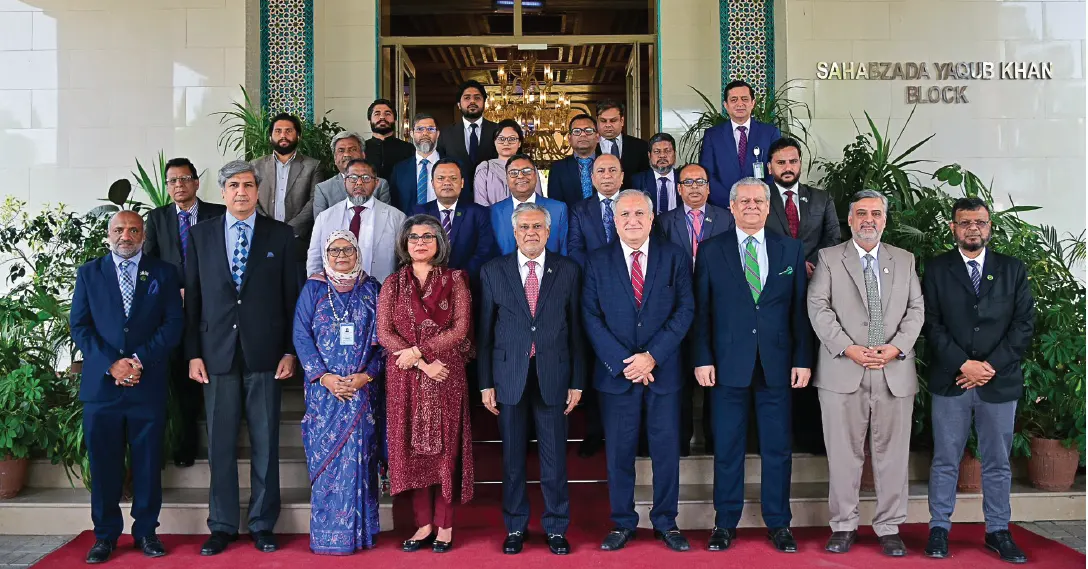
In a telling diplomatic shift, Pakistan has secured the role of hosting civil service training for Bangladeshi officials — a role long held by India. The development reflects the sharp cooling of Bangladesh-India relations following Sheikh Hasina’s ouster in 2024 and the subsequent warming of Dhaka-Islamabad ties under Muhammad Yunus’s interim government. For decades, India has reinforced its soft power in Bangladesh through institutional programmes such as civil service training. Pakistan stepping into that space is not merely a bilateral footnote — it is a signal that South Asia’s diplomatic architecture is being quietly but consequentially redrawn. Is this a temporary political adjustment in Dhaka — or the opening move in a lasting realignment that India may struggle to reverse?
SouthAsia spoke to experts to discuss how significant it is, symbolically and institutionally, that Bangladeshi civil servants are now being trained at the Civil Services Academy, Lahore, and whether this represents a genuine reconciliation of institutional memory or is primarily a transactional arrangement.
For Dr. Moonis Ahmar, former Dean of the Faculty of Social Sciences at the University of Karachi (KU), “It reflects a symbolic reconciliation between Bangladesh and Pakistan”. Noting the process got an impetus during Bangladesh’s Nobel Peace Prize-winning economist, Dr Muhammad Yunus’s time, who was the head of the country’s interim government. Yunus was sworn in as the country’s interim head after Awami League’s Prime Minister, Sheikh Hasina, was forced to quit and flee the country following violent protests, fleeing to India.
For Dr Ahmar, “The decision to send Bangladeshi civil servants to get their training in Civil Service Academy Lahore is some sort of a paradigm shift,” referring to it as a milestone, with this move being “a message to India that it (Bangladesh) is not dependent on New Delhi”. He mentioned that pre-1971, at the time of a United Pakistan, “civil servants from East Pakistan, along with their West Pakistani counterparts, were trained in Lahore”.
To hear Dhaka’s perspective, SouthAsia spoke to Dr Shahab Enam Khan, Professor, Department of International Relations, Jahangirnagar University, Bangladesh, to understand the significance of this development and the message it sends about Bangladesh’s current foreign policy priorities. “Twelve officers and a fortnight don’t change much operationally. Still, the signal is large that Dhaka is dismantling a single-vendor model of institutional dependence, not swapping one patron for another,” states Dr Khan. For him, “This isn’t Bangladesh switching partners — it’s Bangladesh ending the monopoly and expanding the knowledge and efficiency of its bureaucrats.”
One wonders whether Pakistan deliberately pursued a soft-power strategy in Bangladesh or is responding opportunistically to the vacuum left by India’s estrangement from Dhaka. “So far, yes, it’s true that Pakistan is using diplomacy, aid, trade, and things like that in order to deepen its relations with Bangladesh. Training is just one aspect of that. When Bangladeshi civil servants go to the Civil Services Academy in Lahore, it will have an impact on their mindset. For a long time, there was a downward trajectory, particularly when the Awami League was in power. Bangladesh-Pakistan relations underwent a negative transformation during that period,” Dr Ahmar, former Dean of the Faculty of Social Sciences at KU, mentions.
Highlighting the vacuum that emerged after August 2024, when the regime of Sheikh Hasina fell and she took refuge in Delhi, Dr Ahmar recalls that it was also when India-Bangladesh relations began to take a downward turn. “Pakistan’s ability to seize this opportunity, particularly by inviting Bangladeshi civil servants for training in Lahore, reflects the possibility that India may no longer enjoy a dominant position in Bangladesh,” he states.


The writer, who is based in Karachi, is a communications professional and a dedicated UN Volunteer. Feel free to reach out to her at mariaamkahn@gmail.com.
Leave a Reply