



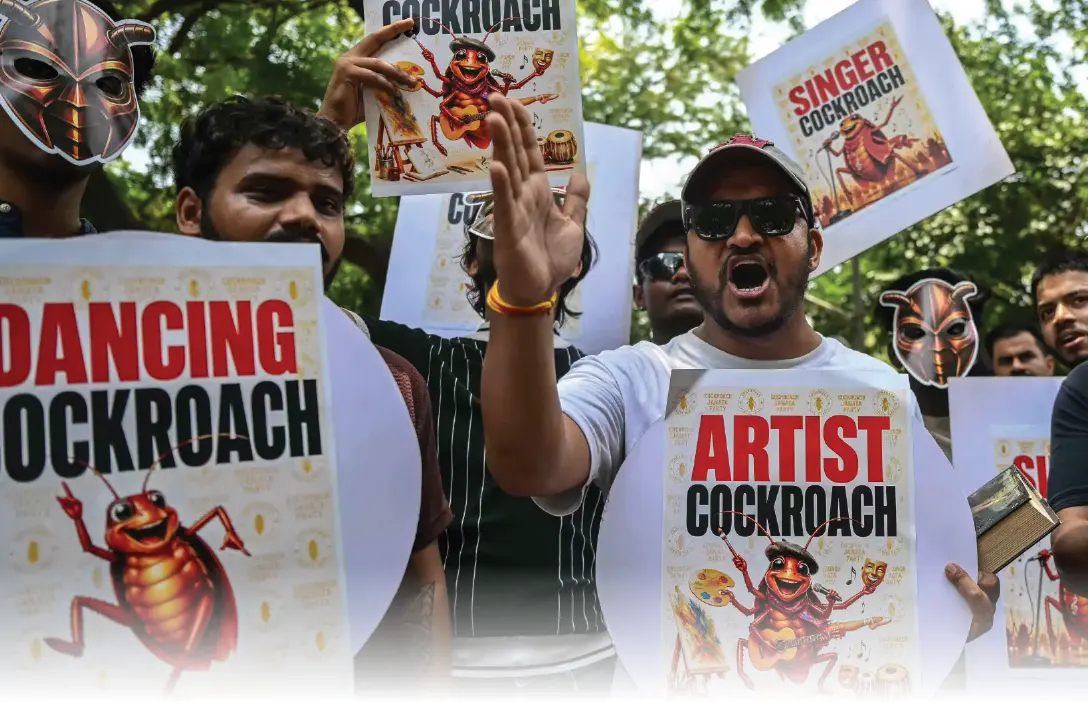
There have been various political symbols that have taken nations by storm. There have been lions, elephants, donkeys, arrows, and more. Perhaps no one would have imagined seeing a cockroach as the symbol of a political party in one of the world’s largest democracies. The origin of this party can be traced to a court hearing that soon turned into a social media highlight. It has since evolved into a political satire movement and an entity advancing with momentum.
The Cockroach Janata Party (CJP), a direct competitor and deliberate parody of the Bharatiya Janata Party (BJP), is essentially about a younger generation that feels unseen and unheard. They are also the ones who feel disconnected from traditional politics.
The controversy traces its roots to remarks made during a court hearing that many young Indians perceived as dismissive. A reference comparing certain unemployed individuals to pests quickly gained traction online, triggering criticism across social media platforms. Although an explanation was later offered to clarify the statement’s context, public reaction had already intensified. In today’s connected world, a controversial remark can spread across millions of screens within hours, often long before any clarification or correction reaches the same audience.
Amid the growing online backlash, Abhijeet Dipke, an Indian student based in the United States, decided to respond with humour. He created the Cockroach Janata Party (CJP), a satirical online movement that borrowed the language and symbolism of politics to highlight the frustrations of India’s younger generation. What began as a sarcastic social media experiment, or perhaps a reaction to public sentiment, quickly attracted thousands of followers. The self-deprecating symbol of the cockroach was embraced by thousands, then millions, of young Indians who felt overlooked by political leaders, institutions, and the system. In a matter of days, an internet joke turned into a nationwide conversation about youth unemployment, representation, and the widening gap between young citizens and traditional politics. The hashtag #MainBhiCockroach began trending across social media. However, beneath the jokes lies a serious story.
The popularity of the CJP reveals something that governments across South Asia should pay close attention to: the growing frustration of young people and their urge to present their concerns to those in power. India is often regarded as one of the world’s fastest-growing economies. Yet economic growth does not automatically remove anxiety. Millions of educated young people continue to struggle with unemployment, rising living costs, and uncertainty about the future.
For many graduates, a university degree no longer guarantees a stable career.
This is not a problem unique to India. In Pakistan, we hear similar concerns. Students spend years pursuing degrees, investing their families’ savings and hopes, only to enter a job market that offers limited opportunities. Many young people find themselves overqualified, underemployed, or unemployed altogether. The result is a growing sense of frustration, with no clear resolution in sight.
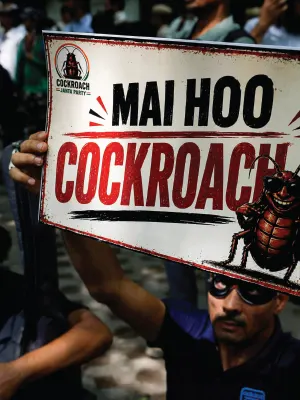 Traditional political parties often speak about youth, but few genuinely engage them. This is perhaps why the Cockroach Janata Party resonates with so many young Indians. It communicates in a language that younger generations understand. It uses humour instead of speeches, memes instead of manifestos, and social media posts instead of political rallies. Some critics dismiss it as political theatre, while others argue it is simply a digital extension of opposition politics. There may be some truth in both claims.


Based in Karachi, the author is a novelist and science fiction writer. He has a special interest in the social and political affairs of South Asia and can be reached at omariftikhar82@gmail.com
Leave a Reply