



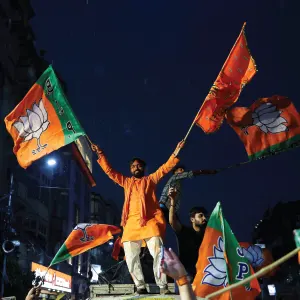
A truly multiparty political culture is the bedrock on which an inclusive, pluralistic, and progressive democracy is erected and thrives. Societies open to participatory political culture evolve along sustainable democratic pathways and yield invaluable socio-economic, political, and intellectual capital. However, those where democracy is increasingly threatened by exclusion, intolerance, and aggressive nationalism risk not only the hard-won gains of democratic consolidation but also the very foundations of inclusive governance. India, proud of being the world’s largest democratic polity, is increasingly regarded with skepticism for its gradual, systematic, and institutionalized drift toward a one-party political culture.
For over seven decades after partition, the idea of a one-party state in India was considered a constitutional impossibility. India’s demographic dynamics and political DNA — fractured by caste, language, region and religion — seemed hardwired against the kind of centralized hegemony found in more homogeneous political systems. Yet, following the BJP’s consolidation across multiple state elections and the political realignments of the past decade, that assumption is being seriously tested. Though the BJP may claim popular trust on the strength of its overwhelming electoral mandate, exploiting that mandate to consolidate political power — at the cost of India’s historically inclusive political legacy — rarely bodes well for the governed.
The BJP’s expanding dominance across states reflects a deepening of its political organization and signals an increasingly centralized decision-making culture. The opposition — the soul of any democratic political culture — is being steadily marginalized from mainstream politics. Political dissent is increasingly cast in anti-national colors; national institutions are being brought progressively under executive command; and financial and organisational resources are deployed to limit the opposition’s political viability — all of which raise serious questions about the future of multiparty democratic discourse in India.
The mechanisms of this hollowing-out are neither abstract nor invisible. The Electoral Bond scheme — introduced in 2017 and struck down by the Supreme Court as unconstitutional in February 2024 — enabled anonymous corporate donations to political parties on a massive scale, with the BJP emerging as by far its largest beneficiary; data later revealed that electoral bonds worth approximately Rs 16,518 crore were encashed by political parties, with disclosure deliberately stripped from the process. Simultaneously, the Enforcement Directorate has been deployed with conspicuous selectivity: since 2014, of 121 political leaders investigated by the ED, 115 belonged to opposition parties — a pattern so stark that fourteen opposition parties petitioned the Supreme Court in 2023 over its alleged misuse.
Also, Delhi Chief Minister Arvind Kejriwal was arrested by the Enforcement Directorate just weeks before the 2024 general elections. He wasn’t alone—several sitting chief ministers from opposition parties found themselves in the crosshairs of central agencies during that period. On the press freedom front, India ranked 157th out of 180 countries in Reporters Without Borders’ 2026 World Press Freedom Index. The report pointed to a growing concentration of media ownership in the hands of big conglomerates seen as close to the ruling party. A big flashpoint was the Adani Group’s acquisition of NDTV in 2022, which many critics called the final nail in the coffin for independent mainstream television news.


The writer, who is based in Kandhkot in Sindh, is a passionate freelance journalist. He can be reached at alihassanb.34@gmail.com.
Leave a Reply