

New Delhi
With Tehran or Tel Aviv?
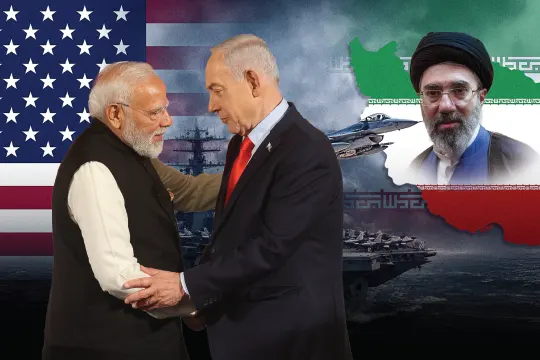
India’s strategic silence regarding the Iran-U.S. conflict does not represent neutrality. Rather, it constitutes a strategic abdication concealed under the guise of diplomacy.

International politics has never been governed by emotion, morality, or historic friendship alone. Nations ultimately act in accordance with their strategic interests, economic priorities, and long-term geopolitical calculations. Yet there are moments in history when silence itself becomes a statement. India’s muted response during the recent Iran–U.S.–Israel tensions was one such moment — a moment that exposed the complex and often transactional nature of international alliances.
For decades, India cultivated exceptionally close relations with Iran. The two countries expanded trade, cooperated in energy projects, developed the Chabahar Port, and frequently projected themselves as strategic partners in Asia. India often portrayed Iran as a gateway to Central Asia and as a civilizational partner with whom it shared centuries of interaction through commerce, language, and regional diplomacy. Yet when Iran found itself under severe military and diplomatic pressure amid escalating confrontation involving the United States and Israel, India’s response remained cautious, restrained, and almost invisible.
This silence has raised an important geopolitical question: was India exercising strategic neutrality, or quietly abandoning a long-standing partner in favor of a broader strategic alignment with Washington and Tel Aviv?
To understand this situation properly, one must examine India’s foreign policy tradition not merely through official statements, but through historical conduct. Indian diplomacy since independence has consistently displayed one defining characteristic: the ability to align itself with stronger or strategically useful powers whenever its national interests demanded it. Whether dealing with neighboring countries, regional powers, or global superpowers, India has repeatedly demonstrated a willingness to reshape partnerships in response to evolving strategic needs.
Historically, India projected itself as a leader of the Non-Aligned Movement during the Cold War. Officially, it claimed neutrality between the Western bloc led by the United States and the Soviet bloc led by Moscow. However, in practice, India gradually tilted towards the Soviet Union, particularly after the 1960s. Moscow became India’s principal supplier of arms, diplomatic cover, and political support. During the 1971 India-Pakistan War, Soviet backing proved crucial for India, especially when the United States openly leaned towards Pakistan.
This was one of the earliest major examples of India’s pragmatic foreign policy. Ideology was secondary; strategic advantage came first.
After the collapse of the Soviet Union, India rapidly adjusted its orientation. The same India that once criticized Western influence began building deeper military, economic, and technological ties with the United States. Over the past two decades, India has emerged as one of Washington’s closest strategic partners in Asia. Defence agreements, intelligence sharing, nuclear cooperation, and Indo-Pacific security arrangements brought the two countries into unprecedented proximity.
Simultaneously, India also developed exceptionally close ties with Israel. This relationship expanded far beyond agriculture or technology into defence cooperation, intelligence coordination, and security collaboration. Israel became one of India’s largest suppliers of sophisticated weaponry, surveillance systems, and military technologies. Indian leaders who once cautiously avoided visible proximity with Israel began openly embracing the partnership.
In international politics, such shifts are not unusual. States evolve according to interests. However, the Iranian case appears particularly striking because of the depth of India’s earlier engagement with Tehran.
For years, India invested enormous diplomatic energy in strengthening relations with Iran. The Chabahar Port project was repeatedly presented as a symbol of India-Iran friendship and strategic cooperation. Energy imports from Iran formed a vital component of India’s economic planning. High-level visits, trade agreements, and regional connectivity projects created the impression of a durable partnership.
Yet critics, especially in Pakistan, have long argued that India’s outreach towards Iran was never purely economic or cultural. According to this perspective, India viewed Iran primarily through the prism of Pakistan. Since India lacked direct land access to Afghanistan and Central Asia due to Pakistan’s geography, Iran became strategically valuable as an alternative route. Chabahar Port was often discussed in contrast with Pakistan’s Gwadar Port, symbolizing a wider regional rivalry.
Within Pakistan’s security discourse, there has also been a persistent belief that Indian intelligence networks exploited Iranian territory to destabilize Pakistan’s western regions, particularly Balochistan. Pakistani authorities have repeatedly accused India’s intelligence agency, RAW, of supporting separatist elements and conducting covert operations through Iranian soil. The arrest of Kulbhushan Jadhav in 2016 significantly intensified these accusations. Pakistan claimed Jadhav operated from Iran to coordinate sabotage and insurgent activities inside Balochistan.
India may walk beside its partners in times of opportunity, but when storms arrive, it does not hesitate to walk away
Whether every allegation can be independently verified or not, the perception itself has profoundly shaped Pakistani strategic thinking. Many in Pakistan came to view Indo-Iranian closeness not merely as diplomacy but as part of a larger geopolitical effort aimed at surrounding Pakistan from both the eastern and western fronts. This context makes India’s recent silence on Iran even more revealing.
When tensions escalated involving Iran, the United States, and Israel, much of the world expressed concern regarding civilian casualties, regional instability, and the risk of a broader Middle Eastern war. Several countries called for restraint, ceasefire, and diplomatic engagement. Yet India, despite its long association with Iran, remained remarkably restrained.
There were no major diplomatic initiatives led by New Delhi. No visible attempts to mediate. No aggressive advocacy on behalf of Tehran in international forums. India appeared careful not to offend either Washington or Tel Aviv.
This cautious behaviour reflects far more than diplomatic balance; it exposes the selective morality that has increasingly come to define Indian foreign policy. For decades, India projected itself before Iran as a dependable friend, strategic partner, and trusted regional stakeholder. Yet the moment Iran faced military pressure and international isolation, India retreated into silence to safeguard its own equations with Washington and Israel. The contradiction could not have been more glaring.
India enjoyed the benefits of friendship with Iran for years — discounted oil, strategic access through Chabahar, regional leverage against Pakistan, and economic cooperation — but when the time came to politically support Tehran during one of the gravest crises in the region, New Delhi chose convenience over commitment. This was not neutrality; it was calculated abandonment disguised as diplomacy.
The episode has once again exposed a recurring pattern in Indian foreign policy: relationships are nurtured enthusiastically as long as they serve Indian strategic objectives, but the same relationships are quietly sacrificed when larger powers exert pressure or when India’s own interests are at stake. History shows that India has repeatedly adjusted its loyalties in response to shifting geopolitical winds while continuing to publicly speak the language of principles, friendship, and strategic autonomy.
What makes the Iranian case particularly significant is the sheer contrast between rhetoric and conduct. India had spent years cultivating Iranian trust and presenting itself as a reliable regional partner. Yet during the conflict, New Delhi neither exercised diplomatic initiative nor attempted to leverage its close ties with Washington and Tel Aviv to reduce tensions or advocate meaningful restraint. A country that often claims aspirations for global leadership appeared unwilling even to defend politically a partner with whom it had enjoyed decades of strategic cooperation.
Ironically, while India remained hesitant and passive, Pakistan appeared far more active diplomatically in advocating de-escalation and dialogue. Islamabad repeatedly emphasized ceasefire efforts, regional stability, and diplomatic engagement. This created an extraordinary geopolitical contrast: the country often portrayed by India as regionally isolated appeared more willing to engage diplomatically for peace than India itself was, despite India’s far deeper economic and strategic ties with Iran.
For many observers across the region, this crisis became an eye-opening moment. It demonstrated that India’s much-advertised strategic partnerships may ultimately rest less on loyalty or mutual trust and more on temporary convenience and geopolitical utility. Countries that today consider India a close partner may also wonder tomorrow whether New Delhi would stand beside them during difficult times or quietly distance itself once circumstances become uncomfortable.
The Iranian episode therefore goes beyond a single regional conflict. It exposes the deeper duality within Indian foreign policy — a policy that frequently speaks in the language of moral leadership while operating strictly through selective pragmatism and self-interest. India expects diplomatic understanding for its own security concerns, yet often fails to extend the same political courage when its partners face existential crises.
India’s silence during the Iran conflict is not merely a diplomatic choice; it is a geopolitical revelation. It reveals the limits of India’s proclaimed strategic loyalty, the fragility of partnerships built primarily around utility, and the uncomfortable reality that in moments of serious international confrontation, New Delhi’s first instinct is not solidarity with friends but preservation of its own strategic comfort.
For Iran and many other countries watching this crisis unfold, the message was unmistakable: India may walk alongside its partners in times of opportunity, but when storms arrive, it does not hesitate to walk away.
Based in Lahore, the writer is a historian and a critical analyst. He can be reached at arslan9h@gmail.com


Leave a Reply