


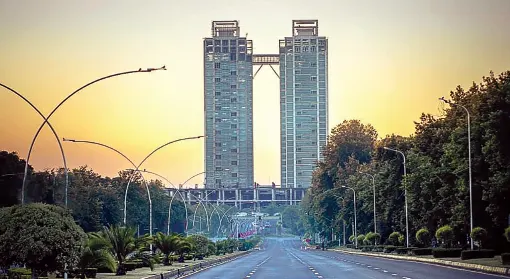
The controversies surrounding One Constitution Avenue and the demolitions around Bari Imam shrine in Islamabad have evolved into a powerful symbol of inequality in urban governance, exposing stark contrasts in how the state treats the powerful and the vulnerable. Together, they have become defining test cases of legality, governance, and equality before the law in Pakistan’s federal capital.
At the center of the One Constitution Avenue controversy lies a two-decade-long legal, financial, and political saga surrounding BNP Group’s luxury twin-tower project built on 13.5 acres of prime land in Islamabad’s Red Zone. Originally leased for the construction of a five-star hotel, the project allegedly transformed into a high-end residential complex comprising more than 250 apartments. This triggered repeated lease cancellations, court interventions, allegations of regulatory violations, financial defaults, and unauthorized land-use conversions. The controversy deepened further amid reports that apartments had been sold to influential figures, including politicians, senior bureaucrats, and members of the judiciary.
The issue regained national attention on May 1, 2025, when the Capital Development Authority (CDA), acting on an Islamabad High Court verdict, initiated evacuation proceedings against residents of One Constitution Avenue. Authorities argued that developer M/s BNP (Private) Limited had violated lease conditions by converting a hotel project into residential apartments while failing to meet its financial obligations over several years.
Yet as the evacuation operation commenced, Prime Minister Shehbaz Sharif intervened, suspended the operation, and constituted a high-level committee headed by Law Minister Azam Nazeer Tarar to review the matter, hear all stakeholders and submit a comprehensive report with recommendations. The committee subsequently recorded statements from CDA officials and residents, while the final report remains pending.
The Prime Minister’s intervention may have appeared to be a routine administrative pause had it not coincided with the CDA’s demolition campaign around the historic Bari Imam Shrine area, particularly in Noorpur Shahan and adjoining settlements. Authorities maintained that the operation aimed to reclaim encroached state land and implement urban renewal plans. But for thousands of residents, the operation unfolded through bulldozers tearing through homes, shops, and historic marketplaces with little meaningful consultation, minimal procedural safeguards, and no high-level review committees to hear their grievances.
The contrast was difficult to ignore.
While affluent apartment owners in Islamabad’s most high-security zone received legal hearings, political intervention, and administrative relief, working-class communities around Bari Imam faced swift demolitions, displacement, and arrests. Clashes erupted between residents and authorities, leaving injuries, detentions, and widespread insecurity in their wake.
Particularly painful was the demolition of the historic Noorpur Shahan bazaar, a marketplace that for generations had served pilgrims visiting Bari Imam Shrine and sustained hundreds of families connected to the local religious economy. Its demolition disrupted not only commerce but also a longstanding social and cultural ecosystem deeply embedded in the area’s identity.
For many observers, the juxtaposition of these two episodes reflects more than an urban planning dispute. It has come to symbolize selective enforcement of law, urban mal-governance, class privilege, and the unequal realities of citizenship in Pakistan. Legality appears negotiable when elite interests are involved but uncompromising when applied to the poor.


The writer is an advocate of the high court based in Islamabad and a human rights lawyer. He can be reached at adv.wajahat.ali@gmail.com
Leave a Reply