



NAPA Celebrates Independence Day
with ‘Rang-e-Watan’
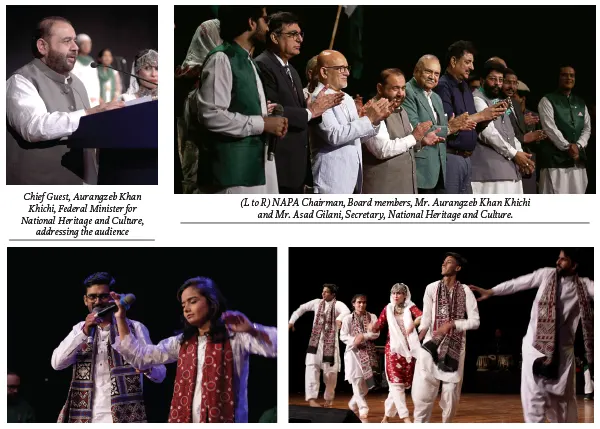
The National Academy of Performing Arts (NAPA) celebrated Pakistan’s 79th Independence Day with a special musical programme, “Rang-e-Watan,” highlighting the country’s rich cultural heritage and diversity.
Held at NAPA’s Zia Mohyeddin Theatre, the event brought together musicians, students, faculty members, and distinguished cultural figures for an evening dedicated to celebrating freedom through music and the performing arts.
The programme featured vibrant musical performances by NAPA’s music faculty and students, showcasing the cultural traditions and regional sounds of different parts of Pakistan. Through a blend of music and artistic expression, “Rang-e-Watan” underscored the diversity that forms an important part of the country’s cultural identity.
NAPA Chairman Syed Jawaid Iqbal, members of the academy’s board, and other prominent cultural personalities attended the event. Their presence reflected the institution’s continuing commitment to promoting Pakistan’s artistic traditions and providing a platform for emerging performers.
The celebration also highlighted the role of the arts in bringing people together and strengthening appreciation for the country’s diverse cultural landscape.
With its focus on regional music and artistic expression, “Rang-e-Watan” offered audiences an opportunity to mark Independence Day while celebrating the many cultural voices that contribute to Pakistan’s national identity.
The event reaffirmed NAPA’s role in preserving and promoting the country’s performing arts and nurturing young artistic talent.
Pakistan sits on $7tr mineral trove, claims planning minister
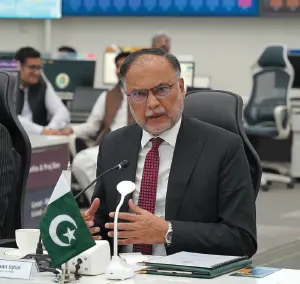
Pakistan’s Planning Minister Ahsan Iqbal has claimed that Pakistan estimates its mineral endowment at more than $7 trillion.
Ahsan Iqbal made these remarks in a conversation with Farwa Amin, director for South Asian initiatives at the Asia Society Policy Institute in New York. The minister said large-scale mining operations require substantial up-front investments and lengthy gestation periods, and the country’s volatile political climate is a primary deterrent to international resource developers.
He said that with improved macroeconomic stability, the government was actively courting foreign partners, including US firms, through mechanisms such as the memorandum of understanding with US Strategic Metals, potential EXIM financing and participation in critical-minerals ministerial processes.
Bangladesh to ‘positively’ consider joining Makkah pact
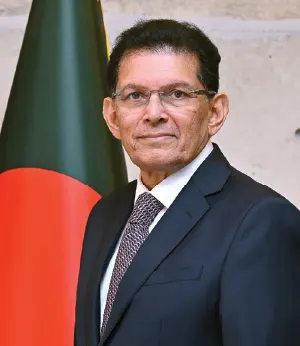
Bangladesh would consider joining the Makkah pact “positively” if invited by founding members, Foreign Minister Khalilur Rahman told parliament.
“Joining the pact or not has not come yet, as it is subjected to the intention of the parties involved in the pact. If they invite Bangladesh to join, then we will definitely consider it positively,” the foreign minister said, assuring parliament that Dhaka would assess the potential benefits before making any decision to join.
“More importantly, we have to keep in mind that it [the Makkah pact] is the Muslim world’s self-defence mechanism,” he added. “And this is our family’s, the Muslim family’s, internal matter. So, there is nothing for others to be concerned about.”
Separately, opposition leader and Bangladesh Jamaat-i-Islami Emir Shafiqur Rahman said that joining the Makkah pact was Bangladesh’s “own decision”. “If Bangladesh takes a decision in the interests and needs of the country and nation, no one else needs to worry about it,” he said in a statement on Facebook.
Nearly 400 dead, 1,400 missing as floods hit Nepal-Tibet border

Nepal’s death toll from devastating flash floods and landslides has reached 392, with more than 1,400 people missing. Rescue teams, soldiers and volunteers are searching devastated villages under dangerous conditions. The disaster was reportedly triggered by a glacial collapse, sending a massive torrent of water, ice and rock through mountain valleys. Authorities fear newly formed lakes could burst, causing further flooding. Hundreds of foreign visitors, including trekkers and pilgrims, remain missing.
50 Years of Beyond the Last Mountain: Still Relevant
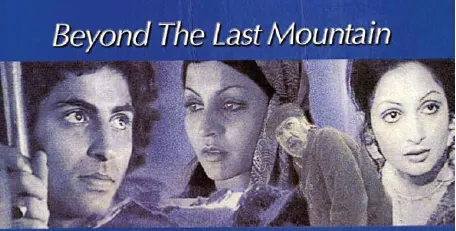
Beyond the Last Mountain, released in 1976, is a Pakistani English-language film written, produced and directed by Javed Jabbar. It was Pakistan’s first and, to date, only English-language feature film, and was shown at the first Bombay International Film Festival in 1976. It was also released in an Urdu version under the title Musafir. The film was recently screened privately in Karachi to mark 50 years since its release. Fifty years after its debut, Beyond the Last Mountain remains one of Pakistan’s most haunting films.
Set in the early 1970s, the film follows Hamid Ahmed, a young upper-class man who returns to Karachi after his father—who is shown as having taken tentative steps into politics—is assassinated by a vengeful political leader. Hamid’s search for his father’s killer gradually becomes a deeper quest to understand his father, himself and the country around him.
But the film is not simply a murder story. Beneath the central plot lies an exploration of class, a society in transition, and the political and social upheaval of post-1971 Pakistan. One of the film’s most striking sequences comes during what appears to be a flower show or exhibition attended by members of Karachi’s upper class. With no dialogue or clear explanation of their motives, a group of apparently politically connected thugs enters the exhibition and proceeds to destroy the flowers, vases and elaborate floral arrangements. The sudden intrusion of violence into what appears to be a genteel upper-class space becomes a metaphor for a society whose old certainties are being disrupted.
The film also looks into the worlds of factories, labour and politics, making clear that the concerns of its characters extend beyond the relatively privileged milieu in which much of the story is initially located. For a film in English, and one centred on an affluent social class, it could easily have retreated into a safe and insular world. Instead, Beyond the Last Mountain uses that setting to examine wider tensions in a changing Pakistan.
Bangladesh to buy Chinese J-10 jets

Bangladesh has confirmed a deal to purchase China’s 4.5-generation J-10CE fighter jets, citing the aircraft’s reported combat performance against French-made Rafale jets during the brief Pakistan-India conflict last year.
The Chengdu J-10C is a single-engine, multirole combat aircraft manufactured in China. Boasting a top speed of Mach 1.8, it can be fitted with a variety of air-to-air and air-to-ground munitions. It played a key role on the first night of hostilities, shooting down six jets belonging to the Indian Air Force.
The Information and Broadcasting Adviser to the Prime Minister of Bangladesh Zahedur Rahman said earlier that a draft proposal to buy the jets had been submitted to the country’s finance ministry and Armed Forces Division for final approval.
The draft proposal includes the purchase of Chinese attack helicopters, VIP transport helicopters and drones. Rahman said Bangladesh “paid attention” to the war last year, when Pakistan used J-10 fighters and PL-15 long-range air-to-air missiles to shoot down Indian Rafales.
Pakistan assumes presidency of UN Conference on Disarmament

Pakistan has assumed the presidency of the UN Conference on Disarmament in Geneva, taking the rotating chair at a time of heightened global tensions over nuclear weapons and arms races.
The CD is the world’s sole multilateral disarmament negotiating forum, and Pakistan’s turn at the helm puts Islamabad in a central diplomatic role. Foreign Office officials said Pakistan will focus on “non-discrimination, equal security, and dialogue” during its presidency.
The agenda is expected to include discussions on a fissile material cut-off treaty, prevention of an arms race in outer space, and negative security assurances.
Given Pakistan’s own nuclear status and its concerns over regional strategic balance, its leadership of the forum will be closely watched by India, China, and Western states. The presidency also gives Islamabad a platform to highlight Kashmir, conventional arms imbalances, and the need for restraint in South Asia.
Google finally opens shop in Pakistan

After years of speculation, Google has officially opened operations in Pakistan. The tech giant’s local presence means businesses, developers, and freelancers will now have direct access to support, billing, and enterprise services without routing everything through Dubai or Singapore.
For Pakistan’s booming freelance and IT export sector, this is a big achievement. Companies dealing with Google Ads, Cloud, and Workspace can now expect local invoicing in PKR, faster customer support, and compliance with local regulations. Industry leaders say it signals confidence in Pakistan’s digital economy despite ongoing challenges with internet stability and policy consistency.
The announcement comes as Pakistan pushes to grow IT exports past $3.5 billion. Having Google on the ground could also help with training programs, startup incubation, and cloud adoption for banks, telcos, and government projects. However, experts caution that one office won’t fix structural issues like payment gateways, data localization rules, and digital taxation.
Foreign Food Firms Post Sales Growth

Major food companies operating in Pakistan recorded strong sales growth during the first half of 2026 despite geopolitical tensions, rising fuel costs and pressure on profitability.
Nestlé Pakistan reported net sales of Rs107 billion for January-June, up 5.7 per cent year-on-year, while profit after tax (PAT) declined 4.3pc to Rs9.9bn. The company attributed the sales growth to brand investment, consumer-focused innovation, improved market execution and disciplined pricing.
FrieslandCampina Engro Pakistan Limited (FCEPL) posted a 12.1pc increase in revenue to Rs60bn from Rs52.5bn a year earlier. Efficiency measures across sourcing, manufacturing and distribution helped expand gross margins by 350 basis points and operating profit by 54pc.
However, FCEPL said that shipment delays, higher freight charges, and fuel price volatility continued to affect its supply chain. It also noted that the packaged milk market remained under pressure following the 18pc sales tax imposed on UHT milk in 2024.
Fauji Foods Limited recorded its highest-ever first-half revenue of Rs12.77bn, representing 12.6pc growth. However, its PAT fell to Rs560 million from Rs734m a year earlier.
The companies maintained cautious outlooks for the remainder of 2026, citing geopolitical uncertainty, inflation, energy costs and subdued consumer demand.
Bangladesh elects ruling party’s Alamgir as president
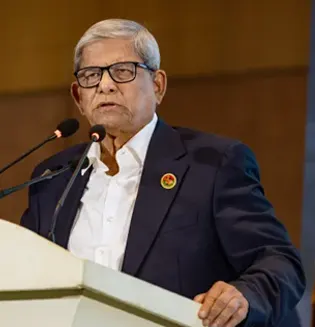
Bangladesh’s parliament has elected veteran Bangladesh Nationalist Party leader Mirza Fakhrul Islam Alamgir as the country’s new president. The vote on 21 Aug 2026 marks a major political transition after the BNP came to power following recent elections. Alamgir, a long-time opposition figure and senior party stalwart, will now head the state in what many analysts are calling a symbolic reset for Bangladeshi politics. The presidency in Bangladesh is largely ceremonial, but the choice of Alamgir carries weight given his decades in opposition politics and his close association with BNP leadership. His election comes at a time when the country is navigating economic challenges, democratic reforms, and public expectations for stability after years of turbulence. Party officials hailed the decision as “a victory for democracy and continuity,” while critics will be watching how the new president balances constitutional duties with the BNP’s political agenda.
Nepal PM allowed to wear sunglasses in parliament

Nepal’s Prime Minister Balendra Shah may keep his signature dark sunglasses on in the legislature due to medical reasons.
The rapper-turned-politician better known as “Balen” has rarely been seen in public without his trademark rectangular shades. The 36-year-old premier has been seen wearing them everywhere from campaign rallies to official engagements and even in his formal portrait after taking office in March.
Earlier this month, Speaker Dol Prasad Aryal advised against wearing dark glasses in the chamber, citing public criticism that such eyewear is out of place in the national legislature.
Unique story collection launched
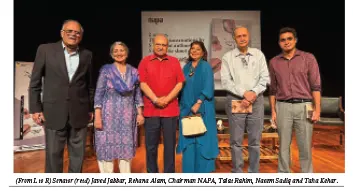
A rare literary collaboration bringing together five acclaimed Pakistani writers to tell different stories centred on the same two characters was unveiled at the National Academy of Performing Arts (NAPA).
Titled Zareena and Abid: Two Characters, Five Authors, Five Stories, the book features five original short stories by Senator (retd) Javed Jabbar, Naeem Sadiq, Rehana Alam, Taha Kehar and Talat Rahim. Each author interprets the same two characters in a distinct way, offering readers five contrasting narratives shaped by individual writing styles and perspectives.
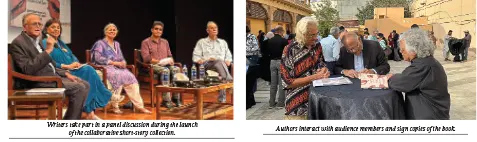
The launch, held at NAPA’s Zia Mohyeddin Theatre, included a panel discussion in which the writers reflected on the creative process behind the project and explained how they approached the shared theme.
Naeem Sadiq revealed that the idea originated with Javed Jabbar, who invited the four writers to lunch before proposing the collaborative project. Calling it a creative challenge, Sadiq said all the authors readily accepted.
Discussing his contribution, Change the Story, Sadiq said he had initially planned to write about a prominent individual. However, after spending nearly 25 minutes waiting alongside the person’s security guard, he became more interested in the guard’s life than that of his employer, inspiring an entirely different story.
Talat Rahim said writing within the framework of an assigned concept was unfamiliar to her, as she usually drew inspiration from personal ideas rather than prompts. Seeing “a girl and a boy” as the foundation of the project, she chose to write a romance, adding that unlike many of her previous works, her story ends on a hopeful note.
Taha Kehar, the youngest contributor to the collection, said the title of his story, The Understudy, came to him before the plot itself. He explained that he preferred exploring characters instead of creating conventional heroes and villains, making Zareena the emotional centre of his narrative.
Rehana Alam’s contribution revisits the 1947 Partition, focusing on the human cost of migration. She said the story was inspired by the experiences of families who moved to Pakistan during Partition and aimed to highlight both the suffering and resilience that shaped the country’s early years.
Closing the discussion, Javed Jabbar described South Asia as home to some of the world’s finest short story traditions. Explaining his own interpretation, he said he imagined Zareena and Abid as unborn twins communicating inside their mother’s womb,
deliberately removing external influences and relying instead on silence and unspoken emotions to drive the narrative.
During the event, each author read excerpts from their work before audience members joined an interactive question-and-answer session.
Leave a Reply