



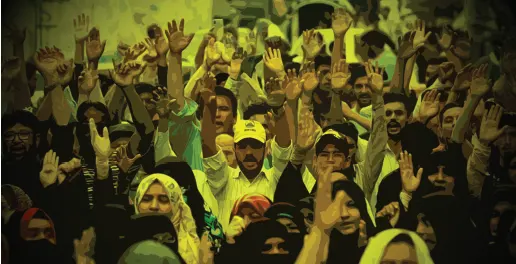
Across South Asia, a younger generation is testing the durability of political systems built long before it came of age. Bangladesh offered the most dramatic example: student protests over government employment quotas expanded into a national uprising that, in 2024, helped bring an apparently entrenched government to an abrupt end. In India, generational dissatisfaction has followed a less revolutionary trajectory, finding expression through elections, protests and an irreverent digital political culture increasingly willing to ridicule the solemnities of traditional politics. The emergence of the satirical “Cockroach Janata Party,” and the remarkable attention it attracted online, is instructive less as a conventional political success than as evidence of something broader: younger citizens no longer believe political participation must occur exclusively through the vocabulary or institutions inherited from previous generations.
Pakistan possesses many of the same ingredients: an overwhelmingly young population, pervasive economic anxiety, digital connectivity and a generation whose relationship with authority has been transformed by social media. Yet the question is no longer simply whether Pakistan is approaching its own Gen Z movement, for it may already be experiencing one. The more consequential question is why generational discontent here has struggled to produce the political consequences witnessed elsewhere.
The answer lies partly in the peculiar architecture of the Pakistani state.
Pakistan’s constitutional order is parliamentary, yet its political history has produced overlapping centers of authority whose boundaries have rarely remained entirely distinct. Governments hold office, Parliament legislates, and elections confer formal democratic legitimacy, but consequential questions of political stability, foreign relations and national security have historically involved institutions extending beyond the civilian sphere. The result is a political arrangement whose formal structure does not always explain where influence begins and ends.
For younger Pakistanis, this creates an unusually complicated paradox. Institutions associated with the protection and continuity of the state also occupy an exceptional place within its political history. Criticism consequently enters difficult territory: where does scrutiny of institutional influence end and hostility towards institutions of national security begin? How does a democratic society debate the appropriate distribution of power when questions of political authority can so easily become entangled with questions of patriotism and security?
This is where comparisons with Bangladesh become considerably less straightforward. Bangladesh demonstrated that mass mobilization can overwhelm an authoritarian civilian government when other institutions of the state ultimately decline to preserve the political status quo at any cost. Pakistan’s institutional history is more entangled. The institutions capable of containing political upheaval are inseparable from the broader architecture through which stability and national security have historically been understood. A movement challenging the political status quo therefore encounters a peculiar dilemma: the structure it seeks to contest overlaps with the structure charged with protecting the state itself.
That is the central contradiction of Pakistan’s Gen Z moment.
It also predates the current confrontation surrounding Imran Khan. The PPP carries its history of confrontation with military government; the PML-N fashioned part of its modern identity through Nawaz Sharif’s battles over civilian authority; and PTI, once accused by opponents of benefiting from institutional favor, subsequently found itself confronting many of the same constraints its rivals had previously described. Pakistan’s political parties have alternated between challenging the prevailing configuration of power and accommodating it when circumstances proved advantageous. Governments change, alliances reverse, and political protagonists exchange positions, and yet, the underlying argument over the boundaries of civilian authority persists.
Generation Z did not invent that argument; it inherited it with a smartphone.
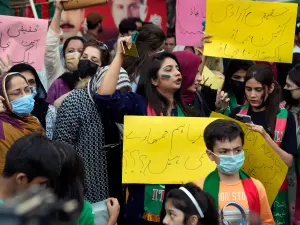 Political arrangements once interpreted through newspapers, television anchors and party intermediaries are now examined instantaneously by millions of people. TikTok, X, Instagram and YouTube have made younger Pakistanis participants in political narration rather than passive consumers of it. Speeches are archived, contradictions juxtaposed, restrictions circumvented and official explanations subjected to relentless public scrutiny. Authority has not necessarily become weaker, but the ability to control how authority is perceived has.


Based in Islamabad, the writer holds an undergraduate degree in Literary Studies from Eugene Lang College of Liberal Arts at The New School and an MPhil in South Asian Studies from the University of Cambridge. She can be reached at fathimahsheikh@gmail.com
Leave a Reply