


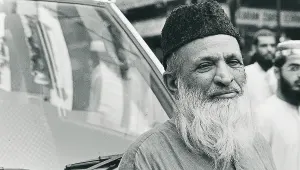
It was a hot, sultry night when my friend Saleem called to say his uncle had died in a small hospital in Gulshan‑e‑Iqbal. The man had no family, no one to claim him, so we turned to Edhi Trust. By the time we reached the centre, it was close to 2 a.m. Inside, Mr. Edhi sat in his bare office — a wooden table, a chair, and piles of files he was quietly working through. He heard us out, instructed his team, and within no time, the body was brought in and the formalities completed. Even at that hour, dignity moved at his pace.
Edhi was kind to society in a surreal way, for he turned his belief into a reality by providing support to the weak in Pakistan. The man himself had nothing to leave behind but an example for others to follow, denouncing kindness as a subjective concept. Possessing two pairs of clothes, he lived like a mere traveller in this world in a room that comprised a bed, which had surrendered to the weight of time long before he did. His ambulance bore more dents than paint, but it served its purpose faithfully.
Born in Bantva in 1928, the man people remember most began his career in Karachi after the partition of the subcontinent. With nothing except the trauma and grief of his mother’s death, he arrived in Karachi with a mindset to save lives. He opened a tiny dispensary and sat on the pavement with a donation box that had seen better days. He bought a used ambulance. And then the city began sending him its wounded — the abandoned, the sick, the ones no one wanted to claim.
In 1957, when Karachi was devastated by the Asian flu, Edhi expanded his services, guided by a philosophy of helping others. That epidemic made him inevitable, for it became a voice for the unwanted in a city gripped with crisis. The Edhi Foundation grew the way living things do through experiences: unevenly and exponentially. From shelters, clinics, and orphanages to kitchens and rehab centres, Edhi built a strong foundational support.
People turned to him when they had no one else. He served humanity in a way that made others ashamed. I, for one, found it formidable, for no one stood for the individuals whose minds had broken under the weight of their own lives. His life was a testament to this belief that humanity is the only religion worth practicing, emphasizing, through his actions, a daily, exhausting discipline.
He was honoured with awards such as the Magsaysay Award, the Lenin Peace Prize, and the Nishan-e-Imtiaz, and accepted them politely without ceremony. The year 2016 marked a turning point for the nation. Edhi departed the world with one last act of service. His corneas were donated to two individuals. It was a gesture that carried forward his legacy, reminding the country that his spirit of giving did not end with his passing. Edhi wasn’t larger than life because he towered over it. He was larger than life because he kept bending down to lift, to clean, to carry — until the very end. 

Khalid Salamat is a Pakistani writer based in Dubai whose work explores quiet courage, memory, and character across fiction and nonfiction. His books include Larger than Life, Blossom in the Dust, and The Faded Portrait. Learn more at: https://theuntoldstory.co/
Leave a Reply