



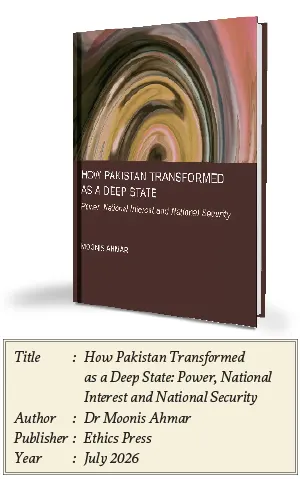
What are the factors that have caused Pakistan to fall behind its peers economically, socially and technologically? Why has a culture of political pluralism failed to emerge in the country? Professor Dr Moonis Ahmar’s book, How Pakistan Transformed as a Deep State: Power, National Interest and National Security, attempts to answer these pertinent questions in depth. It critically analyses the dominance of unelected power centres over democratic institutions and decision-making in the country, while providing a framework for examining the relationship between power, security and the Pakistani state.
What makes the book particularly valuable is Dr Moonis Ahmar’s academic and professional credentials. He is Professor of International Relations at the University of Karachi, Director of its programme on Peace Studies and Conflict Resolution, and a well-known author and columnist.
Ahmar contends that Pakistan’s transformation into a “deep state” requires closer examination and cannot be attributed solely to prolonged periods of military dictatorship. Instead, he traces it to a historical process in which the military, bureaucracy and feudal elites collaborated to form what he describes as a “triad of power”. This, in turn, contributed to the fragility of political parties, corruption, nepotism, poor governance and the erosion of institutions.
What led the deep state to take root in Pakistan? Ahmar argues that it developed through the weakness of civilian institutions and the inability of elected governments to exercise effective civilian control over strategic decision-making. The book’s central thesis is that Pakistan’s political problems stem from a durable power structure involving the military, bureaucracy, intelligence and security establishments and, at times, political and other elites.
The author takes readers back to the early years after independence, when political instability and weak civilian institutions created opportunities for other institutions to acquire greater authority.
“If India under the leadership of Prime Minister Jawaharlal Nehru was focusing on constitution making, democracy, political pluralism, good governance, rule of law and accountability, Pakistan was becoming a deep state where nexus between military, bureaucracy, clergy and feudal elites promoted an authoritarian culture leading to the imposition of first martial law at the national level in October 1958.”
Since 1958, just 11 years after independence, Pakistan has experienced four periods of military rule. The 1958 coup was a major turning point, but Ahmar raises an important caveat: even during periods of civilian rule, vital matters concerning national security, foreign policy and defence were often not fully under civilian control.
The book examines the nexus between national interest and national security, arguing that Pakistan’s rulers have tended to equate the two. This narrow conception of security has had negative consequences. External threats from Afghanistan and India, for instance, have often received greater attention than vital issues such as healthcare, education, the economy and governance.
Ahmar also turns his analytical lens to foreign policy within the broader context of sovereignty and strategic dependence. In particular, he examines Pakistan’s relationships with the United States, Afghanistan, India and other major powers. The book further examines case studies from the United States, Turkey, Egypt and Russia to explore how non-political forces have influenced decision-making processes in different states.
The book is an invaluable addition to the study of Pakistan’s politics because it moves beyond the conventional view that attributes the country’s political trajectory primarily to individual military rulers. Instead, it examines the deeper institutional structures that form the crux of state power.
Ahmar’s book provides considerable food for thought about Pakistan’s political evolution. The country’s fundamental challenge, it argues, is not merely the presence of military influence but the failure to establish a democratic and civilian-centred concept of national interest.
Leave a Reply