



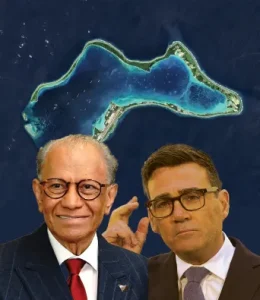
The Indian Ocean has long been a theatre of quiet geopolitical competition, where colonial history, maritime law and military strategy overlap. In 2026, the Chagos dispute acquired a new dimension when the Maldives formally objected to the UK–Mauritius agreement and asserted its own claim to the archipelago.
What London and Port Louis presented as the closing of an unfinished colonial chapter now risks becoming a wider regional controversy. The central question is whether the Maldives can delay or reshape an agreement negotiated over several years, or whether Britain is justified in treating Malé’s intervention as legally irrelevant.
The dispute originates in Britain’s decision in 1965 to detach the Chagos Archipelago from Mauritius before Mauritian independence and create the British Indian Ocean Territory. Between the late 1960s and early 1970s, the Chagossian population was forcibly removed as Diego Garcia was developed into a major UK–US military installation.
The expulsions and Britain’s continued administration of the islands transformed Chagos into one of the most prominent unresolved questions of decolonisation.
Mauritius challenged British control for decades. Its campaign achieved a major breakthrough in 2019, when the International Court of Justice concluded that the decolonisation of Mauritius had not been lawfully completed and that Britain should end its administration of the archipelago as rapidly as possible. The UN General Assembly subsequently endorsed that position.
After prolonged negotiations, Britain and Mauritius signed a treaty in May 2025. Under the agreement, Britain would recognise Mauritian sovereignty over the islands while retaining control of Diego Garcia through a 99-year lease. The financial arrangement was estimated to cost Britain an average of approximately £101 million annually.
For London, the deal appeared to resolve international legal pressure while protecting one of the West’s most strategically important military bases. Yet the settlement did not achieve the finality its architects expected. It faced resistance from British politicians, sections of the Chagossian community and, eventually, the United States.
By 2026, the agreement was already politically weakened. The Maldives is therefore not disrupting a smoothly advancing settlement. It is entering a process that was already under pressure.
President Mohamed Muizzu’s government says it submitted written objections to Britain and raised the matter directly with then-British Deputy Prime Minister David Lammy. The Maldives argues that the archipelago, known locally as Foalhavahi, possesses historical and geographical connections to the Maldivian state.
Muizzu has cited old maps, historical correspondence, traditional navigation and fishing links as evidence that the islands once lay within the Maldivian sphere. His government has also threatened to pursue the matter through international legal forums.
Muizzu frames the claim as a defence of Maldivian sovereignty against larger powers, but, while politically persuasive, it remains legally weak.
Historical contact, fishing activity and geographical proximity do not automatically establish sovereign title. International tribunals generally consider effective administration, colonial boundaries, diplomatic recognition, state practice and consistency in earlier official positions.


Based in Karachi, the writer holds a PhD from CTH, Sweden, and serves as Professor and Chairman of the Physics Department at the University of Karachi. He can be reached at iulfat@uok.edu.pk.
Leave a Reply