



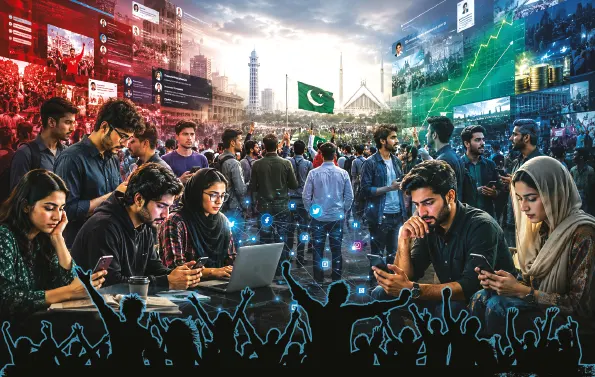
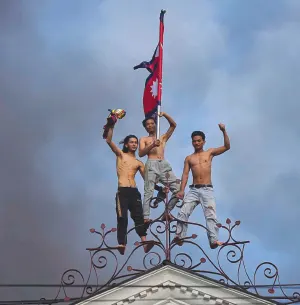
The possible surge of youth assertion is Pakistan’s moment of truth. After Gen Z’s uprisings for regime change in Bangladesh, Sri Lanka, and Nepal, the question is whether Pakistan’s youth, who constitute 60% of the country’s population, will rise to challenge and eradicate an entrenched system of authoritarianism, bad governance, the absence of the rule of law, corruption, nepotism, and the destruction of merit. The recent assertion of youth in India under the banner of the Cockroach Janata Party (CJP) demonstrates that youth mobilisation can exert enough pressure to force even a central education minister to resign through massive protests and demonstrations.
Why does Pakistan’s Gen Z, which constitutes 60% of a population of 250 million, have the potential to rise and launch a massive movement against the poverty, underdevelopment, illiteracy, intolerance, and violence that plague the country, yet remain unable to do so? Is there a history of Gen Z in Pakistan challenging the status quo and the entrenched systems of exploitation, privilege, and perks enjoyed by the ruling elites? What lessons can Pakistan’s Gen Z learn from Bangladesh, Sri Lanka, Nepal, and India? Or does Pakistan’s Gen Z remain divided and unable to assert itself despite prevailing conditions that suggest a ‘ripe moment’ in the country’s history to dismantle a system that not only intensifies frustration and anger among the youth but also deepens their sense of suffocation?
According to Zahid Hussain, a leading columnist writing for Dawn, in an article titled “South Asia’s Gen Z Moment”, published on July 29, 2026: “Pakistan’s Gen Z population (born between 1997 and 2012) is believed to number nearly 70 million. This has dire implications for a country where basic rights are in jeopardy, the media and free expression are restricted, and unemployment is rising. A ‘demographic dividend’ could turn into a demographic catastrophe, with Pakistan occupying practically the lowest rung on South Asia’s human development ladder. The legitimacy of the regime, which is losing its grip in several parts, is being questioned. The economy, meanwhile, is dependent on external assistance, which restricts financial autonomy. Public discontent driven by inflation, unemployment and political repression has created a volatile situation.”
Out of Pakistan’s four provinces, two—Balochistan and Khyber Pakhtunkhwa (KP)—face persistent violence, while Punjab and Sindh are experiencing widespread unrest over political repression, rising prices of essential commodities, and the disempowerment of youth. Gilgit-Baltistan (GB) and Azad Jammu and Kashmir (AJK) are also facing political unrest. When all four provinces, along with GB and AJK, are experiencing turbulence and discontent, why has the country’s youth bulge been unable to bring about any qualitative change in society?
Viewing the history of youth assertion in Pakistan, there is no cogent evidence to suggest that, unlike in Bangladesh, Nepal, Sri Lanka, and India—where Gen Z has focused on critical issues such as the abuse of power by Sheikh Hasina’s regime in Bangladesh, corruption, nepotism, and family dominance in Sri Lanka, corruption and nepotism among those wielding power in Nepal, and leaked medical examination papers and restrictions on democratic freedoms in India—Gen Z in Pakistan has shown a comparable willingness to challenge the issues that are causing serious economic malaise, political repression, and curbs on the media.
In marked contrast, Gen Z in Pakistan appears indifferent to these issues. When the situation in Pakistan is ripe for youth assertion, the Establishment, along with its civilian partners, has nevertheless been unable to silence all voices of dissent.
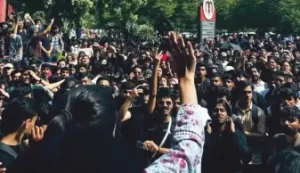 Pakistan Tehreek-e-Insaf (PTI), which claimed to represent the youth and empower them to bring about qualitative change in Pakistan, has faced intense state repression and internal disarray since losing power in April 2022 following a vote of no confidence. PTI’s founding chairman, Imran Khan, has been imprisoned since August 2023 and remains a central figure in the country’s political turmoil. On November 26, 2024, PTI supporters, many of them young people, gathered in Islamabad to stage a major protest demanding Khan’s release. Demonstrators reached the D-Chowk area and clashed with security forces amid a heavy security deployment, tear gas, arrests, and reports of casualties. Punjab also witnessed extensive state action against PTI supporters. The coalition government led by the PML-N and PPP, seeking to retain power and prevent PTI’s political resurgence, has been accused by PTI and its supporters of aligning with the Establishment to suppress dissent and restrict the party’s political space.
 The question of whether Pakistan is approaching its own Gen Z moment needs to be analysed from three angles. First, Pakistan has no established history of youth-led mass movements for democracy, the rule of law, and economic empowerment. Political parties have launched movements in Pakistan, including those in 1968, 1977, and 1983, demanding democracy and protesting electoral rigging, but these movements were ultimately hijacked and culminated in the imposition of martial law. The youth have never played a leading role in bringing about sustained social and political change in Pakistan. The lawyers’ movement of 2007 and the PTI-led movement following its ouster from power in April 2022 also failed to produce lasting positive results.

Based in Karachi, the writer is a Meritorious Professor of International Relations and former Dean of the Faculty of Social Sciences at the University of Karachi. He can be reached at amoonis@hotmail.com
Leave a Reply