




South Asia, a heterogeneous and highly volatile region, has been troubled by political instability, economic challenges and social problems over the past many decades. Home to a population of over two billion, of which hundreds of millions are under 30, it has had a chequered history of military takeovers, bloody wars and civilian unrest.
Recently, however, a phenomenon has arisen that gives hope for a more democratic future. In several countries, the youth have risen on different issues against current governments and, with the force of their passion and unity, have managed to bring about major changes in the political scene.
In Nepal, fresh elections and a young prime minister; in Sri Lanka, a change of government; in Bangladesh, an interim government of civilians followed by elections and a banned but popular political party in power. While the unrest had been simmering for long due to economic and social challenges, the final straw was different in each case. In each country, the young population rose as one voice, demanding redress of their main grievance and, at the same time, calling for reforms in the governance system.
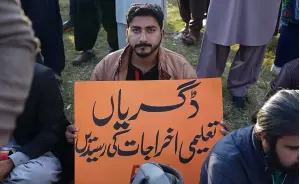
In Sri Lanka, the youth uprising in 2022 was driven by economic collapse, widespread government corruption and lack of opportunities. In Nepal, economic stagnation and political nepotism drove the youth to the streets. In Bangladesh, the uprising was largely due to a quota system in government jobs for the children of freedom fighters of 1971. In India, most recently, youth protests against leaked exam papers caused the education minister to resign — an event unheard of under the BJP government. But the main causes in all cases are similar: high unemployment and inflation, government corruption, and few economic opportunities for the young.
Will the youth bulge of Pakistan — 64% of its 240 million people — rise as a single, focused and dedicated force against chronic corruption, repression of public dissent, forced disappearances and often brutal actions by security personnel against protestors? Despite tranches from the IMF, the economy is in dire straits, with stagnated industry. Inflation and unemployment are high, and corruption is so common that no work can be done in government departments without greasing the palm. What will be the tipping point for the youth?
Since the 2024 rigged elections, the most popular political party, the PTI, has been in the crosshairs of both the farcical civilian government and the real power. No stone has been left unturned to suppress it. Its leaders and young activists have been jailed, brainwashed, their families threatened, and false cases filed in courts presided over by “friendly” judges.
An unprecedented number of young women have been awarded long-term prison sentences and kept in poor conditions in jail. Imran Khan has been in solitary confinement for nearly three years and has been refused meetings with family and lawyers as well as access to his personal physician.
At the time of writing, the government declined to accept the Supreme Court order to shift Khan to a private hospital and have him assessed by a medical board that would include his physician. Social media is fired up at this deplorable act, but will the anger of the young transform into a street movement that refuses to subside until the government gives way? It is doubtful, because it is not the civilian government that is at the helm of affairs but the non-elected yet all-powerful forces that will use all means available to suppress such a movement.
 In some ways, the situation preceding the polls in AJK can be said to be their Gen Z moment. The proscribing of the Joint Awami Action Committee (JAAC) and the banning of their activities caused the people of AJK, and particularly the youth, to protest in nearly all areas. JAAC is a coalition of civil society, traders, journalists and others, and they had been demanding a reduction of seats for refugees from Indian-administered Kashmir in the AJK Assembly.


Based in Karachi, the writer is a development professional, researcher, translator and columnist with an interest in religion and socio-political issues. She can be reached at nikhat_sattar@yahoo.com
Leave a Reply