

Colombo
Six Parties, One Voice?
Can Tamil and Muslim political parties turn their temporary cooperation into sustained political bargaining that delivers meaningful democratic and constitutional change without further fragmenting Sri Lanka’s already divided opposition?

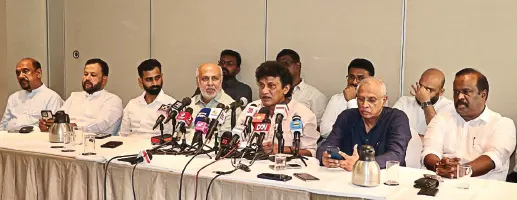
Sri Lanka’s Tamil and Muslim political landscape appears to be entering a new, potentially significant phase, as six minority parties that have traditionally aligned with the opposition Samagi Jana Sandhanaya (SJS) have come together on a common platform to pursue issues affecting their communities. The All Ceylon Makkal Congress (ACMC), Ceylon Workers’ Congress (CWC), Democratic Tamil National Alliance (DTNA), Ilankai Tamil Arasu Kachchi (ITAK), Sri Lanka Muslim Congress (SLMC), and Tamil Progressive Alliance (TPA) have stressed that their decision does not represent a withdrawal from the SJS or an attempt to undermine the parliamentary position of the National People’s Power (NPP) government.
Rather, they describe the new arrangement as a mechanism to collectively raise concerns that, according to their representatives, have not received an adequate response within the opposition coalition. Nevertheless, the emergence of this platform carries implications that extend well beyond the immediate issue of Provincial Council elections and could reshape both minority politics and the broader opposition landscape in Sri Lanka.
The most immediate demand of the six parties is the holding of the long-delayed Provincial Council elections. The elections have remained postponed for years, creating concerns about democratic representation and the functioning of devolved political institutions.
At a recent joint media briefing, former parliamentarian M.A. Sumanthiran argued that the NPP government had pledged to conduct the Provincial Council elections within one year of assuming office but had not yet taken the necessary steps to fulfill that commitment. By making the elections their first major common demand, the six parties have identified an issue capable of bringing together communities with different political histories and priorities. Although Tamil and Muslim parties have often competed with one another or pursued separate political strategies, the absence of functioning Provincial Councils provides a shared democratic concern around which they can cooperate.
The composition of the new platform is particularly important because it brings together parties representing different sections of Sri Lanka’s minority population. ITAK and DTNA have traditionally focused heavily on Tamil political interests, particularly in the North and East, while the CWC and TPA have represented significant sections of the Up-Country or plantation Tamil population.
Meanwhile, the SLMC and ACMC represent important Muslim political constituencies. These communities have distinct political experiences and socioeconomic concerns, and their interests have not always been identical. The fact that they have nevertheless chosen to establish a common mechanism for political engagement suggests a growing recognition that collective bargaining may offer greater leverage than fragmented negotiations with the central government.
For Tamil politics in particular, this development is significant because political fragmentation has historically weakened Tamil representatives’ ability to negotiate effectively with the Colombo government. Tamil parties have frequently been divided by geography, identity, leadership, ideology, and strategic priorities. There have also been internal divisions within major organizations such as ITAK, while disagreements between Northern and Eastern Tamil representatives and plantation Tamil political groups have sometimes complicated attempts to develop a unified political agenda.
Historically, divisions among minority parties have also allowed successive governments dominated by the Sinhala majority to negotiate separately with different political actors. Consequently, the current attempt to build a common platform can be understood as an effort to overcome at least some of these historical divisions without requiring the parties to abandon their individual identities.
The emphasis on a “United Sri Lanka” is equally important. Rather than presenting their demands as a renewed separatist project, the participating Tamil parties have sought to frame their political objectives within the framework of a united state. Their emphasis is on political equality, meaningful devolution, democratic representation, reconciliation, and the protection and advancement of the rights of all communities. This framing is politically strategic. It allows the parties to challenge the central government on issues of minority rights and constitutional reform without giving rise to the perception that their demands threaten Sri Lanka’s territorial integrity. In a country where the question of Tamil political autonomy remains deeply sensitive because of the legacy of the civil war, such language can help create political space for negotiations with Colombo.
The meeting between minority representatives and President Anura Kumara Dissanayake also underscores the new platform’s importance. The NPP government came to power with promises of political change, good governance, and a departure from certain practices associated with previous administrations. Among Tamil voters, these promises created expectations that the government would approach reconciliation and minority rights differently. President Dissanayake’s willingness to discuss constitutional reform and Tamil aspirations therefore created an opening for renewed engagement.
The forthcoming Provincial Council elections in Sri Lanka are likely to become an important test of this emerging political arrangement between Tamil and Muslim minorities
However, there is a considerable difference between political commitments and concrete constitutional change. If constitutional reform remains stalled and the government fails to address the long-standing demands of minority communities, the initial optimism surrounding the NPP could decline further, particularly among Tamil voters.
At the same time, the new platform presents a challenge to the SJS. The six parties have made clear they have not left the opposition coalition, but their decision to establish an independent mechanism for political engagement indicates dissatisfaction with how their concerns have been handled within the broader opposition. Repeated appeals to the SJS reportedly failed to produce an adequate response, encouraging the parties to act collectively. This creates a potential contradiction within the opposition.
On the one hand, the SJS needs the support of Tamil and Muslim parties to maintain a broad-based electoral coalition capable of challenging the NPP. On the other hand, if these parties increasingly conclude that their interests can be advanced more effectively through direct negotiations with the government, the opposition’s cohesion could weaken.
The willingness of the six parties to support the government on matters of mutual interest further complicates the situation. Their position suggests that they do not view politics solely through the lens of a permanent government-versus-opposition divide. Instead, they appear prepared to adopt an issue-based approach: opposing the government when necessary while cooperating with it when cooperation produces tangible benefits for their communities. Such flexibility could increase their bargaining power.
If the NPP requires political support for particular measures, the minority parties could use their cooperation to seek progress on issues such as Provincial Council elections, devolution, language rights, regional development, reconciliation, and minority representation. However, this strategy could also expose them to criticism from the wider opposition if cooperation with the government becomes too extensive.
The Provincial Council elections are therefore likely to become an important test of this emerging political arrangement. If the government takes meaningful steps toward holding the elections, the six parties could claim that collective pressure has produced results. If the elections continue to be delayed, the parties will have a powerful issue around which to mobilize their respective constituencies. Their ability to coordinate their response could determine whether the new platform develops into a durable political force or remains a temporary arrangement.
Ultimately, the significance of this development lies not simply in the formation of another political alliance but in the possibility of a new form of minority bargaining in Sri Lanka. Tamil and Muslim parties are attempting to preserve their individual political identities while cooperating on issues that transcend their traditional divisions.
At the same time, they are attempting to balance three competing objectives: maintaining their relationship with the opposition, negotiating with the NPP government, and responding to the demands of their respective communities. Whether they can sustain this delicate balance remains uncertain. Their greatest challenge will be maintaining unity once concrete decisions about constitutional reform, elections, devolution, and electoral alliances are required. If they succeed, the platform could provide minority parties with greater political leverage and potentially influence Sri Lanka’s future constitutional settlement.
If they fail, the country may return to the familiar pattern of fragmented minority politics and limited concessions from successive governments.
The central question, therefore, is not merely whether Tamil and Muslim parties can unite, but whether they can transform temporary cooperation into sustained political bargaining capable of securing meaningful democratic and constitutional change without further fragmenting Sri Lanka’s already divided opposition.
The writer, based in Islamabad, holds a Master’s degree in Defence and Strategic Studies. He can be contacted at daniyaltalat2013@gmail.com.


Leave a Reply