



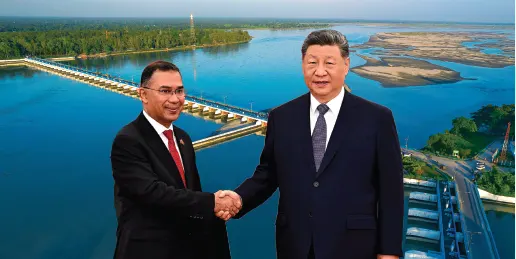
For almost 40 years, the Teesta River has been a thorn in the side of Bangladesh-India relations. For the past 15 years, however, it became part of an implicit political bargain: Sheikh Hasina’s government would go easy on India over the water-sharing issue, while India would go easy on Dhaka over democracy. For both sides, it was a win-win arrangement.
That arrangement collapsed twice: first on August 5, 2024, when Hasina’s government fell, and she fled to Delhi; and again on February 12, 2026, when the BNP returned to power after two decades.
Tarique Rahman’s election has reshaped the dynamics of India-Bangladesh relations. Under his leadership, Bangladesh is no longer treating the Teesta issue as a bilateral matter to be quietly managed for the sake of appeasing its neighbour. Instead, it is approaching it as a strategic negotiation in a much colder neighbourhood.
Under the Awami League, the Teesta was an embarrassment India could afford to ignore. Hasina had built her foreign policy around India—granting transit, cracking down on insurgents, and keeping China at arm’s length on sensitive projects. In return, Delhi provided political cover. The Teesta deal, agreed in principle in 2011, remained unsigned after West Bengal Chief Minister Mamata Banerjee objected. Delhi calculated that there was little cost in waiting. Hasina, meanwhile, could not afford to make the issue a breaking point, even as the status quo imposed a colossal disadvantage on Bangladesh.
The BNP government has no such constraints—and no reason to subordinate its foreign policy to the interests of its larger neighbour.
Since Tarique Rahman took office, relations between Dhaka and Delhi have cooled with a speed that has stunned even seasoned observers. India continues to host Sheikh Hasina and has refused Bangladesh’s extradition request. Visa processing for Bangladeshis has remained largely frozen since late 2024. Border killings, after declining for a period, spiked again in March and April. But the biggest shift may be strategic: instead of reassuring India about China, Dhaka is now openly inviting Beijing in.
It is against this backdrop that the long-stalled Teesta River Comprehensive Management and Restoration Project has resurfaced.
The project—a $1 billion Chinese proposal to dredge, embank and build reservoirs and industrial zones along 108 kilometres of the Teesta from the barrage to the Jamuna—was first offered in 2020. Under intense pressure from India, Hasina’s government put it on hold, giving Delhi time to propose its own conservation project. That proposal, however, never moved forward.
On April 15, the BNP-led government officially revived the Chinese proposal. Within 48 hours, India’s Ministry of External Affairs issued a rare public statement expressing “serious security concerns” over any third-party involvement near the Siliguri Corridor.
That corridor—the 22-kilometre “Chicken’s Neck”—links mainland India to its seven northeastern states and lies less than 50 kilometres from the Teesta project site. To India, a Chinese engineering presence in northern Bangladesh is no longer simply a water project. It has crossed into the realm of strategic security.
For the BNP’s political base, standing up to India is a matter of sovereignty after years of what it sees as Sheikh Hasina’s subservience to Delhi. It is one of the central pillars of the mandate that brought the BNP back to power.
The BNP sees Chinese financing as essential after the reserve crisis of 2023–24 and the de facto slowdown in India’s Line of Credit disbursements since the regime change. Yet it also knows that pushing ahead with the Chinese Teesta project despite India’s objections could turn a water lifeline into a geopolitical fault line.
This is why treating the Teesta as a purely India-Bangladesh issue is no longer merely narrow; it is obsolete. The old bilateral era ended with the election.


Based in Houston, United States, the writer is the executive director of a US-based human rights organization. She can be reached at scballand@thechrd.org
Leave a Reply