The CJP phenomenon is not merely about a single minister or a single exam scandal. It is about a profound generational disillusionment that has been building for years.
ByAtif Shamim Syed | September 2026
For years, Narendra Modi’s government has cultivated an aura of invincibility. It has weathered economic slowdowns, farm protests, pandemic mismanagement, and relentless criticism from civil society. It has controlled the narrative through a formidable media machine, crushed dissent with a heavy hand, and won elections with sweeping majorities. Yet, in the sweltering summer of 2026, that invincibility was pierced—not by a rival political party, not by a coalition of regional actors, but by a six‑word social‑media post and an army of angry, unemployed young people who proudly embraced the label “cockroaches.”
The story begins with an unguarded remark by India’s Chief Justice, Surya Kant. On May 15, while hearing a case about lawyers seeking senior designation, he observed: “Some young people are like cockroaches—they have no place in employment or in the profession. Some of them become journalists, some become social‑media activists, RTI activists, and then they attack everyone.” Within hours, the Supreme Court issued a clarification, insisting the Chief Justice was referring only to those using fake degrees to infiltrate the legal profession. But the damage was done. The insult had already been screenshot, memed, and shared a million times over.
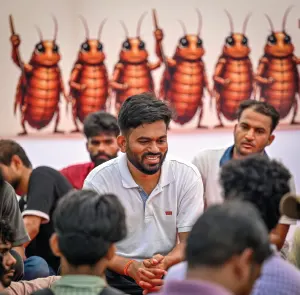
What followed was utterly unprecedented. A young graduate named Abhijeet Dipke, recently returned from Boston University, wrote on his social media page: “What if all the cockroaches unite?” That single question gave birth to the “Cockroach Janta Party” (CJP). Initially, it was nothing more than a joke—a sarcastic retort aimed at an arrogant put-down.
Within four days, the account had amassed nine million followers—eclipsing the Bharatiya Janata Party’s (BJP) official Instagram handle. Within the next five days, it crossed ten million, surpassing even the 141-year-old Indian National Congress. By the end of May, the count approached fifteen million. All this with only 56 posts, compared to the BJP’s 18,000.
This was not a political party in any traditional sense. It had no constitution, no membership rolls, no local committees, no fundraising apparatus. What it did have was a generation’s collective rage, a wicked sense of humour, and an intuitive mastery of short‑form video. The CJP’s content was a blend of memes, sarcastic skits, and raw testimonials from jobless graduates. It spoke in the Gen Z language—meme references, slang, and ironic self‑deprecation. And it resonated because it articulated a truth that mainstream parties had long ignored: India’s much‑touted demographic dividend was turning into a demographic disaster.
The numbers are stark. According to the Centre for Monitoring Indian Economy, the unemployment rate for graduates under 25 hovers around 40 per cent. Over 20 million young people enter the job market each year, but formal sector jobs are growing at a fraction of that pace. The promise of “Make in India” and “Skill India” has failed to deliver decent livelihoods. Instead, young Indians are trapped in a brutal cycle of coaching classes, competitive exams, and perennial disappointment. And when those exams are repeatedly leaked—as was the case with the NEET-UG medical entrance test in May 2026—the sense of betrayal turns into fury.
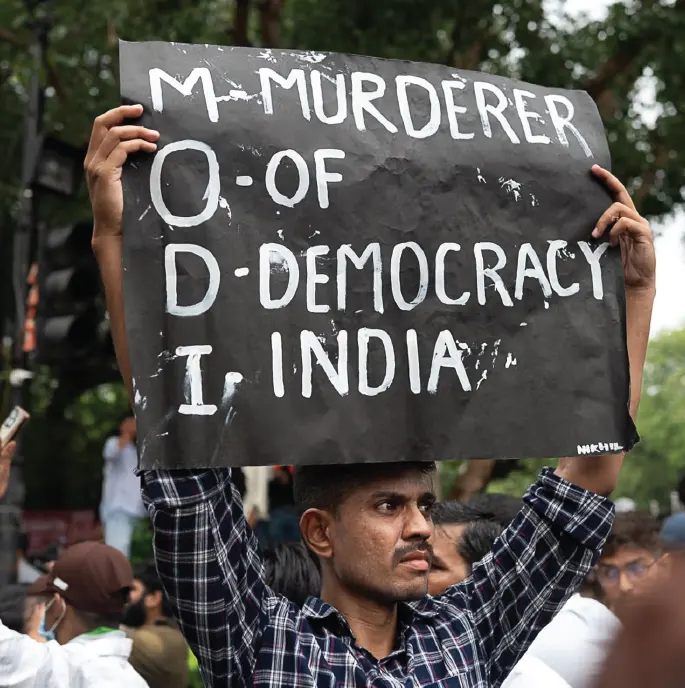
The NEET-UG paper was leaked before the exam, forcing nearly 2 million candidates to retake it. Several students committed suicide, their families blaming the government’s inability to secure the exam process. It was a déjà vu of the 2024 leak, which had also gone unpunished. But this time, the CJP channelled that anger into sustained street action. They set up camp at Jantar Mantar, New Delhi’s traditional protest site, and demanded the resignation of Education Minister Dharmendra Pradhan. For weeks, the protests were small and largely ignored by the mainstream media. Then, on July 18, Delhi police forcibly removed education activist Sonam Wangchuk, who was on a hunger strike, and hospitalized him. Two days later, tens of thousands of young people—organized through CJP’s Instagram stories—marched towards Parliament. Police responded with baton charges and tear gas, and the images of bloodied students went viral.
That was the turning point. What might have fizzled out instead became a national movement. The government’s heavy‑handed response backfired spectacularly, drawing sympathy from middle‑class parents who had previously been ambivalent. On July 26, Dharmendra Pradhan resigned. It was the first time in Modi’s twelve‑year rule that a cabinet minister was forced out by sustained public pressure—not by a parliamentary no‑confidence motion, not by a coalition partner’s ultimatum, but by a loosely organized online campaign that spilled onto the streets.
Political analyst Nilanjan Mukhopadhyay, quoted by the Associated Press, called it “a major defeat for Mr. Modi.” CJP spokesperson Saurav Das put it more bluntly: “A government that had not blinked in twelve years was forced to blink when the youth stood united.”
Yet, in a twist that confounds traditional political observers, the CJP has adamantly refused to become a political party. At a press conference, founder Dipke declared: “We need a people’s movement to restore accountability and integrity in our institutions. We do not want to be another party; we will function as a pressure group to raise public issues.” This is not mere rhetoric. The movement knows that its strength lies in agility and authenticity, not in bureaucratic hierarchies. It has no ambition to contest elections, no ticket distribution machinery, no caste-based calculus. It is, in essence, a digital‑first protest movement that has discovered that in the age of Instagram, organizational weight is less important than emotional resonance.
The internet has even dubbed Modi the “Pookie PM” and “Kuchupuchu”—a deliberate attempt to co‑opt the very language of the youth
This has led many to dismiss the CJP as a flash in the pan—a temporary Gen Z blip that will fade once the next meme cycle arrives. After all, social‑media followings are notoriously fickle. The BJP, with its deep pockets and grassroots network, has survived far more serious challenges. And indeed, the government has already launched a counter‑offensive. Prime Minister Modi has appeared in a series of Instagram reels—some featuring him in casual avatars, others using the theme song of the American sitcom Friends with the caption “F.R.I.E.N.D.S… PM Modi is here for you.” Young BJP parliamentarians have begun peppering their speeches with Gen‑Z slang like “delulu” and “clock it.” The internet has even dubbed Modi the “Pookie PM” and “Kuchupuchu”—a deliberate attempt to co‑opt the very language of the youth.
But these cosmetic adaptations reveal more about the government’s anxiety than its strength. When the most powerful man in India starts making Instagram reels to court a demographic that has just humiliated his minister, it is a sign that the old tools of control—television, print, and even WhatsApp—are no longer sufficient. The state may still regulate other social media handles, but it missed the memo on Instagram. And that oversight cost it a cabinet portfolio.
More fundamentally, the CJP phenomenon is not merely about a single minister or a single exam scandal. It is about a profound generational disillusionment that has been building for years. This generation grew up under Modi’s rule. They were fed a steady diet of nationalist pride, aspiration, and the promise that education and hard work would deliver a better life. Instead, they face a labour market that is shrinking for the educated, a gig economy that offers no security, and an education system that prioritizes rote learning over employability. The repeated exam leaks are merely the most visible symptom of a system that has failed them.
The government’s response to the NEET-UG leaks is instructive. Instead of overhauling the examination machinery, it tried to bulldoze through the protests. When that failed, it resorted to police brutality. When that also failed, it offered cosmetic concessions—a new exam date, a few arrests of low-level officials. Only when the CJP’s street presence became too large to ignore did the Prime Minister’s Office finally push for Pradhan’s resignation. This was not a principled retreat; it was a tactical surrender to avoid further damage to Modi’s personal image.
So, has Modi’s aura of invincibility finally cracked? The answer is both yes and no.
Yes, because the CJP has demonstrated that sustained, digitally‑organized pressure can extract real concessions from a government that had previously seemed impervious to public opinion. The fear threshold has been broken. The state’s monopoly on coercion and narrative is no longer absolute. For the first time, a movement without a conventional party structure has forced a cabinet resignation. That is a historic shift in India’s political landscape.
No, because the CJP itself is unlikely to evolve into a durable political force. It has explicitly ruled out electoral politics. Its leadership is thin, and its organizational capacity is limited to social media virality. It has no answer to the question of governance: what would it actually do if it came to power? Its strength is in opposition, not in administration. And as the news cycle moves on, its Instagram followers may drift away, just as they drifted towards it. The BJP, for all its recent embarrassment, remains the most formidable electoral machine in the world, with a well‑oiled RSS network, vast financial resources, and a loyal core base that cuts across caste and class.
Yet, even if the CJP fades, the fault lines it has exposed will not disappear. India’s youth population is its greatest asset and its greatest liability. Nearly half of the country is under 25. They are better educated, more connected, and more globally aware than any previous generation. But they are also more frustrated, more precarious, and more cynical. They have seen their parents’ dreams of a stable government job evaporate. They have seen crony capitalism flourish while small businesses collapse. They have seen the promise of “New India” dissolve into a hyper‑competitive scramble for a handful of decent positions.
The CJP has given them a vocabulary for that frustration—a vocabulary of memes and irony, but also of collective action. It has shown them that they do not need to wait for Rahul Gandhi or Mamata Banerjee to articulate their grievances; they can do so themselves, using the tools in their pockets. That is a dangerous precedent for any establishment, whether in New Delhi or elsewhere.
The cockroach, after all, is a survivor. It has outlasted dinosaurs, empires, and ideologies. And now, it seems, it may outlast the Modi era’s claim to invincibility.




 But these cosmetic adaptations reveal more about the government’s anxiety than its strength. When the most powerful man in India starts making Instagram reels to court a demographic that has just humiliated his minister, it is a sign that the old tools of control—television, print, and even WhatsApp—are no longer sufficient. The state may still regulate other social media handles, but it missed the memo on Instagram. And that oversight cost it a cabinet portfolio.

Leave a Reply