



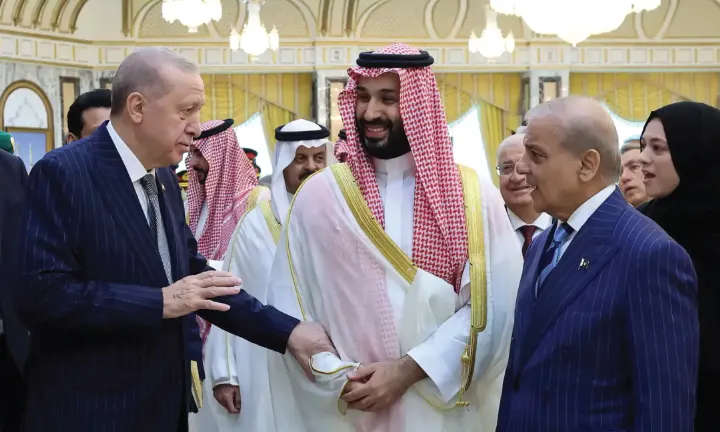
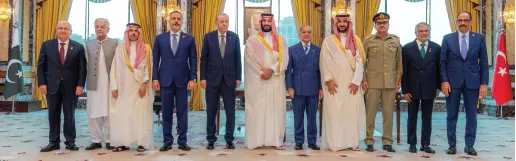
Pakistan, Saudi Arabia, and Türkiye signed the Makkah Joint Defence Agreement, a trilateral mutual-defence accord, in the holy city of Makkah on 7 August 2026. Prime Minister Shehbaz Sharif signed the agreement alongside Saudi Crown Prince and Prime Minister Mohammed bin Salman and Turkish President Recep Tayyip Erdoğan. The agreement is also referred to as the Makkah Accord. Pakistan’s Deputy Prime Minister and Foreign Minister Ishaq Dar has described it as a purely defensive pact, saying that it is not directed against any country. He has also said that the agreement remains open to other regional countries that support its principles.
However, the signing of a mutual defence agreement by three important countries of the wider Middle East – at a time when the region is faced with a devastating war imposed on another important Muslim country, Iran, by the USA and Israel – is bound to raise strategic concerns in many countries within the region and beyond. For different reasons, these may include the Gulf States, Iran, the USA, Israel, India, China, and Russia, among possibly others. The Accord will certainly give impetus to India’s political and diplomatic hostility towards Pakistan.
Pakistan is upbeat about this diplomatic achievement for obvious reasons. First, it has bolstered its political influence, diplomatic stature, and strategic clout in the Middle East at a time when the political and strategic dynamics in the region are undergoing far-reaching changes. Second, its closer alignment with the most influential state in the Gulf region – Saudi Arabia – will bring added economic and strategic benefits. Third, the partners in the trilateral Accord have implicitly recognised Pakistan as a significant security provider in the region.
Pakistan signed a similar bilateral defence pact with the Saudi Kingdom last year. The expansion of this bilateral agreement to include Türkiye has changed its nature, scope, and complexion, from a bilateral understanding to a multilateral defence accord, particularly as it remains, in the words of our Foreign Minister, open to other countries of the region. The door has been left ajar for any other interested country to join, underscoring its non-aggressive character. This has placed it on the path towards a multilateral alliance for collective defence and security, a step in the right direction towards a worthy cause. Such a move may help ease regional tensions and mitigate rivalries among regional leaders.
While the pact, as already elaborated, enhances Pakistan’s strategic position as a net security provider – bolstering its political, strategic, and diplomatic clout – it also brings in its wake numerous strategic challenges. These relate to balancing its bilateral relations with the Kingdom of Saudi Arabia, other Gulf States, and Iran, given the existing diplomatic divergences, political and strategic antagonisms, economic competitions, and leadership rivalries among them.
Pakistan was probably looking for such a strategic alignment in view of its internal political polarisation, economic predicament, and escalating tensions with India and Afghanistan. However, we should be cautious about pinning overly euphoric hopes on the trilateral agreement. Will it deter India from destabilising Pakistan or heating up the border? I doubt it. We may secure loan rescheduling or additional economic assistance from our Arab brothers. But such assistance can provide only temporary relief; it cannot transform our economic position unless we undertake the long-overdue structural reforms needed to place the economy on a sustainable footing.
Foreign Minister Ishaq Dar’s assertion notwithstanding, countries like Iran, Israel, the UAE, India, and the USA will certainly be looking askance at the motives of the signatory states. Inter-state conduct is always subjected to thorough scrutiny in order to discern the real motives behind any diplomatic move. Diplomats are among the most watched people in their host countries; their movements and contacts with local opinion-makers are closely restrained. The axiom followed by diplomats is this: read between the lines, carefully observe the body language of your interlocutor, use your skills of face-reading, and draw your conclusions.
Iran’s low-key reaction to the Makkah Accord, as conveyed by the spokesman of its Foreign Ministry, notwithstanding, the event has not aroused a positive public reaction in the country. One Iranian politician commented tauntingly, warning the Saudis that a paper agreement with Pakistan and Türkiye would not bring them security – just as years of one-sided milking by the Americans did not. The Iranian leadership’s formal reaction, though low-key so far, has been pragmatic and wise, aimed at avoiding any new controversy involving friendly countries like Pakistan and Türkiye.
Iran has shown caution while commenting on the agreement, saying that it “did not regard the agreement as an immediate threat.” Spokesperson Esmail Baghaei claimed that the pact “reflected a changing regional perception of the US,” underscoring that regional countries could no longer rely on Washington for their security in the manner they had in the past. He further asserted that Tehran “had no reason to believe that the agreement was directed against Iran,” pointing to the deep religious, historical, and civilisational ties between Iran and the three signatories.
The phrase ‘immediate threat’ in his first statement significantly reflects Iran’s concerns about the pact. While he takes a cautious and pragmatic stance, Iranian leaders will continue to view the pact with suspicion – especially given that it has been signed in the immediate context of the Houthis’ active involvement in disrupting maritime traffic through the Bab el-Mandeb strait, between the Red Sea and the Gulf of Aden. However, Iran will avoid confronting the signatory states and becoming unwisely embroiled in any new antagonism.


Based in Karachi, the author is a seasoned professional who previously served as a member of the Foreign Service of Pakistan and enjoyed a seven-year tenure as an Ambassador. Feel free to get in touch at brohialam7@gmail.com.
Leave a Reply