



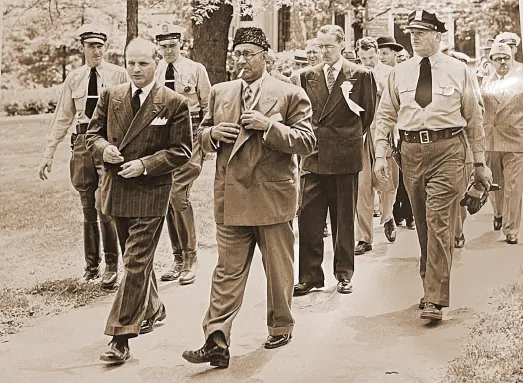
Although situated in the geographic center of the United States, far removed from the renowned coastal cities of New York and San Francisco, Kansas City enjoys the unique distinction of having welcomed Liaquat Ali Khan, the first Prime Minister of the newly independent state of Pakistan, three years after the country was created in 1947.
Over half a century ago, as the Western World was recovering from the ravages of the Second World War, and many new countries including India, Pakistan, Myanmar, Syria, Jordan, and others, were appearing on the world map, Kansas City in 1950 was a small city, but an important railroad hub and center for global trade of agricultural products.
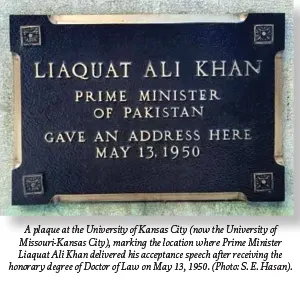
Metropolitan Kansas City, straddling the western boundary of Missouri and the eastern boundary of Kansas, was populated by 475,000 people. The majority of the people were living in Jackson County, Missouri, while Johnson County in Kansas accounted for 7% of the total population. The city’s only university—the University of Kansas City was a private, 23-year-old institution. It was a vibrant university that had earned the reputation of hosting world-class dignitaries: US President, Harry S. Truman (June 28, 1945); President of Mexico, Miguel Aleman Valdes (May 7, 1947); and the first Prime Minister of Pakistan, Liaquat Ali Khan (May 13, 1950). The Prime Minister was invited by Clarence R. Decker, President of the University of Kansas City, to receive an honorary degree of Doctor of Law. A special convocation was held on May 13, 1950, to confer the degree, following which Liaquat Ali Khan addressed the faculty, students, and guests. A plaque marking the occasion was installed at this site that read “Liaquat Ali Khan, Prime Minister of Pakistan, gave an address here, May 13, 1950”.
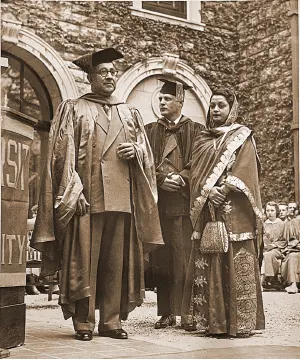 I was able to obtain a copy of Prime Minister Liaquat Ali’s speech from the university archives. It is full of faith, passion, and hope for the new country of Pakistan. Space does not allow reproduction of the 5-page-long speech, but the following excerpts are noteworthy:
The Prime Minister acknowledged America’s progress in science and technology and declared: Our ancient steadfast faith which is such a source of strength to us on the ideological front in these modern uneasy times must be wedded to the pioneering virility of modern technology. This is the synthesis we must achieve and achieve it quickly, not merely for the sake of progress but for the sake of world peace itself. On the vision of Pakistan, he promised: We consider the role of Pakistan to be that of a stabilizing factor in a backward and discontented part of the world. We hope to play this role successfully by our strong faith in God, in democracy and in our own unity, the resources of our lands, waters and by our will to work.
 Liaquat Ali Khan shared his hope for the new country thus: We hope that our country, too, by following the same path [of individual enterprise and civil liberties] and believing in the same moral values will shorten the period as a peaceful, stable democracy and its emergence as a prosperous state. About the government’s responsibility, he said: A free people must maintain their own freedom first. Otherwise, they will disgrace the fair name of free men and women all over the world.
It was a profound tragedy that such a selfless and dedicated leader did not live to see his vision and hopes turn into reality. His life was cut short by an assassin’s bullets on October 16, 1951, while delivering a public address in Rawalpindi. His untimely death was a devastating blow, and the political instability that has plagued Pakistan still reflects the enduring impact of that tragic event.
Based in Kansas City, USA, the author is Professor Emeritus of Geoscience at the University of Missouri. He is an internationally recognized authority on waste management, a two-time recipient of the U.S. Government’s Fulbright Senior Scholar Award (2016, 2020), and the only scientist worldwide to have independently authored two award-winning college textbooks in the field.
He can be reached at: hasans@umkc.edu
Leave a Reply