



In a world riddled with conflicts, can literature offer a worldview, allowing us to peek through a fictional keyhole to help build a world of peace? What power does literature hold in today’s political climate? Can literature become a space where those who hold power encounter characters who mirror them—and perhaps laugh at or even detest those mirror images?
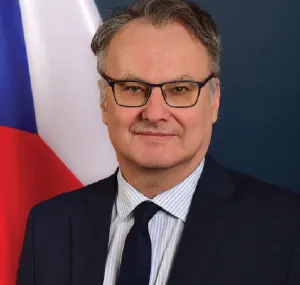
In this exclusive interview with SouthAsia, Dr Tomáš Kafka, Director of the Central European Department at the Ministry of Foreign Affairs of the Czech Republic, talks about how literature shapes political imagination and civic resilience at a moment of global democratic backsliding, and how it preserves an unmanipulated collective memory in times of censorship.
SouthAsia: Do you believe literature still possesses the power to shape societies, or has that influence been eclipsed by social media and the 24-hour news cycle?
Dr Tomáš Kafka: Literature, unlike the other genres mentioned above, fulfils a rather different function. This does not necessarily make it more relevant, but it certainly makes it unique. Its primary domain is the human imagination. Imagination is, of course, not the only characteristic that distinguishes human beings as a species, yet without it, much of what we are and what we do would lose its meaning. In the context of the current, fervent debates about whether AI may eventually eclipse human-written texts, it is worth emphasizing that human imagination serves not only to make sense of the world around us. It also enables us to create nonsense, to play with ideas, and to make fun of the things that surround us. This capacity is, at least occasionally, of great importance for our understanding of both the world and our own lives.
SouthAsia: You recently wrote that literature and art ‘should not moralise’ but instead ‘help us find the right perspective from which to continue our efforts’. Could you expand on this?
Dr Tomáš Kafka: In response to this question, I would like to quote our former president, Václav Havel, who once said that hope is not the conviction that something will turn out well, but the certainty that something makes sense, regardless of how it turns out. Literature should play the role of an engine, or at least the fuel that keeps this engine running in our minds and hearts. It should prevent us from giving up, even when the prospects of a happy ending, whether in private life or in politics, seem exceedingly remote. Moralising cannot help us in such situations. Ultimately, everything depends on us and on the way we choose to engage with the world around us. Literature cannot solve our problems, but it can help us appreciate this world a little more deeply than the routines of everyday reality often allow. It can help us to overcome our disillusionment.
SouthAsia: You also spoke of ‘political nostalgia’ being as dangerous as any other form of nostalgia. How can literature help societies resist that nostalgia without asking them to abandon hope or memory altogether?
Dr Tomáš Kafka: Speaking of nostalgia as a danger is, of course, somewhat of an exaggeration. For my part, I tend to be quite nostalgic myself. Yet my own experience has taught me that nostalgia, if allowed to run free and remain unchecked, can distort our perception of future opportunities and sometimes even paralyse our willingness to engage with the world as it is. We should therefore treat nostalgia with the same caution that we now apply, for example, to sugar. Both are delightful in moderation, but both can become harmful when consumed in excess.


The writer, who is based in Karachi, is a communications professional and a dedicated UN Volunteer. Feel free to reach out to her at mariaamkahn@gmail.com.
Leave a Reply