



According to SP’s Naval Forces magazine, Asia Times, and Business Standard, the Indian Navy currently has around 132 ships, 220 aircraft, and 16 submarines, including two active nuclear ballistic missile submarines (SSBN) and two 45,000-tonne aircraft carriers, the INS Vikramaditya and the INS Vikrant. For the last few decades, India has struggled to make its navy a blue-water force, a maritime force capable of operating in the open oceans for long durations to project “credible power” in the distant seas.
In the above context, India has followed an ambitious plan of expanding its naval assets/capabilities through indigenous production and acquiring naval vessels from Russia and France. India became more enthusiastic about building its navy as a Blue Water Force after signing an agreement of strategic partnership with the US, especially after the US declared it a lynchpin in its Indo-Pacific strategy and a major defence partner, and India can purchase defence equipment from the US and Western military powers.
Hence, India has multiplied its plans to expand its naval power. As per its Maritime Capability Perspective Plan, the Indian Navy plans to have 200 ships, 500 aircraft, 24 attack submarines, and a third aircraft carrier capable of countering Chinese naval power/influence in the Indian Ocean and discouraging China from providing military support to its regional rivals in the Indian subcontinent, such as Pakistan.
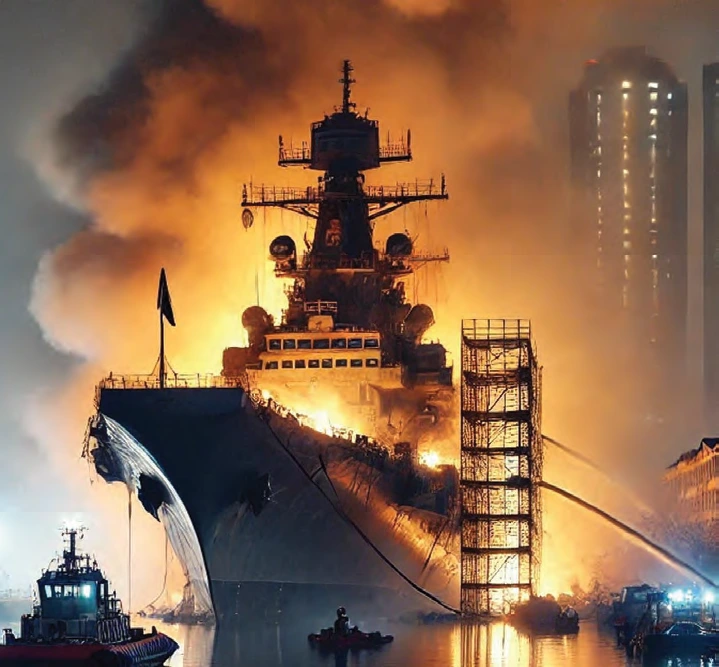
But India’s hopes of building a Blue Water Navy have been dimmed by frequent accidents of its naval assets. As per India’s print media, the recent major incident was the multi-role front-line warship INS Brahmaputra, which caught fire during its maintenance in the Indian Naval Dockyard on 21 July 2024 and overturned, leading to significant damage and one sailor being reported missing.
Subsequent firefighting efforts managed to control the fire, but the vessel capsized in the afternoon of July 22, 2024. The Indian Ministry of Defence press release also confirms that the ship could not be brought to an upright position despite all efforts. It continued to list further alongside her berth and is presently resting on one side.
Talking about the earlier accidents, the Press Information Bureau, Government of India, Ministry of Defence Report on Frequent Incidents of Mishap in Indian Navy dated 02-December-2014, as reflected by Print, states that 24 accidents involving Indian Navy ships and submarines have been reported between years 2012 to 2014. According to USNI News dated 6 February 2014, the Indian Chief of Naval Staff, Admiral DK Joshi, resigned as the head of the Indian Navy in 2014, claiming “moral responsibility” for the string of accidents in his tenure.
As per the USNI news dated 6 February 2014, India’s aspiring blue water navy lost two warships and one submarine in the harbour in two major accidents. On 30 Jan 2011, INS Vindhyagiri collided with a merchant ship while entering Mumbai harbour. The resultant catastrophic fire and flooding sank the Ship. On the night of 13/14 August 2013, INS Sindhurakshak, a Kilo-class submarine, exploded into a huge fireball, killing 18 personnel. On Dec 5, 2016, INS Betwa, a 3850-ton guided missiles frigate, keeled over during undocking with the loss of two lives. India Today describes the following reasons for frequent major accidents in the Indian Navy: The Indian Navy has an aging fleet, with an abundance of two-decade-old platforms, including submarines and frigates. Many accidents occurred due to oversight and significant human failure involving basic navigational skills and domain awareness. There are also lapses in operating procedures and safety measures.

 The writer is also a former Research Fellow of IPRI and a Senior Research Fellow of SVI Islamabad. He can be reached at hanifsardar@hotmail.com
Leave a Reply