


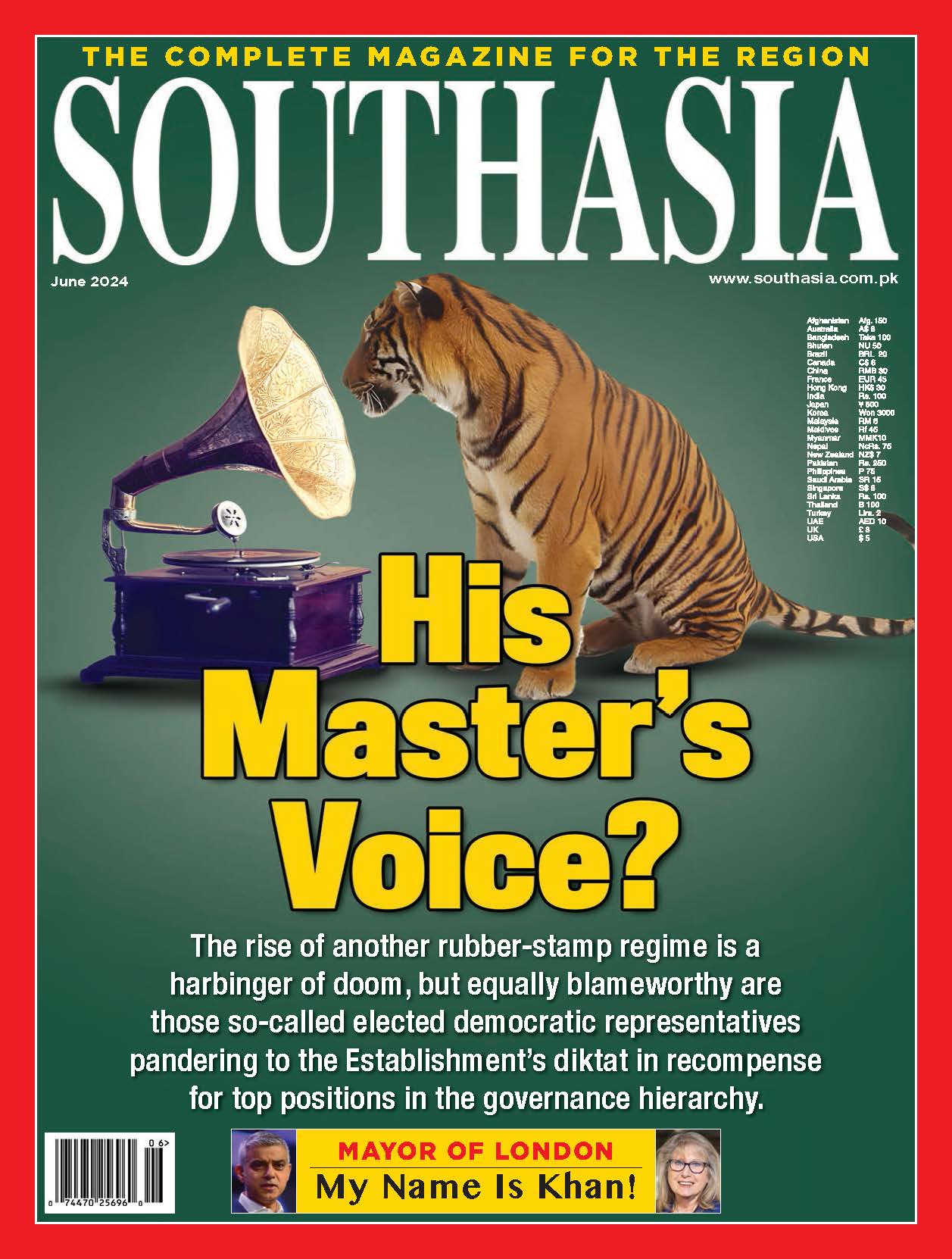
His Master’s Voice
This is with reference to last month’s cover story titled ‘His Master’s Voice.’ One must say that the primary theme of the cover story was well-directed towards the powers that be that cannot operate without the connivance of like-minded political stooges, who are second to none in working for their holier-than-thou masters at the expense of self-respect and honour. The incumbent PML-N regime, not to exclude the PPP, is nothing more than a puppet regime being played at the hands of invisible forces that revel in non-democratic ethos and subjugation of human freedoms for their vested interests. God knows when the current state of affairs will be able to see any improvement. So far, there is no light at the end of the tunnel.
Shazia Baig,
Toronto, Canada.
Critical Reflections on Religious Minorities
 Muhammad Arslan Qadeer’s article, “Majoritarian State,” appeared in SouthAsia in the June 2024 issue, presents a compelling and insightful analysis of Indias current political trajectory and its implications for the nation’s democratic and pluralistic ideals. The author’s comprehensive examination of the rise of majoritarianism under the Bharatiya Janata Party (BJP) and Prime Minister Narendra Modi is both timely and relevant, shedding light on the significant challenges India faces in maintaining its diverse and inclusive identity. Muhammad Arslan Qadeer’s work is a testament to his profound understanding of India’s political landscape and his ability to articulate the complexities involved. His insightful critique and historical perspective provide a valuable framework for understanding the current political climate and the need for a more inclusive and democratic approach. This article is a must-read for policymakers, scholars, and anyone interested in the future of Indian democracy and its role in fostering regional and global harmony.
Ameera Ghaznavi,
LA, California, USA.
Victory with a Cost
 In a distressing turn of events for Indian Prime Minister Narendra Modi, the Bharatiya Janata Party (BJP) just managed to register a win by a thin majority instead of its pre-poll ‘400 paar’ tall claims. Adding insult to injury, the BJP suffered a humiliating win at the hands of the Indian National Congress and Samajwadi Party in Uttar Pradesh, India’s largest state. Although the NDA alliance has been able to form the government in the centre, the recent fiasco is much more the lot of hardline Hindutva activists can handle. Despite his repeated tall claims, Narendra Modi bites the dust by falling short of the required number of seats. Securing a victory with a heavy political cost, the Modi 3.0 is going to be nothing more than a 4-year debacle in the name of governance.
Kamran Khuwaja,
Hyderabad, Pakistan.
SouthAsia—Epitome of Bold Journalism
 Thank you for your complimentary copies of the monthly issues of SouthAsia Magazine. I appreciate your quality publication with creative and bold cover content, along with the editor-in-chief’s comments, objective regional coverage, and all other articles. SouthAsia Magazine is improving with each month, bringing in new distinguished contributors from different countries. It is a refreshing departure from other media of the country. Congrats to the publisher and your team on surviving in these challenging times in the interest of the country and peace in the region.
Nisar A. Memon,
Islamabad, Pakistan.
New Government in Bhutan
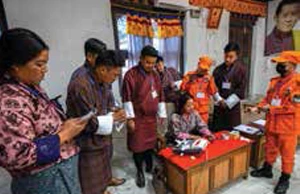 The general elections in Bhutan were successfully held in January this year. The recent polls were the fourth polls in a row since Bhutan transitioned from a monarchy to a parliamentary democracy in 2008. The PDP, a liberal-oriented political alliance, won most seats, while the BTP (Bhutan Tendrel Party) secured 17 seats in the 47-member parliament. The recent elections in Bhutan were held against the backdrop of rising unemployment and a brain drain as the most talented young people are going to foreign countries in record numbers in search of better prospects. It is up to the incumbent government to address the issue, as the country’s three-billion-dollar economy cannot prosper with increasing unemployment opportunities for its youth.
Robin S. Uthapa,
Kathmandu, Nepal.
Matter of Concern
 For a crisis-ridden country like Nepal, the year 2023 was marked by an intensification of political crisis to the extent of nationwide anarchy and mayhem. To make things worse, the year 2024 has not yet proved to be any different for the people of the Himalayan nation. Other than prevailing political instability, macroeconomic indicators in Nepal are still at the lowest ebb. Recently, a series of major monetary scams grabbed the news headlines. At the same time, ongoing concerns such as rising unemployment, increasing natural disasters, the mushroom growth of mafia-styled businesses, along with soaring emigration for work and education paint a bleak picture of Nepal. The need of the hour is to bring political stability to put the country’s poor economy on track.
S. K. Abhimoda,
Kathmandu, Nepal.
One-party State
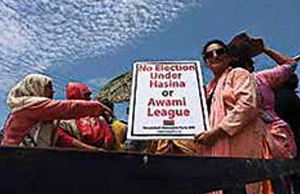 Held in January this year, the parliamentary elections in Bangladesh can be referred to as an electoral façade wherein the entire state machinery was operating to put the incumbent Awami League regime back into power on the trot. As per international observers, this year’s elections once again cemented the smooth transition to a “dominant-party” political system, which is not a positive development for a struggling economy like Bangladesh. Although the rise of the Awami League (AL) as an opposition boycott on Election Day aided the leading party, the Awami League (AL) has yet again been gifted with another five-year term in power. This makes it a harsh reality to accept that political dominance comes with its own risks and challenges. However, today’s Bangladesh has become a one-party state at the expense of human freedoms and the unaddressed political stalemate plaguing the nation like a ghost.
Shahab Uddin,
Chittagong, Bangladesh.