

Environment
Vagaries of Climate Change
Climate Change is a serious issue that needs urgent and result-oriented handling.

Sranding at the cusp of a climate crisis, the region of South Asia finds itself ensnared in a very alarming situation. The gradual upsurge in global temperature is likely to create a surfeit of impediments for South Asian countries. Thus, a region that has historically been enmeshed in geopolitical conundrums and marked by socio-economic turmoil, will now likely face a climatic predicament as well – one that is going to leave a scar so deep that removing it would become a wild-goose chase.
According to a recent report by the United Nations Intergovernmental Panel on Climate Change (IPCC), South Asia is predicted to face one of the most alarming climate crises ever. With a forecast highlighting hotter weather marked with much longer periods of monsoon in conjunction with severe draughts, South Asian countries have now become severely vulnerable to weather patterns and extremely hot temperatures. The IPCC has further emphasized that by 2040, there will be a gradual rise of 1.4 degrees Celsius and with global temperatures having the potential of peaking at about 5.8 degrees Celsius by the turn of the new century, the world and South Asia in particular will succumb to one of the harshest environmental conditions ever faced. Just for context, a mere 1.4 degrees rise in global temperature, will leave about 14% of the world’s population at the risk of facing one heat wave after every five years - the kind of heat wave we are currently facing.
With a 2 degrees rise, this percentage would encompass 37% of the global population. What’s more alarming is how two South Asian countries – India and Pakistan – find themselves at the top 20 countries that are most likely to be affected by climate change, according to the Global Climate Risk Index. This seems to place the whole region of South Asia in an environmental limbo and create a plethora of negative implications for the region.
One of the many consequences of the rising temperatures in South Asia is severe glacial retreat. South Asian countries such as Pakistan and India are home to one of the largest glaciers in the world that are primarily situated in the Himalayan region. These glaciers have also become subject to rising temperatures which has resulted in the melting and disappearance of glacial ice sheets. As per NASA, the Himalayan glaciers are the most rapidly depleting glaciers in the world. One such example of glacial disappearance occurred when Pakistan’s Shigar Glacier lost 800 meters of its length. Thus, it can be said that rising global temperatures will cause irreversible damage to the existence of glaciers in the Himalayan region.
With an increase in glacial retreat, the global sea level will also rise inevitably. This is going to be a severe blow for the coastal regions of South Asia. As a high population resides near coastal belts such as Karachi and Mumbai, rising global sea levels could mean life-threatening tsunamis and flooding throughout the region. Global sea levels are rising by 8 inches every year. This is likely to lead to more severe marine geo hazards and leave countries like Sri Lanka and the Maldives in dire straits.
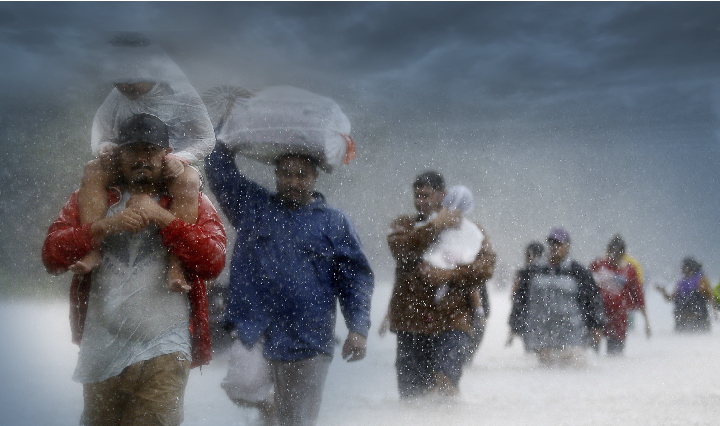
Furthermore, the threat to the coastal population could possibly trigger a domino effect which would bring forth a plethora of other problems such as the exponential increase in “environmental refugees”. People are more likely to shift away from coastal belts and into various other cities. This mass exodus of people from very dense coastal cities may give birth to demographic and economic constraints, as higher population means a mushrooming in street and organized crimes and will also see a drop in the standard of living. In India, the year 2020 saw about 3,856,000 people become displaced due to environmental disasters; this was 989 times more than the 3,900 persons displaced by conflicts. This sheds a light on how the future for South Asian countries could become more bleak.
The water crisis arising from the rise in global temperatures could also lead to conflicts over shared water sources. In South Asia, climate change is severely going to affect the availability of water resources and will make water a scare commodity in the coming years. Therefore, monopoly over water sources will become a flashpoint for future conflicts not only between neighbouring states or provinces of the same country – such as the rise of water monopoly between Sindh and Punjab –but also between countries in the region such as India and Pakistan. This would hurt the agrarian economy and will also create food insecurity as its aftermath.
With rising global temperatures, it is deemed necessary for South Asian countries to form a legal framework that helps in better water management and climate control. The Article 9 of the Constitution of Pakistan enshrines the fundamental right to life and this includes the right to proper water supply and a clean environment. Therefore, it is necessary for South Asian countries, such as Pakistan and India, to better manage water sources and provide infrastructure improvisations to help the public during onslaughts of heat waves. ![]()
POSSIBLE SOLUTIONS
The climate crisis is a global challenge - and we all need to work together to solve it. There are teams around the world working on projects and initiatives to reduce emissions and help people and nature adapt to a warmer world.
Energy production and use is the biggest source of man-made greenhouse gas emissions, but opportunities abound to use energy more efficiently and shift from fossil fuels to renewable energy.
Cities, which are home to more than half the global population and generate 70% of global carbon emissions, have an important part to play in tackling the climate crisis. Through initiatives such as the One Planet City Challenge, WWF works to increase political leadership and public engagement and devise innovative solutions to transform cities and ensure their alignment with the 1.5C goal of the Paris Agreement.
CLIMATE ALLIANCES
WWF is working with coalitions in countries around the world to take actions, increase public support, and engage national governments to build a zero-carbon future together.
CLIMATE AND BUSINESS
Businesses of all sizes are already taking important steps to cut their emissions, but we need more ambitious actions to limit global warming to 1.5C.
CLIMATE CHANGE ADAPTATION
Rising temperatures and increasingly unpredictable climate patterns are already threatening biodiversity and people around the globe.
WWF is working to help people and nature cope with a changing climate through supporting efforts to build climate resilience, implement national adaptation plans/strategies, capacity building of vulnerable groups, offering guidance on reducing climate risks from disasters and extreme weather events.
CLIMATE POLICY
To avoid the worst impacts of climate change, we need policies that will enable a rapid reduction in the world’s greenhouse gas emissions and help the vulnerable to adapt.
Governments need to implement ambitious policies that favour climate-resilient, zero-low-carbon development, energy efficiency, and clean renewable energy for all.
NATURE-BASED SOLUTIONS FOR CLIMATE CHANGE
Nature-based solutions for climate harness the incredible power of nature to reduce greenhouse gas emissions while also helping people and biodiversity adapt to the impacts of climate change.
WWF is working to boost nature-based solutions for climate in countries around the world and emphasise the benefits of protecting biodiversity and restoring nature to businesses, cities, communities and countries.
We need to stop funding activities that harm our planet and invest in climate solutions that ensure a sustainable future instead.
WWF is also working day and night to influence regulators, insurers, banks and other financial institutions to help them understand nature’s true value and shift their investments away from fossil fuels and other carbon-intensive projects and help vulnerable to adapt.

The writer is a journalist based in Islamabad. She can be reached on Twitter @iAnumSheikh


Zabardast