

Region
Respite for Refugees?
The Rohingyas have become a part of a serious refugee crisis because of the intransigence of Myanmar. Solutions are still elusive.

The institutionalization of international and humanitarian laws in the aftermath of World War Two had raised hopes of doing away with the inhumane acts and humanitarian crisis that haunted humankind for millennia. Though laws exist and bar genocide and persecution of ethnic minorities on any pretext, their outcomes have never been that much promising. The horrific manifestation in modern times appeared in the name of pogrom of the Rohingya ethnic group termed as “a textbook example of ethnic cleansing” by the UN High Commissioner for Refugees and as “one of, if not, the most discriminated people around the world” by the United Nations incumbent Secretary General Antonio Guterres.
Rohingya is an ethnic Muslim minority group living in the northern Rakhine province of Myanmar. Since Myanmar authorities have always considered them as illegal immigrants from Bangladesh, these people have been excluded from the Citizenship Act 1982 and the latest census in 2014. The group has been suffering state prosecution for over decades now. Their plight, however, worsened in August 2017 when the Myanmar military, supported by Buddhist extremist mobs, unleashed terror and violence causing a mass exodus of terrified refugees to neighbouring states, predominantly Bangladesh. Over 288 villages in Rakhine were razed to the ground by fire. Medicine Sans Frontier (MSF) reported 6700 dead, including children below five. The Myanmar authorities, however, termed this merciless massacre as a clearance operation in response to attacks by Arakan’s Rohingya Salvation Army (ARSA).
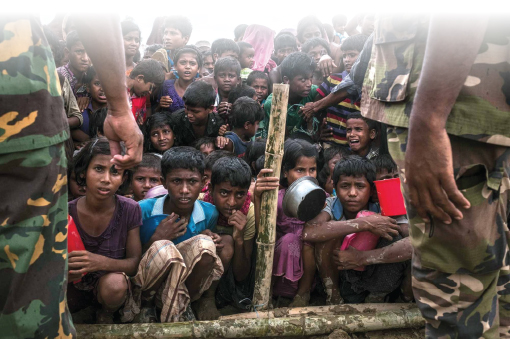
As a result of the crisis, nearly a million Rohingyan fled to Bangladesh and encamped mainly in the Cox’s Bazar district. Bangladesh’s generous humanitarian gesture of hosting the refugees has been acknowledged across the globe. Though the dignified and safe return of the refugees to their home country is one solution, the circumstances, however, were not conducive for it. This was because of Myanmar’s reluctance to take meaningful steps for their voluntary return.
The resources the Rohingya refugees are living on in Bangladesh’s territory are under great strain. Moreover, the topography of the Cox’s Bazar camp is prone to landslides among other catastrophic calamities. Basic necessities, infrastructure and service delivery appear under great strain. A number of refugees’ children are reported to be unable to attend primary level schools. Moreover, health and sanitation are other areas lacking necessary attention. The impacts of the crisis began to be felt by the local communities in deforestation, paucity of firewood and lowering of wages due to increased labour supply. In this backdrop, the hapless souls shouldn’t have been left at the mercy of ill-fated statelessness and the subsequent agonies.
What can Bangladesh do to address the humanitarian crisis facing the Rahingya refugees? What plans needto be charted out to carve win-win conditions? Perhaps the most significant role the country can play in redressal of the Rohingyas is still not clear. Short and medium term plans need to be framed and then they should be respectably repatriated to their home country. The average trend of period of displacement globally is a decade or so. Bangladesh might not be an exception. An all-encompassing, inclusive and compact approach can go a long way in redressing the Rohingya issue altogether. The strategy needs to be two-pronged and hybrid: first, focusing on the care and cure of hapless refugees and second, on efforts redressing the roots of the issue and their subsequent respectable repatriation to Myanmar.
As far as facilitation of the refugees’ is concerned, Bangladesh can call for international support in the light of the UN General Assembly’s New York Declaration 2016, which has made it obligatory for states to come to the assistance of refugees. Immediate logistic and financial aid is not the only factor in responsibility sharing. Bangladesh’s refugees framework approach should also call for holistic assistance: financial incentives, employment opportunities, livelihood, education and overall well-being of the refugees.
Such a comprehensive approach can reinforce the necessities of the refugees besides bolstering support to the local people and the host country. The lessons from the comprehensive compact approaches of similar humanitarian crisis can help build a more feasible and affordable refugee’s short-term integration framework. The Jordan Compact, for instance was an all-encompassing and inclusive response that included joint commitment from the European Union, the World Bank and many other countries. The approaches in Lebanon and Ethiopia also serve as the models to be emulated in dealing with the refugees in Bangladesh. The well-thought-out frameworks of Jordan, Lebanon and Ethiopia can help, to a large extent in improving the living standard of Rohingya refugees.
A permanent and lasting solution to the Rohingya crisis lies in the honourable return of the refugees to Myanmar. For this purpose, though the two countries have reached agreements, there have been no considerable development. Bangladesh needs to robustly engage regional countries, human rights organizations, and global civil society to press Myanmar for creating a secure, dignified, voluntary and sustainable environment for the return of the Rohingyas.![]()

The writer is a freelance columnist and researcher based in KandhKot, Sindh. He can be reached at alihassanb.34@gmail.com


Leave a Reply