


 Bringing the masses out of poverty is indeed not only a sign of having a progressive vision but a classy execution plan by the leaders. Bringing millions of people out of poverty by keeping up a democratic governance structure and an intact parliamentary power shift, makes it more appreciable.
Though PM Imran Khan keeps praising China’s economic model that has pulled out millions of Chinese out of poverty, but he forgets that their governance model has no resemblance with ours. On the other hand, India liberalized its old-fashioned economy through a transformation that eventually pulled out about 300 million out of poverty, fueling one of the biggest wealth creations in history.
On July 24, 1991, Manmohan Singh’s budget speech is considered as an indication of commencement of economic reforms in India and now, on completing three decades of economic reforms, India has shown an exponential growth in economic terms. In the boom after liberalization, growth crossed 8%. Technology giants like Infosys were born and start-ups worth billions are now mushrooming in Bangalore. A new middle class emerged that watched Netflix, shopped online on Amazon, and dated without fear.
In the south, the Wistron factory won special economic benefits to assemble Apple iPhones. India became the world’s biggest supplier of generic medicines and the Serum Institute of India became the world’s biggest vaccine maker. An Indian exchange now handles the world’s highest number of derivatives contracts. But on her way to become an economic giant in South Asia, ‘Covid-19’ happened.
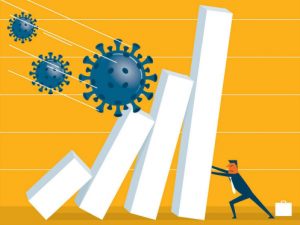
The corona surge left overflowing hospitals turning away the dying and crematorium smoke darkening the skies of Indian cities. The apparent economic progress of decades had been shattered in months. Millions of Indians, who were scratching their way out of poverty, now face dreadful job prospects and carry heavy debt loads to get themselves through the pandemic.
 Devastation caused by a pandemic has unearthed the poor health care and its infrastructure is often neglected in the apparent economic boom after liberalization. India’s government spent less than 2% of GDP on healthcare before the pandemic. So, was the progress an eye wash for the world in general and Indian citizens in particular? We leave this question for some other time; instead let’s have a quick look at the Indian losses and let’s analyze whether the Indian economy would bounce back in the post-Covid world?


The writer is a columnist and broadcast journalist. He teaches at UVAS Business School in Lahore and can be reached at mali.hamza@yahoo.com
Leave a Reply