


 The Covid-19 surge took a serious turn when the second wave struck Nepal harder than the Nepalese expected. Reportedly, on March 8 there were only 89 confirmed cases, including one fatality. Since that day, the scenario quickly deteriorated. With a population of roughly 30 million, the number of people infected by the outbreak increased dramatically to over 9,000. After the outbreak commenced, nearly 3,500 individuals died. Within just a month overall prevalence of Covid-19 escalated to nearly 10,000 each day, up from 300+ daily in mid-April 2021.
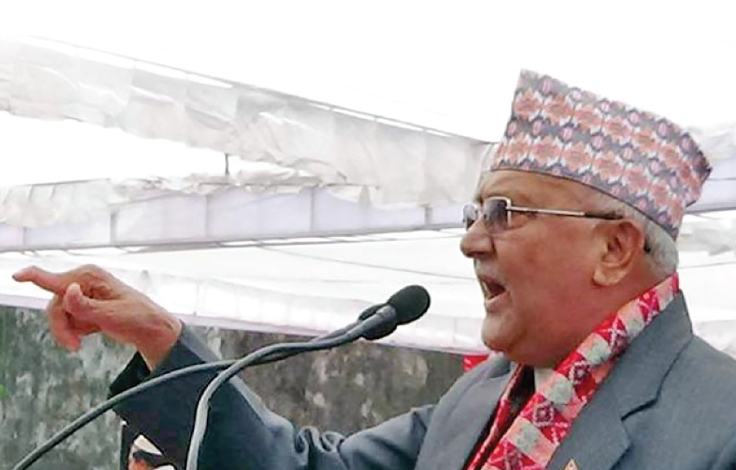
From one crisis to other, the Nepalese encountered various issues. The President of Nepal has dissolved Parliament for the second time in less than six months and called emergency elections, sparking legal challenges and throwing the nation into further political turmoil as it fights a “catastrophic” increase in Covid-19 cases.The situation is creating instability in Nepal, which saw ten different administrations in as many years until KP Sharma Oli and his coalition of communist parties was elected in 2017. The political turmoil had arisen as Oli’s administration had been chastised for its dealing of a new wave of Covid-19 outbreak that had spread from India. As per experts, Oli has been focused on organizing demonstrations and political events in order to get votes. According to Yug Pathak, a civil society representative, Oli urged for the dissolution of Parliament because the epidemic would prevent new elections from being held swiftly. He noted “The Prime Minister has violated the Constitution time and again. It seems that he wants to kill the Parliament at any cost if it won’t keep him as Prime Minister. Oli’s intent was not to hold elections, but to “prolong his rule.” He added, “It’s clear that polls couldn’t happen during the pandemic. His only intent is to postpone the polls after the health emergency.”
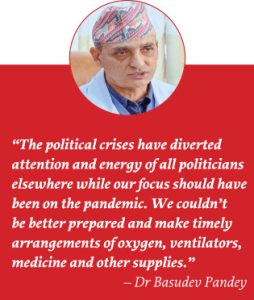
However, concerns still remain related to political turmoil, suggesting that it would deepen Nepal’s Covid-19 situation.The epidemic has overloaded Nepal’s hospital system, which was already dealing with facility limitations before the outbreak. The country’s hospital bed and oxygen capacity is limited, and most healthcare institutions outside major cities lack the machines needed to perform the Polymerase Chain Reaction (PCR) tests which are essential for diagnosing Covid-19 efficiently. Public health experts are afraid that political turmoil and rallies will spread the coronavirus even wider now that Nepal’s Parliament has been dissolved.
The former director of epidemiology and disease control at Nepal’s Department of Health Services, Baburam Marasini claims that political riots or confrontations will endanger the public. He said, “It’s impossible to break the chain within the next one or two months, as the virulent virus has already spread to communities, villages and the countryside”.
 In rural Nepal, there is a scarcity of health-care services. People are also less apt to consider pandemic protocols. Marasini cautioned that election campaigns throughout Nepal that are mostly conducted door-to-door, would be impossible until the general populace had been fully vaccinated; as only 2.5% population is vaccinated, this needs to be resolved on urgent basis. It is not that the Nepalese administration has done nothing to combat the Covid-19 outbreak. Nepal was one among the first few nations in the world to start an immunization campaign on January 27, using one million doses of vaccine provided by India as part of a donation. The objective at that time was to immunize 72% of the country’s total population of 14 and above by May but unfortunately, at 10% (22 million eligible individuals) the vaccine ran out. As an outcome, even seniors, 65 and older, who had received the first dose of vaccine did not get the second dose.


The writer has done his Masters in Defence and Strategic Studies. He can be reached at daniyaltalat2013@gmail.com
Leave a Reply