



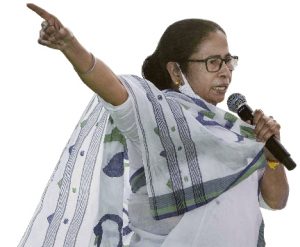
 In May 2021, Trinamool Congress (TMC) supremo Mamata Banerjee was sworn-in as chief minister of West Bengal for a third consecutive term after her party secured a thumping victory in the West Bengal assembly elections. Following this commendable feat, political observers vociferously asserted that Banerjee had the distinct capability to act as the glue that can hold together a united opposition against the BJP.
Any scope for opposition in an inherently desecuralized India should be viewed as a welcome move. For months, the Indian media has been abuzz with reports about efforts to establish a unified front that can give stiff competition to the RSS-backed ruling party in the 2024 Lok Sabha elections.
That Banerjee has weathered the political storms and challenges posed by the BJP in West Bengal renders her a formidable contender for the Modi Sarkar. Even so, such ambitious claims of eligibility often run the danger of being conflated with political rhetoric if they aren’t gauged through plausible actions.
The TMC chief was able to combine her party’s organizational strength with a much-reviled politics of appeasement to win the assembly elections. However, triumphs in state-level electoral contests cannot prepare her for the political minefields involved in the national arena. At this stage, Banerjee needs to undergo a political baptism that will allow her to adopt a new vocabulary to cope with the rigour and intensity of national politics. The TMC supremo will need to move beyond the blinkers of West Bengal’s political milieu and broaden the scope of her vision. Even so, the possibility of Banerjee emerging as the face of a united opposition appears slim under the country’s political realities.
Some commentators have been tempted to compare Banerjee’s political trajectory with that of the Indian Prime Minister Narendra Modi. In an uncanny coincidence, Modi was appointed as chief minister of Gujarat for three consecutive terms. He became the PM candidate of an opposition party while he was chief minister. Modi’s growing political stature can be attributed to the fact that he was an RSS worker who faced no difficulty finding support within the so-called ‘Hindu heartland’. Apart from gaining widespread organizational backing from the RSS, Modi was also affiliated with a party that was nationally recognized.
Skeptics have asserted that Banerjee doesn’t enjoy the same privileges as Modi. Since the TMC’s influence is restricted to a single state, the party supremo will encounter challenges in garnering the necessary organizational capacity to obtain political mileage. Banerjee may also find it difficult to achieve her political aspirations on account of a linguistic handicap as she doesn’t possess Modi’s fluency in Hindi.
 In addition, the West Bengal chief minister will have to reckon with the Congress and actively seek its approval to become the face of the opposition. Conventional wisdom would have us believe that regional parties have a limited influence in Indian states where the Congress is embroiled in a tough competition with the BJP. Any attempt to defy this cold political reality will, therefore, be futile. Even if Banerjee makes a consistent effort to emerge as the face of a federal front comprising regional parties, she will have to confront the hegemony of the Congress.


The writer is a journalist and author. He analyses international issues and can be reached at tahakehar2@gmail.com
Leave a Reply