



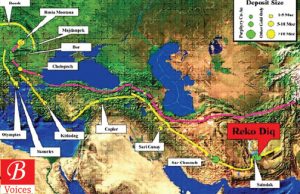
 Pakistan is rich in natural resources and this is no exaggeration. Consider gold and copper. Historically, a substantial quantity of gold was sent to the Greeks as tax after Alexander came to know about the wealth in this part of the world. But where is the treasure? Take one example: Reko Diq, one of the largest copper mines in the world, having estimated reserves of 5.9 billion tons of ore grade reserves amounting to 41.5 million oz. According to experts, gold deposits exist wherever there are copper deposits. High deposits of copper is the actual reason for Reko Diq’s significance, but the reputation of Reko Diq is now associated with the Reko Diq court case.
An agreement, generally known as CHEJVA (Chagai Hills Exploration Joint Venture Agreement), was signed between the Australian mining company BHP Billiton and the Government of Balochistan in 1993. The purpose of the agreement was to allow BHP Billiton to explore the existence of copper and gold deposits at Reko Diq, conduct a feasibility study and later, the company would extract copper and gold from the site. BHP Biliton had 75% share in the deal while the rest was with the Government of Balochistan.
In 2000, BHP handed over the contract to another Australian company, Mincor Resources. Another company, TCC (Tethyan Copper Company), procured the project in 2006. Soon after TCC took control of the project, a lawsuit was filed in the Balochistan High Court against the agreement, stating that it was illegal and ran counter to the provisions of Pakistani law. However, the claim was discarded by the High Court and CHEJVA was declared legal and valid. The ripple effect did not fade out, though.
In 2010, TCC completed the feasibility study and shared its findings with the Government of Balochistan. Later, in 2011, TCC submitted a Mine Lease Application to receive formal permission for excavating the copper and gold as per the agreement. The lease application by TCC was turned down by the provincial government.
Reasons for the rejection included, i) smelting and refining to be done in Pakistan as opposed to the original agreement, in which smelting and refining was to be done outside Pakistan ii) increase in royalty rates iii) review of financial model iv) hiring more local population in the project.
 TCC refused to revise the conditions. According to TCC, an amount of $220 million (had been invested by the time the Balochistan Provincial Government unexpectedly refused to grant them the mining lease. They demanded $11.43 billion in damages for such unanticipated and abrupt termination of the agreement. TCC took the matter to ICSID (International Centre for Settlement of Investment Disputes) and the World Bank Group. Moreover, in 2013, the Supreme Court of Pakistan declared the CHEJVA agreement as void and described it as contrary to public policy. The Supreme Court further stated that TCC had no legal rights to start excavation in Reko Diq. The decision of the Supreme Court was contrary to an earlier decision by the Balochistan High Court in 2006. In 2017, the ICSID passed a verdict in favour of TCC. The ICSID verdict approved a legitimate expectation of receiving the mining lease and found no wrongdoing in CHEJVA, the ground on which the Supreme Court of Pakistan ruled to terminate the agreement.


The writer is a columnist and broadcast journalist. He teaches at UVAS Business School in Lahore and can be reached at mali.hamza@yahoo.com
Leave a Reply