



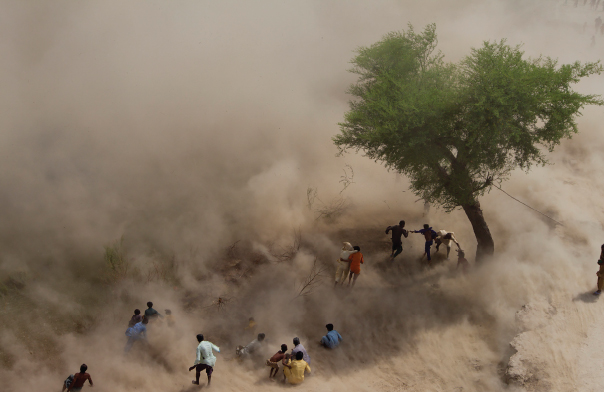
 The Global Climate Risk Index publishes annual rankings of countries in terms of how badly they have suffered from natural disasters induced by extreme weather incidences such as cyclones, droughts, hailstorms, heat waves, hurricanes, and floods. The latest report published in January 2021, ranks Pakistan as the 8th most affected country from climate change impacts in the world in the period, 2000 to 2019. In the past two decades, Pakistan experienced 173 climate-related events that cost the country roughly Rs. 560 billion worth of losses. In the CRI ranking for 2019, two South Asian counties i.e., Afghanistan (6th) and India (7th) were ranked among the 10 worst affected countries of the world. Among the remaining countries of South Asia, Nepal was placed 12th, Bangladesh 13th, Pakistan 15th, and Sri Lanka at 23rd place, while the Maldives and Bhutan were not so intensely affected.
Although Pakistan’s share of global carbon dioxide emissions for 2019 was far less (0.68%) than its immediate neighbour, countries as China contributed almost 28%, India 7.18%, and Iran 2.14%. As such, this region, including China, emitted almost 38% of the world’s total CO2, which travels transboundary via air circulation in the lowest atmospheric layer. The high Climate Risk Index of countries in the entire Himalayan region indicates very high vulnerability to continued disruption and destruction of human lives and property from more frequent and intense extreme meteorological events.
While Pakistan’s small share in global GHG emissions saves it from being amongst the highest emitters responsible for contributing to global warming, but it is definitely responsible for not protecting its forest cover and letting it slide down to just 5%, the lowest in the world. The importance of forests, in the context of climate change, is that they capture and trap carbon dioxide directly from the air and store it as biomass. As long as trees live, CO2 remains out of the atmosphere and cannot be a source of warming.
Decades of unabated deforestation has left Pakistan nearly barren. Priority action should include urban plantation, restoration and reclamation of deforested and degraded rangelands, afforestation in barren areas, protection of grasslands, wetlands, and mangroves in the coastal belt, preferably with indigenous trees species suitable for the local environment. The worst climate-related disruptive and destructive events in Pakistan hitherto, include the drought in Balochistan in 2000, the 2007 Cyclone Yemini in Sindh and Balochistan, Cyclone Phet which hit the coastal areas of Sindh in 2010, the Atta Abad landslide in Hunza in January 2010, the July 2010 floods affecting most of Pakistan and the Golen Gol GLOF events in Chitral in July 2019 and July 2020.
 During the last two decades, Pakistan has devised policies, which in one way or the other, relate to climate change. These include National Environmental Policy 2005, National Climate Change Policy 2012, National Sustainable Development Strategy 2012, Framework for Implementation of Climate Change Policy 2013, Pakistan Climate Change Act 2017, Draft National Food Security Policy 2017, and National Water Policy 2018. Recently the Federal Ministry of Climate Change and Disaster Management was established. However, establishment of Pakistan Climate Change Council, Pakistan Climate Change Authority, and Pakistan Climate Change Fund provided by the Climate Change Act 2017 are yet to become a reality.
In spite of all this, governments were unable to control the menace of deforestation that perpetuated throughout these years in broad daylight. Uncontrolled land-use changes resulted in productive agricultural lands lost to jungles of brick and mortar that has not only adversely affected agriculture but also caused depletion of the water table and affected arid and semi-arid areas. Pakistan has shown gross negligence to building new water reservoirs and now faces chronic and severe water scarcity. Similarly, mega development projects were completed without proper environmental impact assessment and management plans.
After decades of negligence and non-action on environmental issues, a political party has been voted into power that values a clean and healthy environment and promotes massive afforestation drives to help restore the degraded ecosystem. The theme of World Environment Day 2021, for which Pakistan was selected as the host country in recognition of its environment-friendly policies and actions, was “Reimagine, Recreate, Restore”. It focuses on rehabilitating degraded ecosystems on land and sea to help recover the planet’s health from years of exploitation and profiteering.
This decade has been designated as the UN Decade for Ecosystem Restoration till 2030. According to the World Bank’s Pakistan Climate Change Profile 2017, two major GHG producing sectors include energy and agriculture that caused almost 90% emissions in 2008 and 2012. With that in the background, these two sectors need high priority interventions to reduce emissions by switching over to renewable energy resources instead of fossil fuels and adopting climate smart agricultural practices. Other areas of government intervention include water, forestry, mountains and rangelands, deserts, coastal areas, wetlands, and disaster preparedness sectors. 

The writer is Advisor to the Quality Assurance Program, Higher Education Department, Government of Khyber Pakhtunkhwa. He can be reached at srsyed55@gmail.com
Excellent article!
A wake up call for government of Pakistan and provincial governments legislation and implementation.