


Building Economy
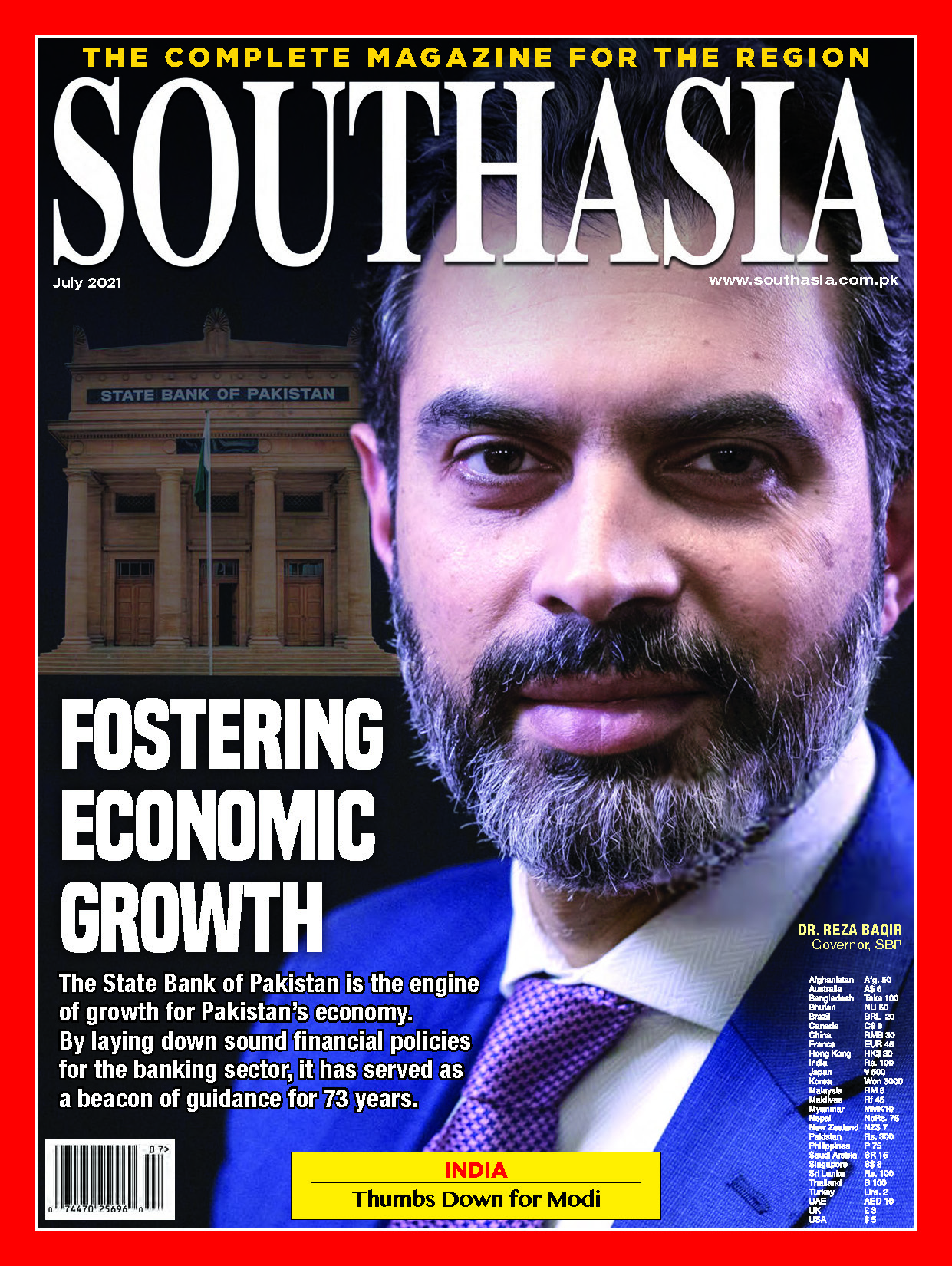 This is related to your story on the State Bank of Pakistan that served as a beacon of guidance for 73 successful years. The article ‘Fostering Economic Growth’ highlights the role of the State Bank of Pakistan in the economic development of Pakistan, particularly during the Covid-19 pandemic.
In his interview, Governor Dr. Reza Baqir sheds light on SBP’s future plans to be an independent and credible central bank. His positive approach towards taking Pakistan out of the grey list by October 2021 is a ray of hope. The views of Syed Salim Raza, former SBP governor, Iqbal Hassan, former SBP Director and veteran banker, Zafar Masud, President and CEO of the Bank of Punjab, and Dr. Aadil Nakhoda, Assistant Professor of Economics at IBA, are also valuable and coincide well with the 73rd anniversary of the State Bank of Pakistan.
Tayyab Ali,
Karachi, Pakistan
The British Mandate
 Aside from the fact that Jews created international law on Mt. Sinai, 3,500 years ago, allow me to update your readers on what is law and what is political posturing.
The British Mandate for Palestine was created in 1920 as part of the San Remo Accords, following Turkey’s loss of the Ottoman Empire in WWl. Other mandates included Jordan, Lebanon, Syria and Iraq. The League of Nations ratified the Mandate for Palestine as the reconstituted homeland for the Jews in 1922. The Mandate ended in 1948, when the British left.
Article 80 of the UN Charter, once known unofficially as the Jewish People’s clause, preserves intact all the rights granted to Jews by the League of Nations, even after the Mandate’s expiry. So, when in 1947, the UN passed Resolution 181 to partition Palestine into Arab and Jewish states, it was a suggestion, not law. The Jews accepted, but the Arabs launched a war of genocide against Israel.
In summary, under International Law, Israel includes Gaza and Judea and Samaria (West Bank). Only Israel has the right to partition its territory or change its status in any way. The UN can pass all the resolutions it wishes to, but they are not law. The UN and its agencies can exercise moral pressure, but cannot demand compliance.
Jacques Fortier,
Montreal, Canada
Book Lover
 Books are people`s best friends, and the dictum is especially true for the elderly.
The happiest people in the world are those who develop the habit of reading, as books expand knowledge and wisdom, teach love and patience, give courage in difficult times, and groom a personality.
Educational institutions across the country should organise book-reading competitions to encourage this healthy habit. They should also distribute prizes among the students to keep them motivated. Moreover, the government must establish public libraries in every city so that people do not have to travel long distances to quench their thirst for knowledge.
Dalai Lama has rightly said, `Share your knowledge. It is a way to achieve immortality.’
Nick Travis,
Edinburgh, Scotland
Electronic Voting
 This is with reference to the article ‘The Way Forward’ written by S.R.H. Hashmi about the electronic voting system taken up by the PTI government in Pakistan. The introduction of electronic voting in Pakistan is a way to enhance the knowledge of digital technology among Pakistanis, provided the people are eager to learn it and the system has the capacity to perform.
The inclusion of electronic voting in Pakistan could bring to fruition the promise made by the party to overseas Pakistanis to give them voting rights. It can further speed up the counting and re-counting of election votes and eliminate disputes about rejected votes.
Tehreem Fatima,
Islamabad, Pakistan
Taking Care of Animals
 Animals are the most precious creatures and hence, we must protect and facilitate them instead of hunting them. There are numerous instances where dogs, cats, horses, rabbits, chickens, etc., are abused or neglected by humans and they suffer with no choice of their own.
Animals depend on humans to love them, feed them, give them a good and happy home and so many do not receive any of that. There are many organisations which rescue animals and work hard at healing them and finding a good home. Hence, it is our responsibility to take care of them.
Kashaf Sohail,
Lahore, Pakistan
Leave a Reply