If enacted, the Pakistan Media Development Authority Ordinance will erase all critical media voices through coercive censorship and only a pliant media will survive.
ByShahrukh Mehboob | July 2021
Recently, the Ordinance proposed by the Pakistan government to regulate the media is at the centre of a storm. Human rights bodies and media organizations have rejected the Pakistan Media Development Authority (PMDA) Ordinance 2021, which proposes to repeal all media-related organizations and merge them. The Ordinance also proposes to nominate a bureaucrat to head the PMDA - a provision that is being widely criticized as coercive censorship. The opposition parties, as well as media organizations, have called the Ordinance "martial law". Those against the proposed law have vowed to resist the draconian steps by taking trade unions, academia, political parties, and citizens' organizations on board.
The Ordinance proposes to repeal all current media-related laws in the country and wants them to be merged under the PMDA. Pakistan has several media-related laws like the Newspaper Employees, (Conditions of Service Act), 1973; the Pakistan Electronic Media Regulatory Authority Ordinance, 2002 (amended in 2007); and the Motion Pictures Ordinance, 1979. These laws govern different media and the way content is presented. But the Imran Khan government now wants a single authority for the entire media sector - a move that is being vehemently opposed by various bodies.
Throughout the decades after 1947, media space in Pakistan remained tightly regulated by the state. There were hardly any players in the broadcast sector. It was restricted to only government-managed television and radio operations. Pakistan Television (PTV) and Pakistan Broadcasting Corporation (PBC), both owned by the state, remained the sole means of mass broadcasts for news and current affairs during this time.
Some historians suggest that the media blackout started after the departure of Quaid-e-Azam. The Quaid’s sister, Fatima Jinnah was not allowed to give a speech just after his death. Ironically, when she persisted with her desire to proceed with an uncensored text, she was given a go-ahead to make the speech. Suddenly a technical fault developed and the full speech could not be delivered.
Media reforms were enacted in 2000, in General Musharraf’s time, allowing for non-government, private broadcast media to emerge. The dozens of television channels and FM radio stations which subsequently erupted, fundamentally altered the contours of public opinion mobilization and were then directly responsible for the resistance to Gen. Pervez Musharraf’s dispensation. It is unfortunate that the very media that the General liberated turned against him.
The print media had been fairly independent before partition. Invaluable sacrifices were made by various Muslim journalists who set highstandards of reporting and posed a resistance against media restrictions. It is Ironical, therefore, that while Pakistan was achieved after a vociferous media struggle, restrictions were later imposed on media under the pretext of national security. The restrictive and monopolistic control of media paved the way for martial law and perpetuate military rule.
The saying of Alexander Pope,“Let fools argue over the form of government. What is administered best is best.” kept people ignorant about the detrimental effects of martial law and deprived them of resisting the dictatorial dispensation following the imposition of media restrictions. There was hardly any educated public opinion or awareness over fundamental rights, education, citizen welfare and entrenched democratic ethos. Sadly, military regimes were largely unimpeded by democratic resistance in the absence of mobilization of independent public opinion through mass media. This entire saga of media restrictions offers interesting insights into Pakistan’s political evolution.
In the wake of the war on terror, an urge was felt to change the narrative and provide a justification for the volte-face on several policies that the state had been pursuing for the last 50 years without giving its citizen any say. “Enlightened Moderation” was made fashionable by the Musharraf government to improve the image of the country and perk up its democratic credentials in the world. Ownership of different media such as news channels, newspapers and magazines was also changed dramatically. Most of Pakistan’s private media are now family-owned businesses that have their own interests. Many news channels have been developing particular interests and agendas impacting politics and governance and sometimes threatening the stability of the system. Apart from a personal axe to grind, some news channels tow the official line to get rewarded while some run into head-on collision with the state. There have been several instances when the media caved in to official pressure or were tempted to fall in line with the official’s narrative. In other cases, there have been abductions of journalists and blocking of news channels.
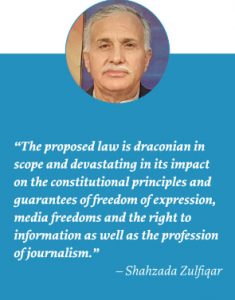
The Pakistani media has gone from being one of the liveliest and free to being one of the most subdued and controlled. The Pakistan Media Development Authority Ordinance 2021 seeks to repeal all the existing legislation and merge media into a single body. Journalist unions have condemned the move, calling it draconian.There have been many attempts to regulate free speech, but the Pakistan Media Development Authority stands out because it has sections that criminalize speech and grants unchecked powers to curtail and persecute. The new law is laced with ambiguity and has been criticized for violating Articles 4, 10-A, 14, and 19 of the Constitution. It has in some instances even provided clues about the impropriety of content.
The proposed PMDA Ordinance has been described as an unconstitutional and draconian law against freedom of press and expression and a step towards imposing state control to regulate all segments of media. Pakistani media needs to take steps to protect its hard-earned freedom.



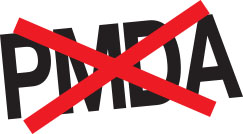 Recently, the Ordinance proposed by the Pakistan government to regulate the media is at the centre of a storm. Human rights bodies and media organizations have rejected the Pakistan Media Development Authority (PMDA) Ordinance 2021, which proposes to repeal all media-related organizations and merge them. The Ordinance also proposes to nominate a bureaucrat to head the PMDA - a provision that is being widely criticized as coercive censorship. The opposition parties, as well as media organizations, have called the Ordinance "martial law". Those against the proposed law have vowed to resist the draconian steps by taking trade unions, academia, political parties, and citizens' organizations on board.
 The print media had been fairly independent before partition. Invaluable sacrifices were made by various Muslim journalists who set highstandards of reporting and posed a resistance against media restrictions. It is Ironical, therefore, that while Pakistan was achieved after a vociferous media struggle, restrictions were later imposed on media under the pretext of national security. The restrictive and monopolistic control of media paved the way for martial law and perpetuate military rule.

Leave a Reply